Make the next technology decision.
Assess your systems, compare options and turn uncertainty into a practical investment and delivery roadmap.
Explore the approach ↗Architecture assessment · Fractional CTO/CIOEnterprise architect / Hands-on leader / Fractional CTO
I help organizations modernize critical systems, build secure products and turn ambitious plans into reliable operations—from the first conversation to the final handover.
 Microsoft Azure
 Amazon Web Services
 Google Cloud
 Microsoft 365
 Kubernetes
 Terraform
 Docker
 Python
 Microsoft Foundry
 Amazon Bedrock
 Vertex AI
 Azure AI Search
 Microsoft Sentinel
 Azure Monitor
 BigQuery
 Databricks
01 / How I help
Start with the problem you need to solve. I connect executive decisions with the architecture, engineering and delivery needed to move forward.
Assess your systems, compare options and turn uncertainty into a practical investment and delivery roadmap.
Explore the approach ↗Architecture assessment · Fractional CTO/CIOPlan and deliver infrastructure, cloud, identity, email and application migrations with clear dependencies and recovery paths.
Explore the approach ↗Datacentre · Cloud · Workplace migrationTranslate customer needs into a working product, secure APIs, dependable data and an actionable path from MVP to production.
Explore the approach ↗Software · SaaS · IntegrationConnect identity, security, recovery and observability so teams can prevent problems and respond when they happen.
Explore the approach ↗Cybersecurity · SRE · ResilienceFind a valuable use case, connect the right data and evaluate a controlled pilot before expanding its responsibility.
Explore the approach ↗AI · RAG · Agents · AutomationSupport customer discovery, proposals, architecture, implementation and complex escalation across partner and managed-service environments.
Explore the approach ↗MSP · CSP · MSSP · Customer engineering02 / Selected work
Six windows into my work across enterprise, service-provider and founder environments. Expand a story for responsibilities, architecture and delivery detail.
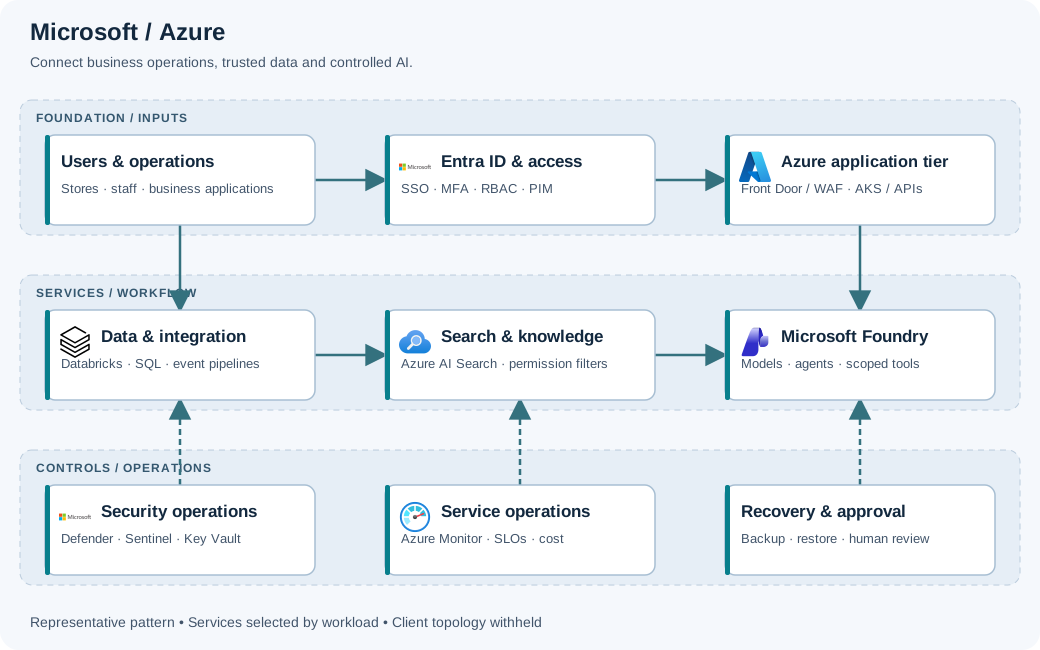
Bring stores, employees, inventory and digital services together on a governed Microsoft and Azure foundation. My remit joined business discovery, architecture, engineering and operational readiness.
I owned architecture across cloud, infrastructure, security, data and AI, translating business needs into deployment standards, integration designs and operating procedures.
View the connected architecture diagram ↗
Separate enterprise infrastructure scope from AI pilot scope. Identity, data permissions, security policy, service telemetry and recovery procedures span the design.
Architecture decisions, infrastructure templates, deployment guides, pilot criteria, operational runbooks and technical enablement.
The enterprise program and the limited AI pilot had different rollout boundaries. Detailed client topology and exact site counts are not disclosed here.
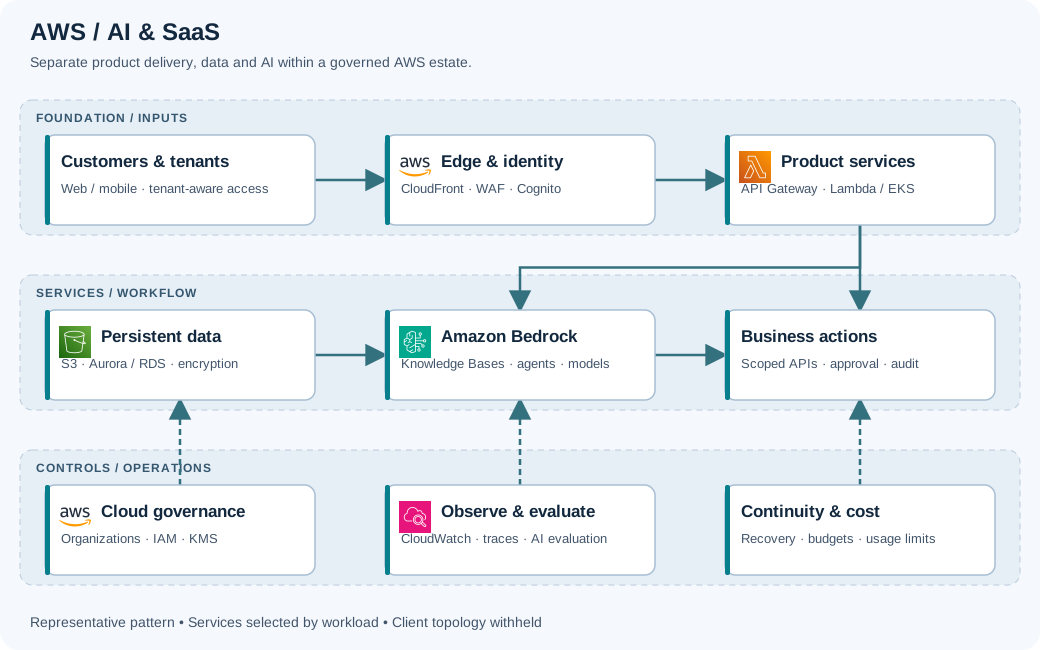
Connect business priorities to architecture, investment and engineering decisions. I worked across AWS, AI and SaaS modernization, from current-state review to production-readiness planning.
I directed technology strategy and architecture across cloud, applications, data, cybersecurity, AI, reliability and cost. Each platform choice was evaluated against the business and operating model.
View the connected architecture diagram ↗
Make tenancy, security, availability and cost explicit. Select EC2, containers, serverless and managed data services according to workload needs, rather than combining every service.
Investment roadmap, architecture options, decision records, implementation backlog, readiness criteria and operating-model guidance.
Fractional strategy and architecture engagement. Individual designs, evaluations and implementation work are distinguished during a permitted technical discussion.
Help service providers deliver secure, repeatable customer environments across Microsoft Azure, AWS, Google Cloud, IBM and Oracle—with the identity, networking and operations needed to connect them.
I led discovery, architecture, technical qualification, implementation and escalation across customer and partner environments, bridging commercial requirements and engineering execution.
View the connected architecture diagram ↗
Customer boundaries, least privilege, change control, recovery sequencing and documented ownership support repeatable multi-tenant operations.
Service catalog, deployment standards, migration waves, acceptance checks, SLA/OLA responsibilities and escalation runbooks.
Multiple engagements across service-provider environments. Platform and scale details vary by customer and are not combined into a single fictional deployment.
Alfalah.app brings together product thinking, open-source software, multi-tenant architecture and AI-assisted workflows. I own the path from the initial idea to engineering, deployment and iteration.
I translate user needs into architecture and working software, combining product ownership with application, data, platform, security and AI engineering.
View the connected architecture diagram ↗
Tenant isolation, authorization checks, secrets, data retention, recovery and measurable model quality are core design concerns. Open-source software and managed hosting are distinct parts of the stack.
Source code, architecture decisions, deployment configuration, operational guidance and an evolving product backlog.
Founder-led product with iterative delivery. This portfolio does not present all roadmap features or intended global scale as verified live usage.
From physical infrastructure and carrier connectivity to virtual platforms and hosted services, I built and operated systems across successive technology generations in continuously operating environments.
I progressed through systems administration, engineering and architecture, combining hands-on infrastructure work with availability, migration, capacity and operational accountability.
View the connected architecture diagram ↗
Availability depends on the whole chain: facility, carrier, network, storage, operating system and application. Designs addressed redundancy, fault isolation, dependencies and recovery.
Build standards, topology, provisioning procedures, migration plans, incident runbooks and recovery exercises.
Experience includes critical and security-sensitive datacentre environments. No client identity, facility certification or personal security clearance is asserted by this description.
Modernize messaging, documents and identity while protecting the information people need every day. I combined migration engineering with access, retention, coexistence and operational transition.
I designed and executed migration and hybrid-identity work, aligning technical cutover with information governance and user adoption.
View the connected architecture diagram ↗
Mailbox counts, user counts and document volume are distinct measures. Reconciliation, access verification and business validation determine migration acceptance.
Migration and reconciliation records, identity design, administrative procedures, retention guidance and support ownership.
An anonymized professional-services engagement. Client-specific volumes, topology and dates are withheld from the public case.
Client identities and sensitive implementation details are withheld. These are anonymized experience summaries, not public client endorsements. Any deeper discussion remains subject to confidentiality obligations.
Architecture / See how the systems connect
Connected, presentation-style views for business and technical conversations. Open a view to explore it, or download its scalable diagram.
Public reference patterns based on the experience catalog. These explain design choices, not confidential as-built client systems. Solid arrows: flow or dependency. Dashed arrows: controls, feedback or contingency.
Application requests pass through identity and the application tier. Governed data feeds search and agents. Security, telemetry and recovery apply across the environment.
Authenticated product requests use application services. Bedrock retrieves permitted knowledge and calls scoped business tools. Observability, account controls and recovery span every layer.
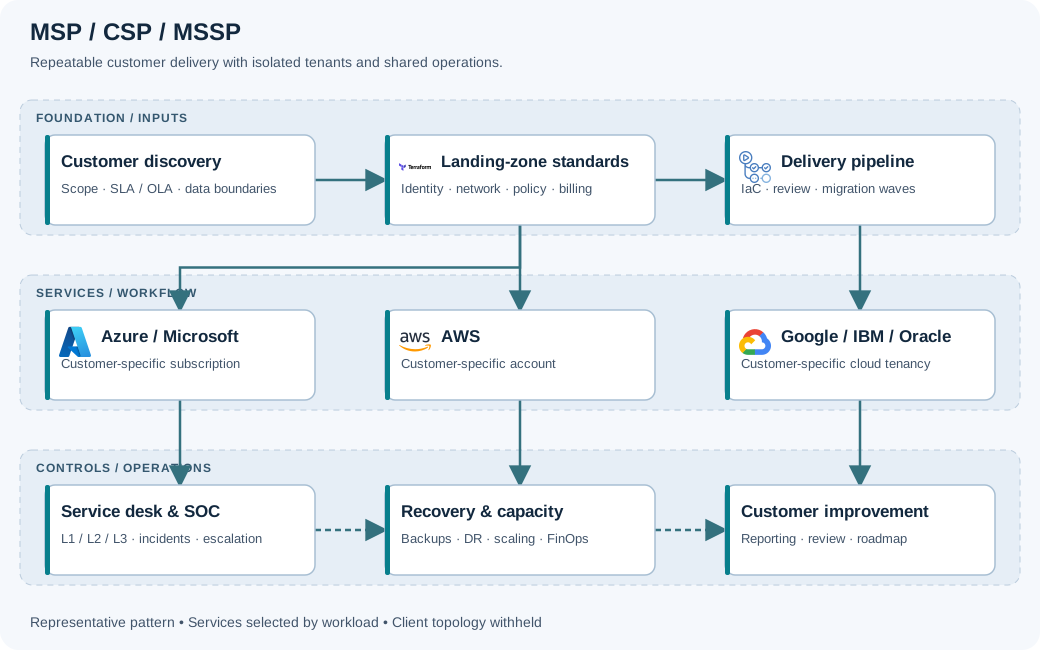
Discovery defines the service contract and customer boundary. Reusable standards feed separately isolated cloud environments. Support, security, recovery and reporting complete the operating model.
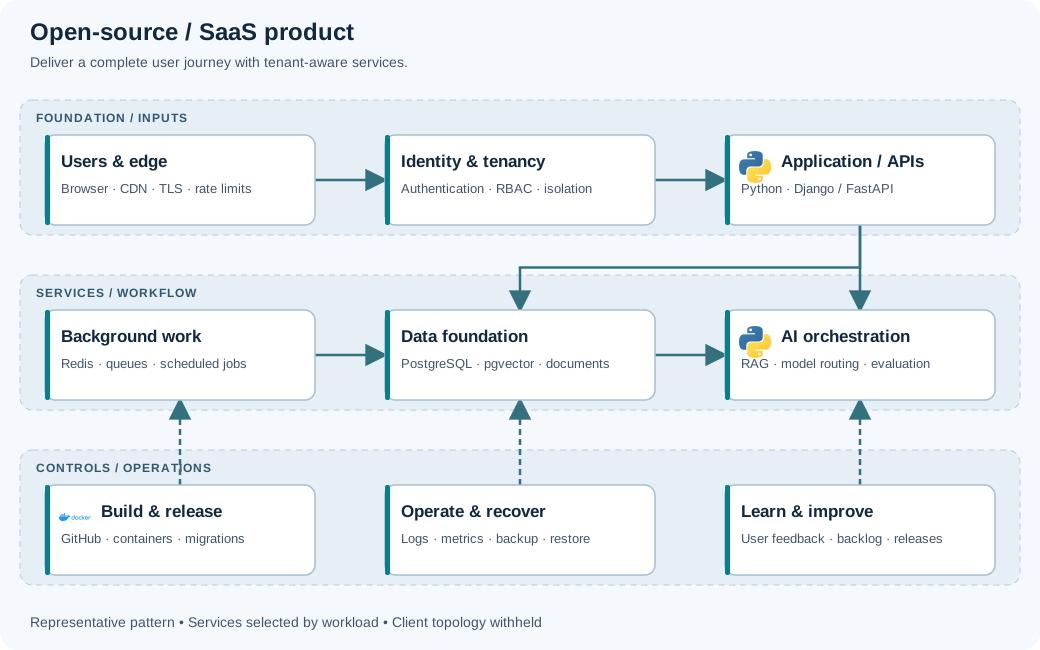
Tenant-aware application access protects data and retrieval. Background jobs handle longer tasks. Versioned releases, restore procedures and feedback support the product lifecycle; this is not a claim of all roadmap features being live.
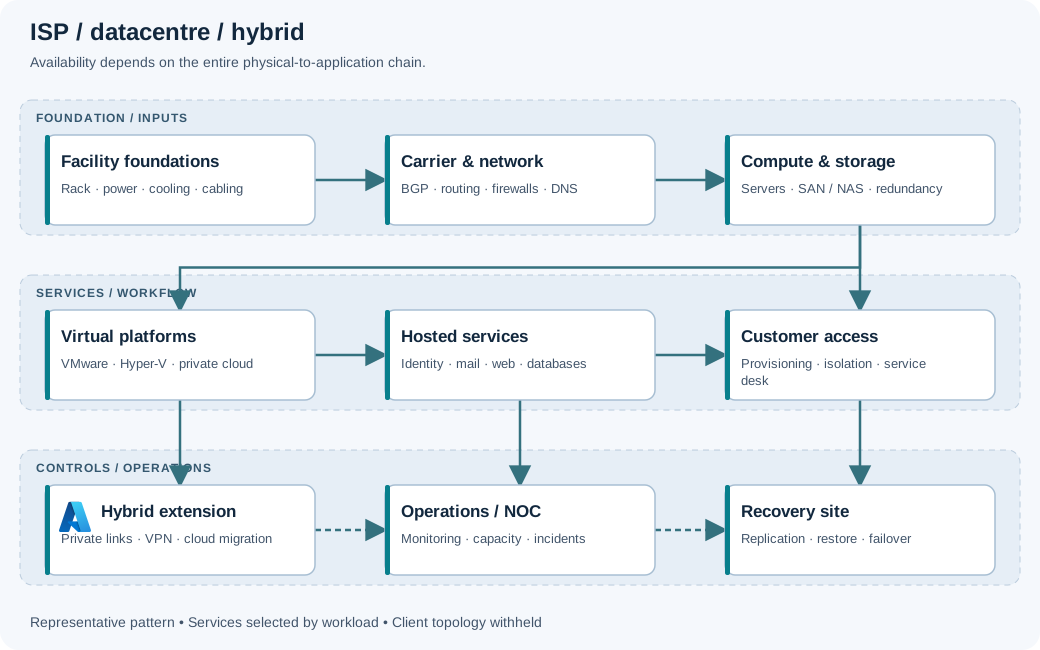
Facilities and carrier networks support compute and storage. Virtual platforms host customer services. Hybrid connectivity, monitoring and tested recovery address failures across layers.
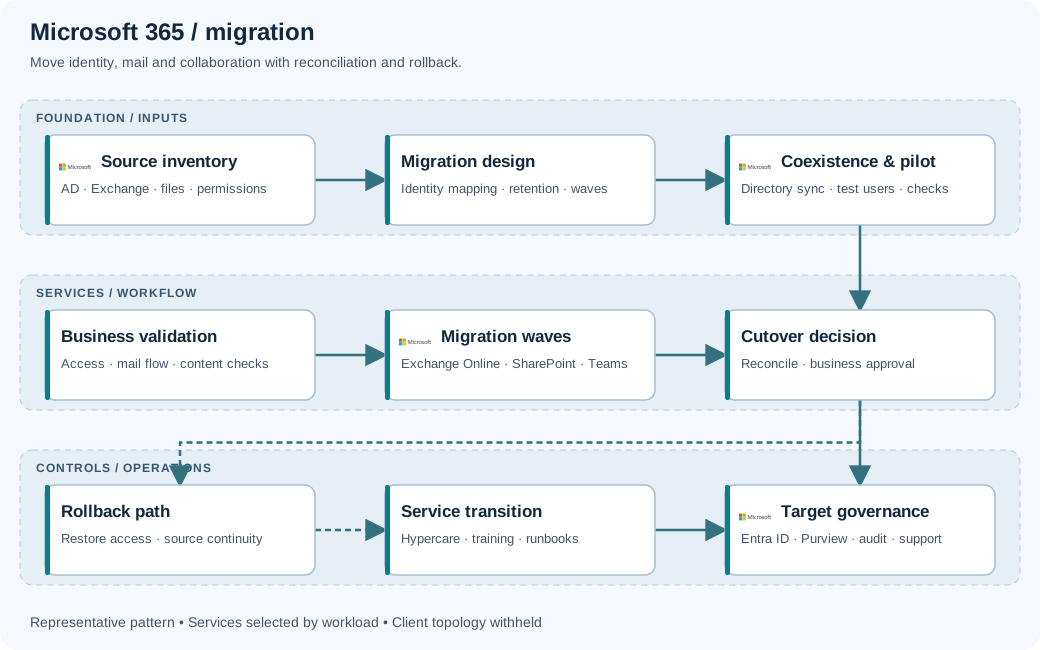
Inventory and pilot precede staged moves. Business checks and reconciliation gate cutover. Rollback remains available until acceptance, followed by hypercare and operational ownership.
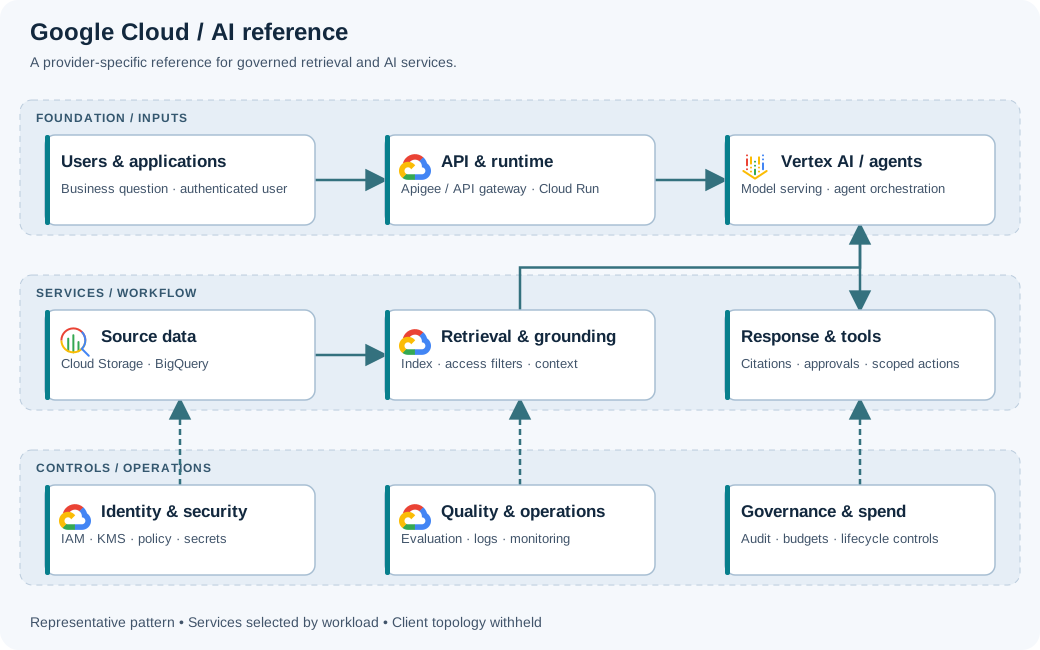
Reference pattern for discussion, not a separate claimed client deployment. Governed retrieval supplies context to AI services; tools, output evaluation and access controls limit the workflow.
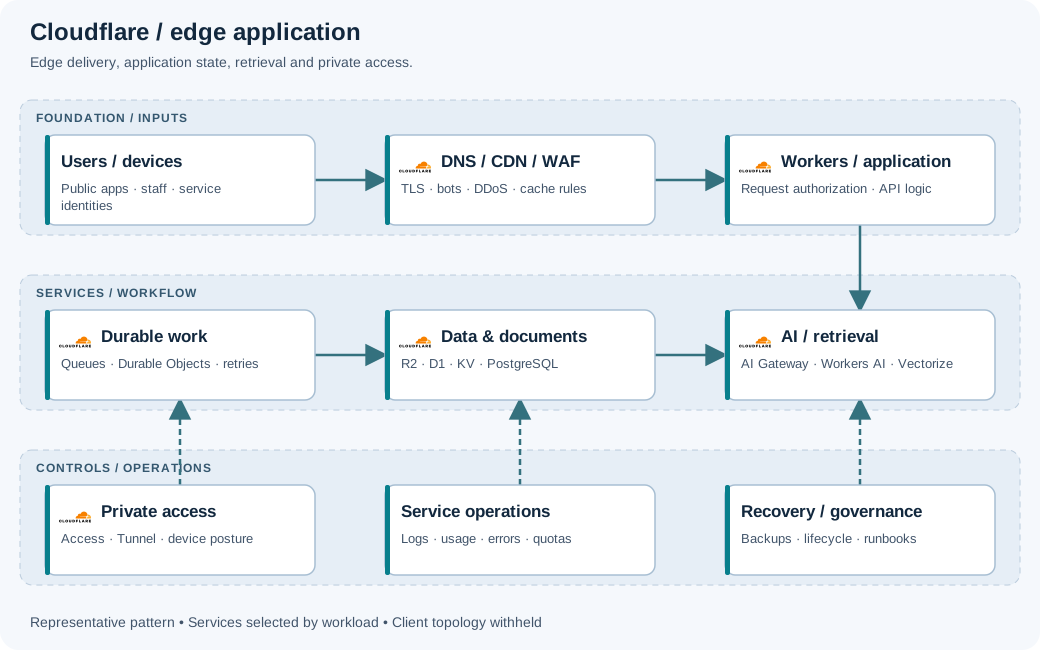
Resume-described Cloudflare components connected as a reference pattern. Public application authentication and employee Zero Trust access are distinct. Storage consistency, replay and recovery are designed per service.
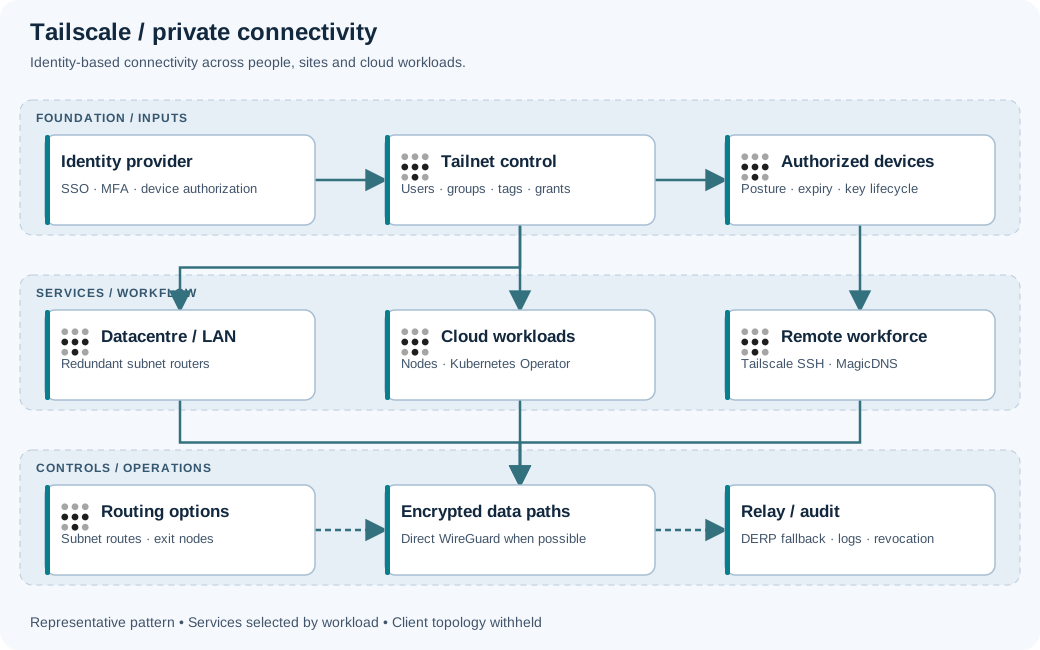
The control plane distributes identity and policy. Authorized endpoints carry encrypted traffic directly where possible, with DERP relay fallback. Subnet routers and exit nodes serve different routing purposes; application authorization remains necessary.
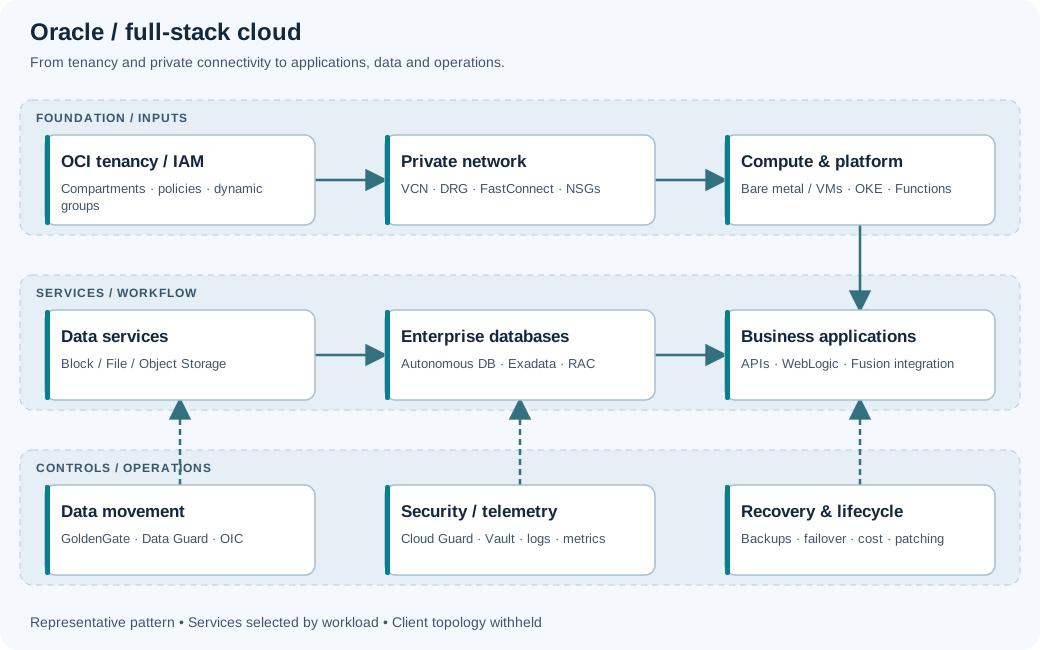
Resume-described OCI architecture. RAC addresses local database availability; Data Guard addresses replication and disaster-recovery patterns. SaaS integration, managed platform services and infrastructure ownership are distinct responsibilities.
Resume-described IBM infrastructure, database and integration experience. The reference separates legacy coexistence from container modernization, with migration sequencing and recovery dependencies. Named services are alternatives selected per workload.
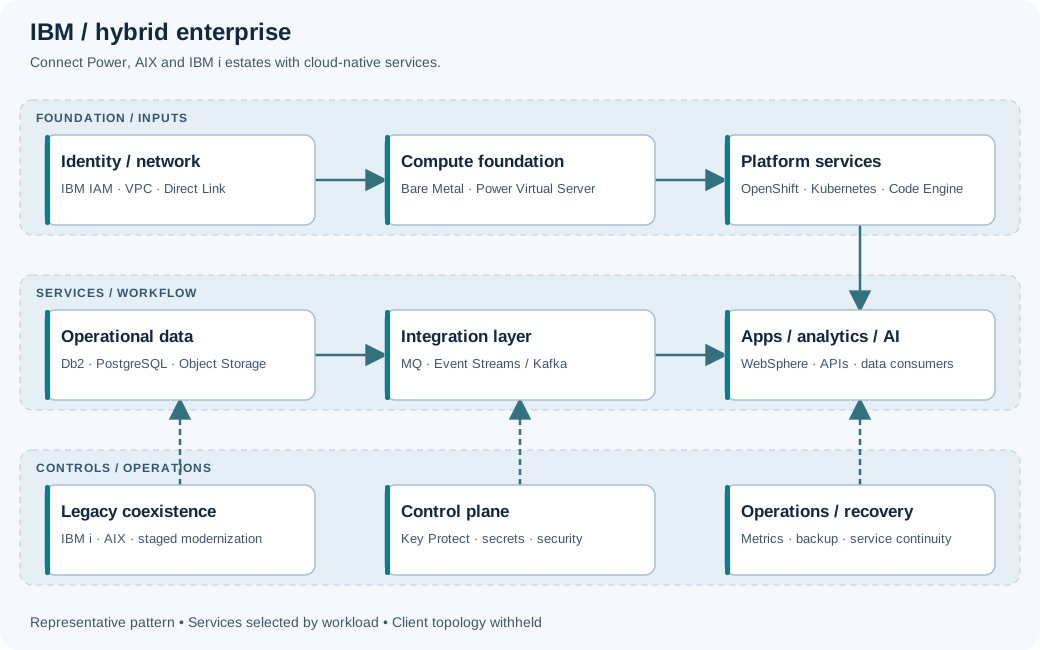
Research/reference only: Alibaba Cloud is requested by the owner but is absent from the current resume. This comparison must not be interpreted as a completed Alibaba Cloud engagement. Exact regional services, editions and entitlements require workload-specific validation.
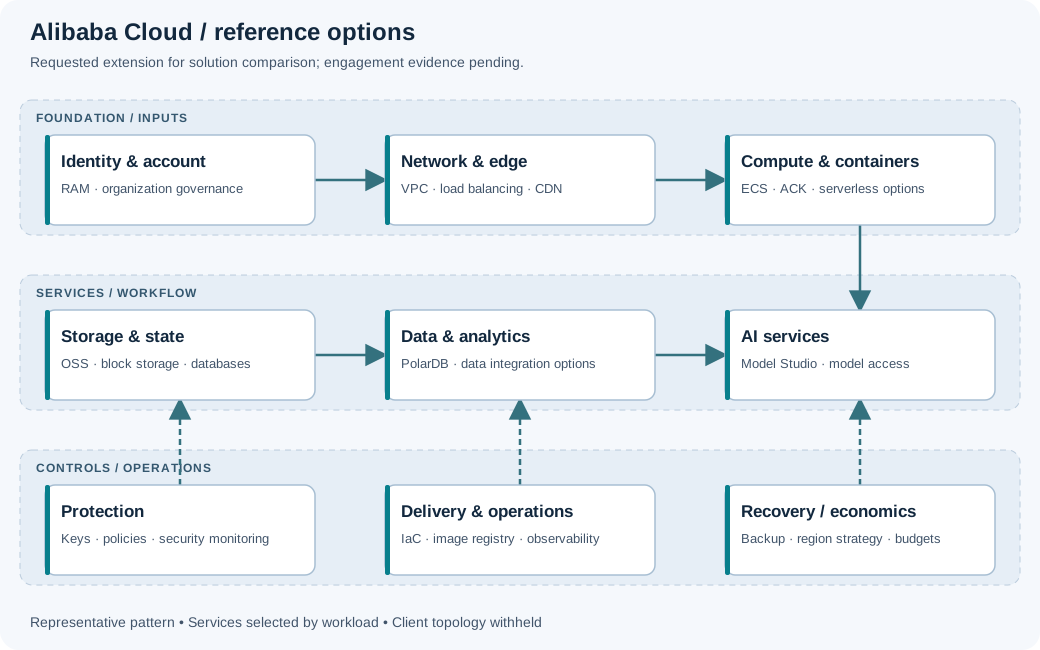
Physical and colocation architecture based on resume infrastructure scope. BMC isolation, boot-image integrity and PXE provisioning are design considerations, not claims of a specific unlisted installation. Facility Tier classification is separate from application availability.
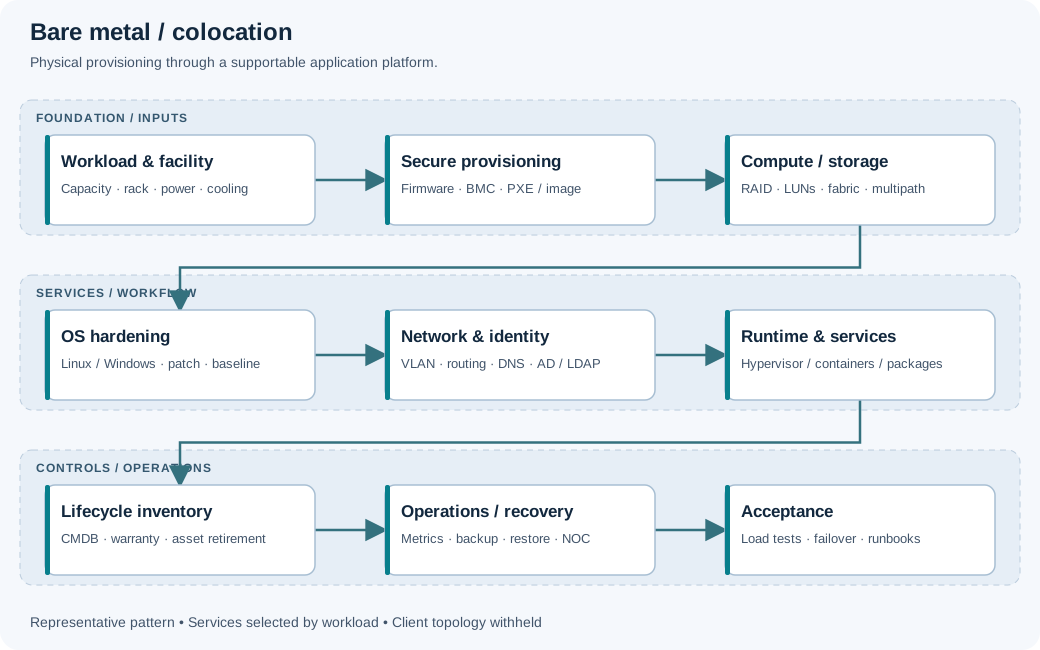
Resume-described virtualization alternatives. VMware Fault Tolerance, clustering, live migration and backup solve different failures; snapshots alone are not a backup strategy. Customer isolation and resource ownership are explicit.
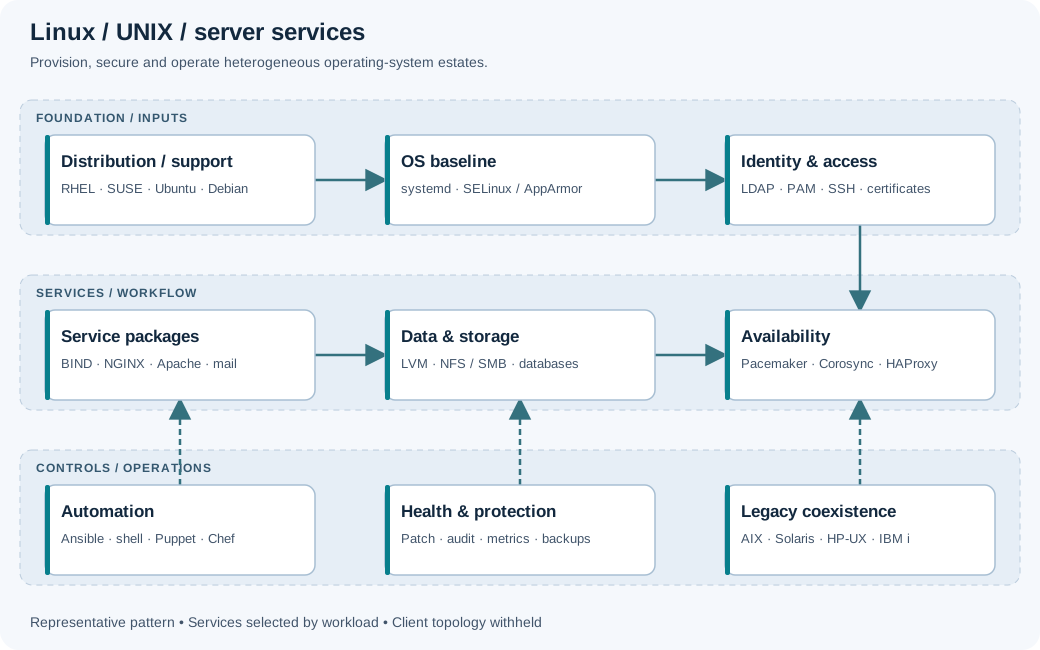
The resume names 13 Linux distribution families plus UNIX/IBM operating systems. This view preserves those boundaries instead of claiming 50+ variants. Kernel, NUMA, storage and network tuning follow workload measurements.
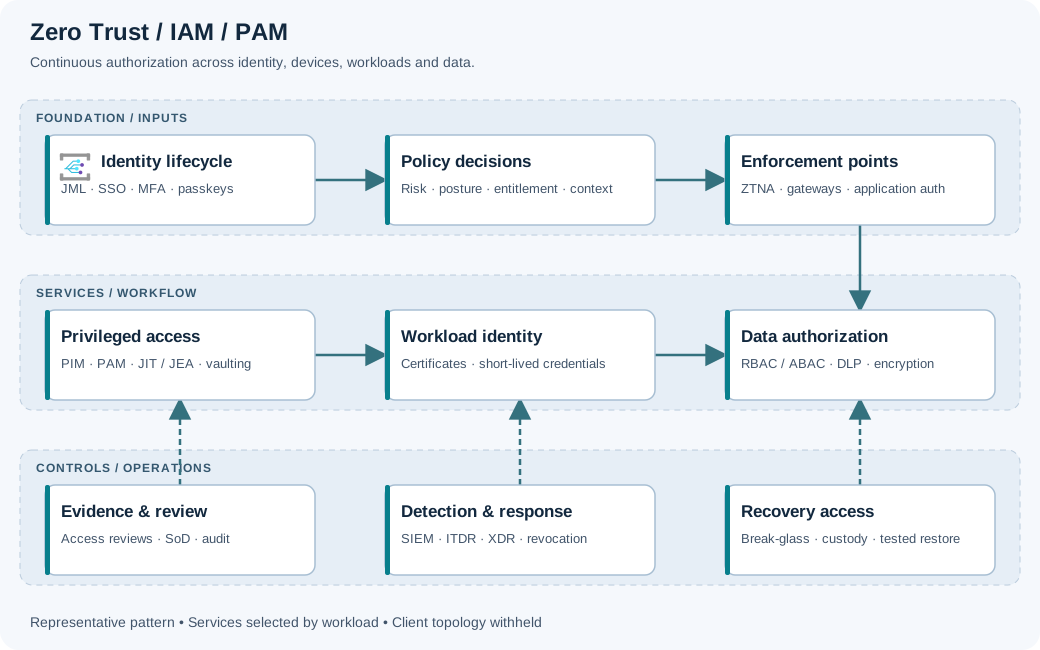
NIST SP 800-207-aligned reference. A private network is not automatically trusted. Policy applies to each resource request, with least privilege, device and workload context, monitored privileged sessions and recoverable identity dependencies.
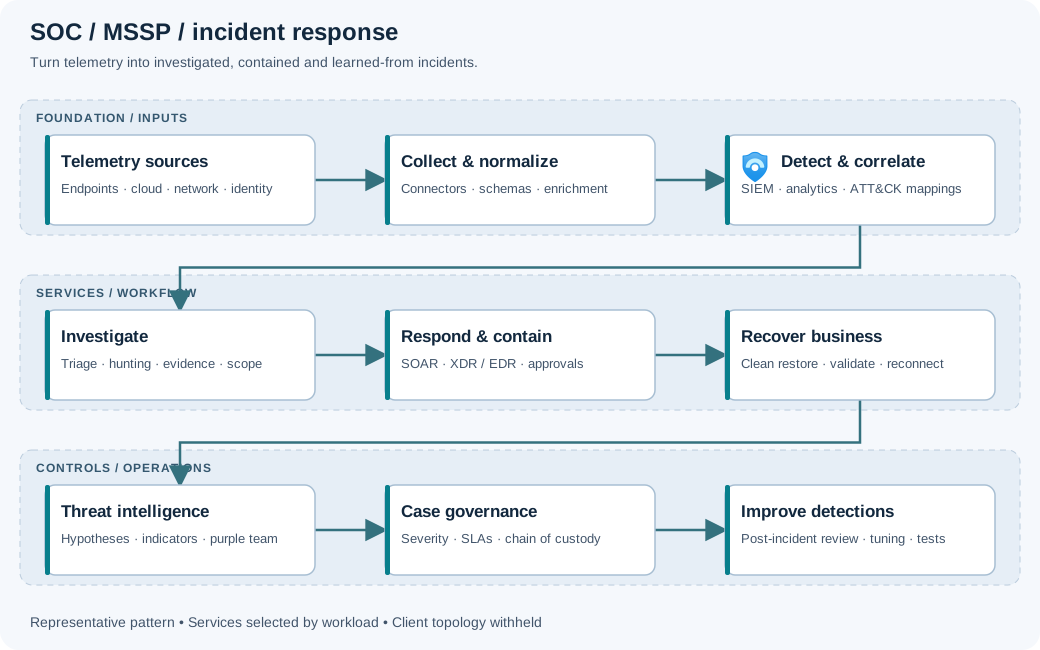
Resume-described SOC technologies include Sentinel, Defender XDR, CrowdStrike, Splunk, QRadar and Cortex XSOAR. MDR describes an operating service, not a synonym for an endpoint product. Automation follows approval and containment boundaries.
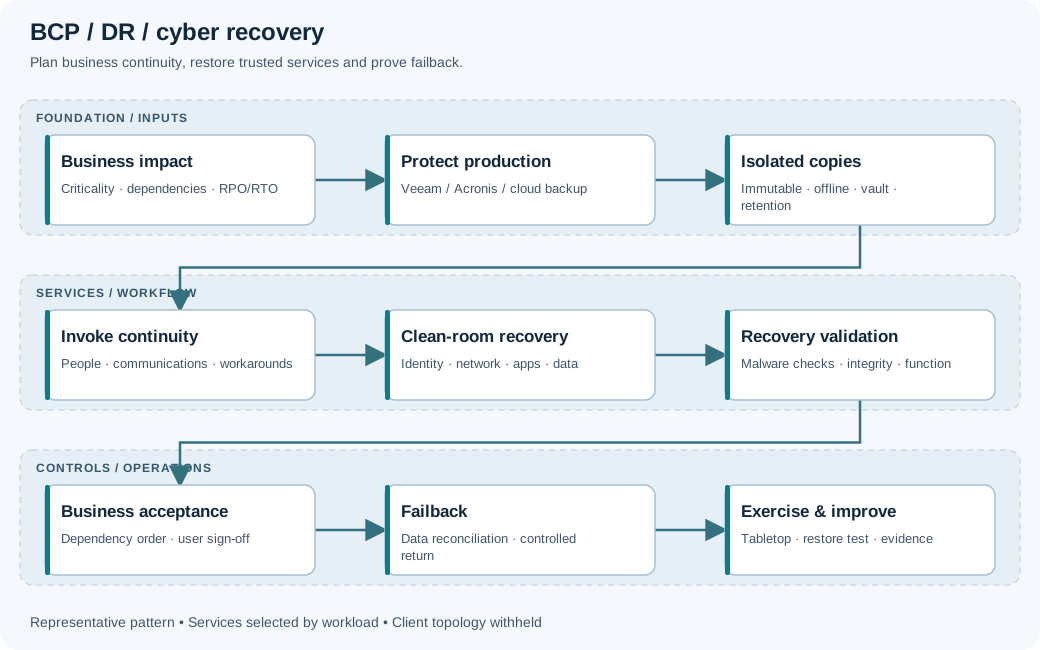
Resume evidence includes Veeam, Acronis, Rubrik, Commvault, Cohesity, Zerto, Datto, Veritas and IBM Tivoli. Backups, replication, disaster recovery and the broader business continuity plan are separate controls. Recovery tests provide evidence against agreed objectives.
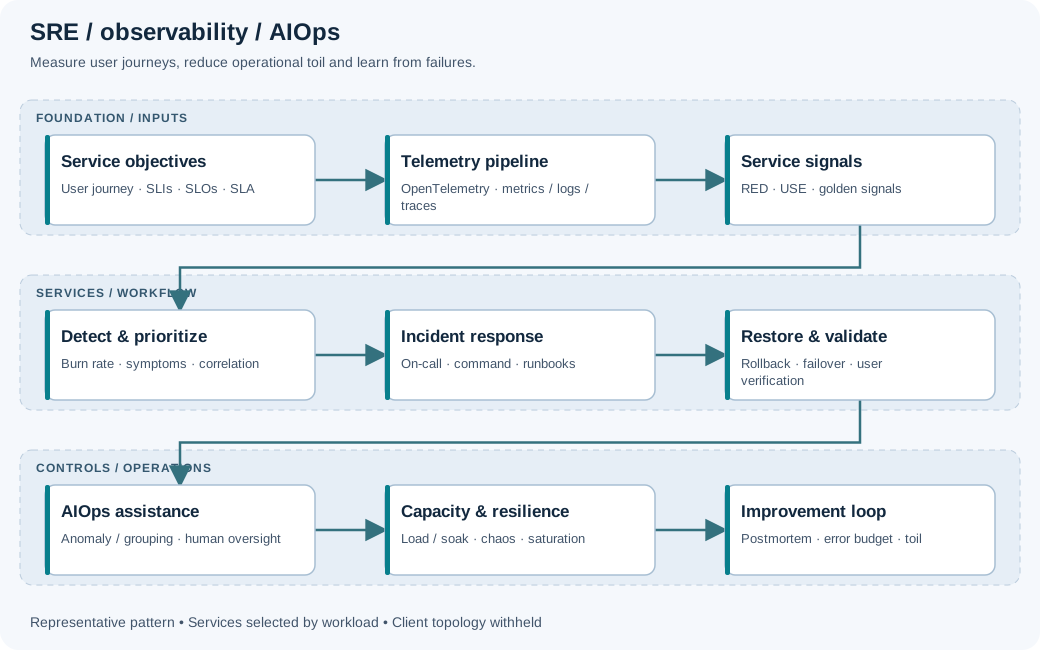
The resume reports 99.99%-class services. 99.999% is a design target requested for discussion, not a verified delivered result. Five nines permits about 5.26 minutes of annual unavailability over 365 days; maintenance exclusions and measurement boundaries belong in the SLA.
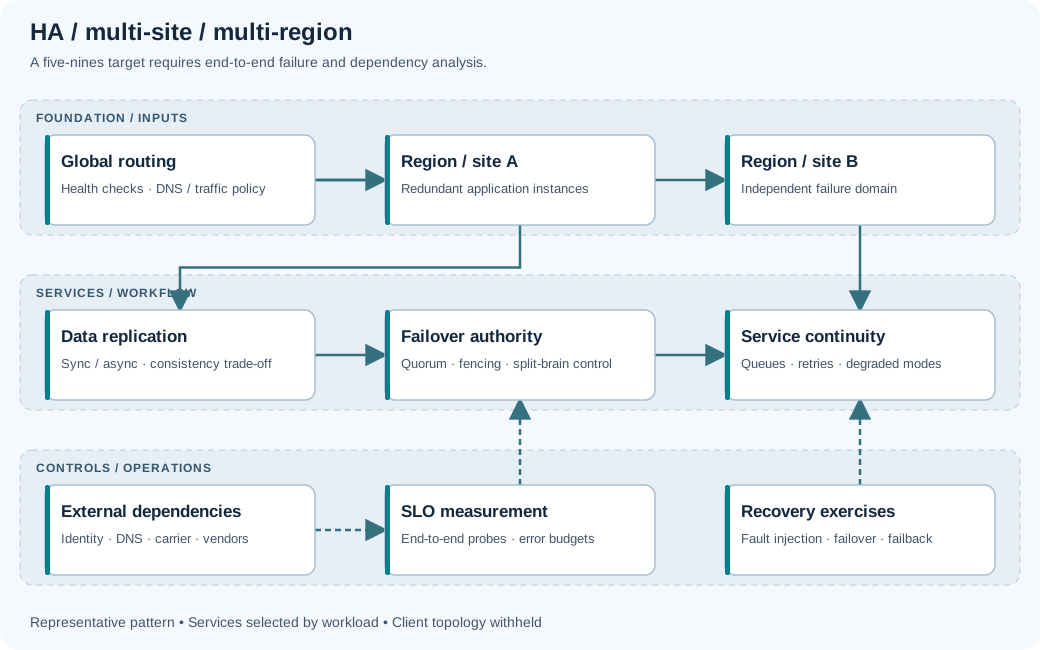
Resume-derived CI/CD, GitOps and supply-chain practices. Gates are concrete evidence checks. Build provenance, artifact identity and runtime controls remain traceable through release and rollback.
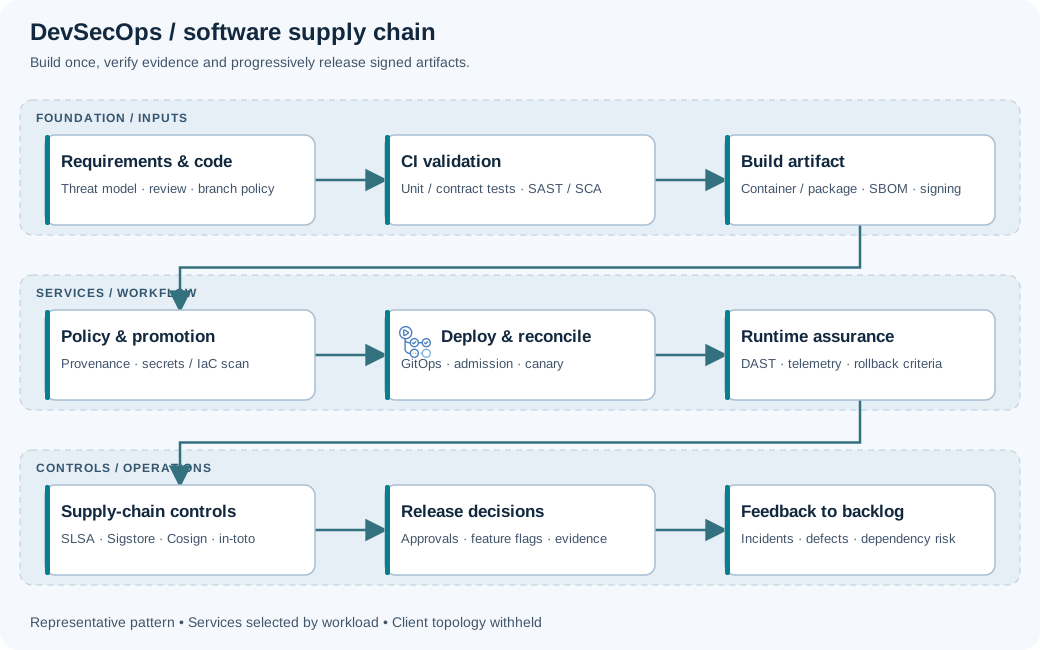
Resume-derived internal platform and fleet practices. Developer experience, provisioning time, reliability and adoption guide the roadmap; a collection of tools alone is not an internal developer platform.
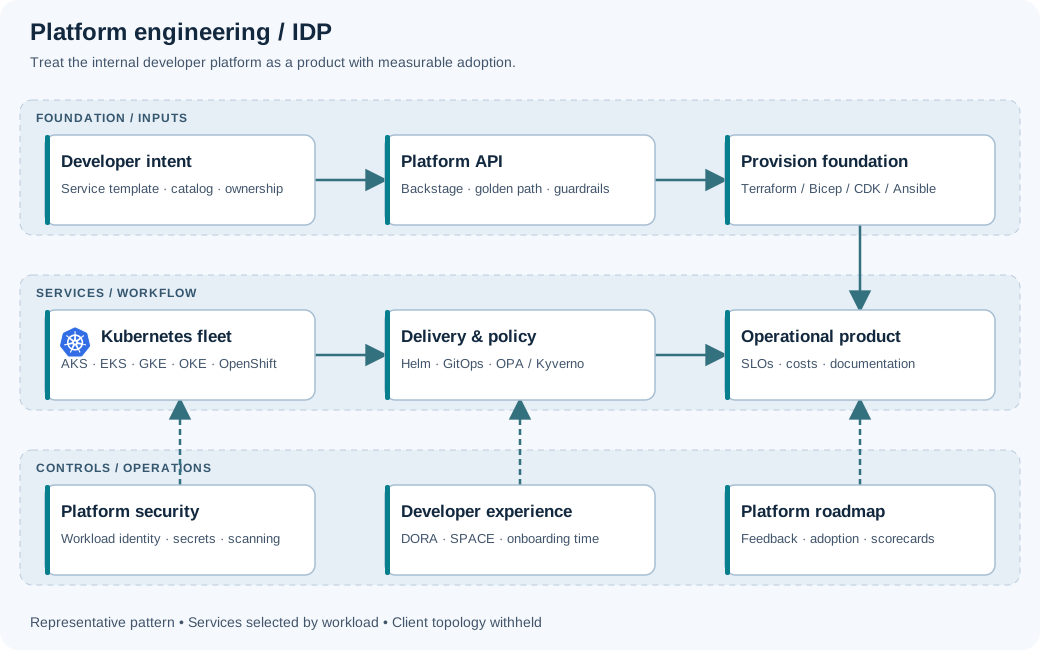
Resume-described SRE and observability work. AIOps supports correlation and prioritization; privileged remediation remains controlled. Error-budget decisions connect reliability to delivery rather than treating uptime alone as the service outcome.
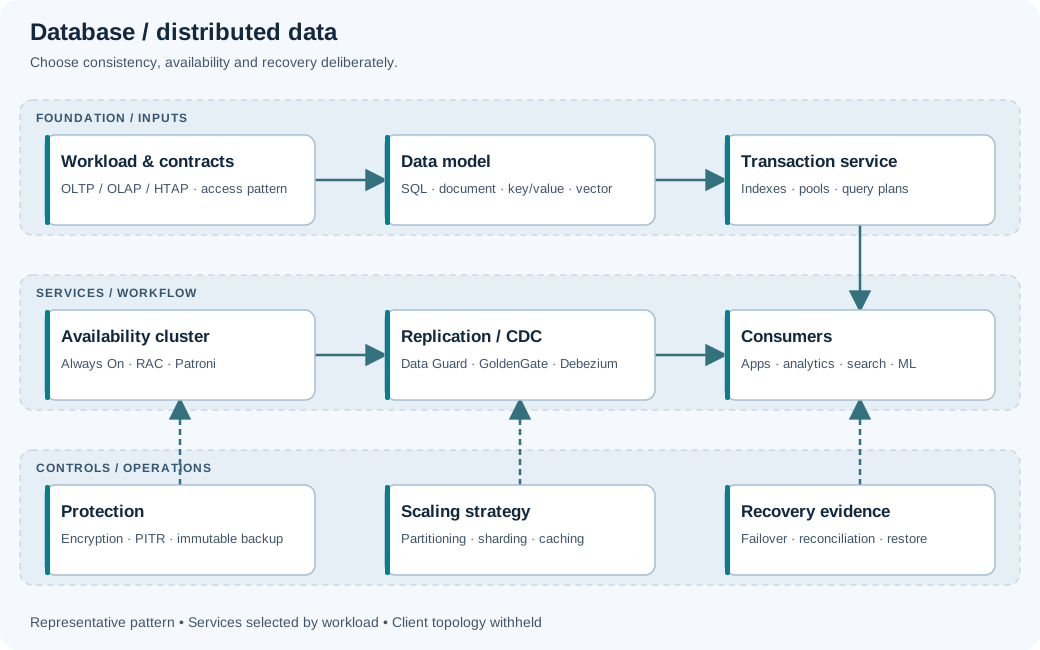
Resume-derived database design and operations. Database products and replication models are alternatives; consistency, latency, data-loss windows and licensing determine selection. Analytics replicas and backups have separate recovery roles.
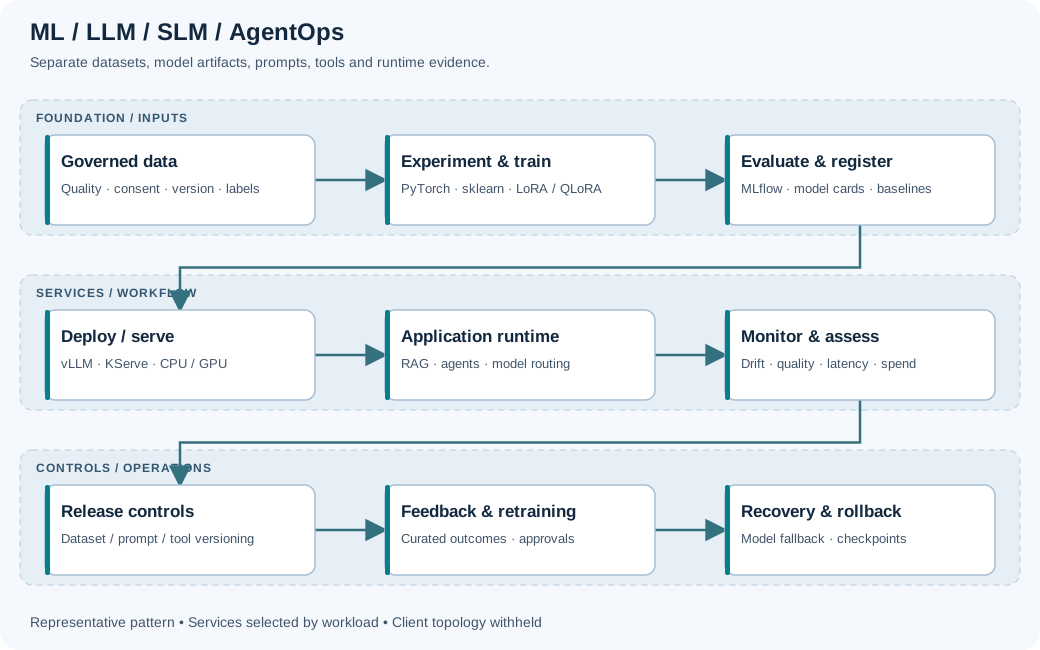
Resume evidence spans design, prototypes, evaluation and delivery; see individual project tiers. SLMOps applies lifecycle controls to small language models rather than implying a separate completed engagement. Training data, retrieval data and evaluation data must remain distinct.
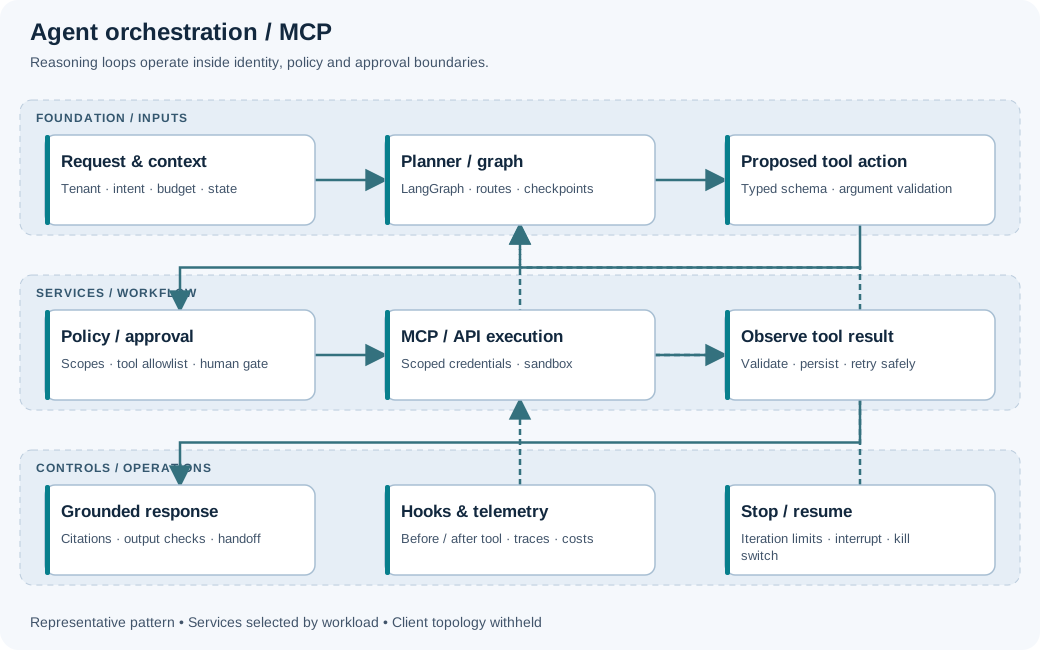
Reference expands resume-described agent loops, MCP, checkpoints and tool authorization. The policy gate must run before privileged execution. Hooks are extension points, not security guarantees. MCP provides a protocol; application authorization and replay-safe side effects remain design responsibilities.
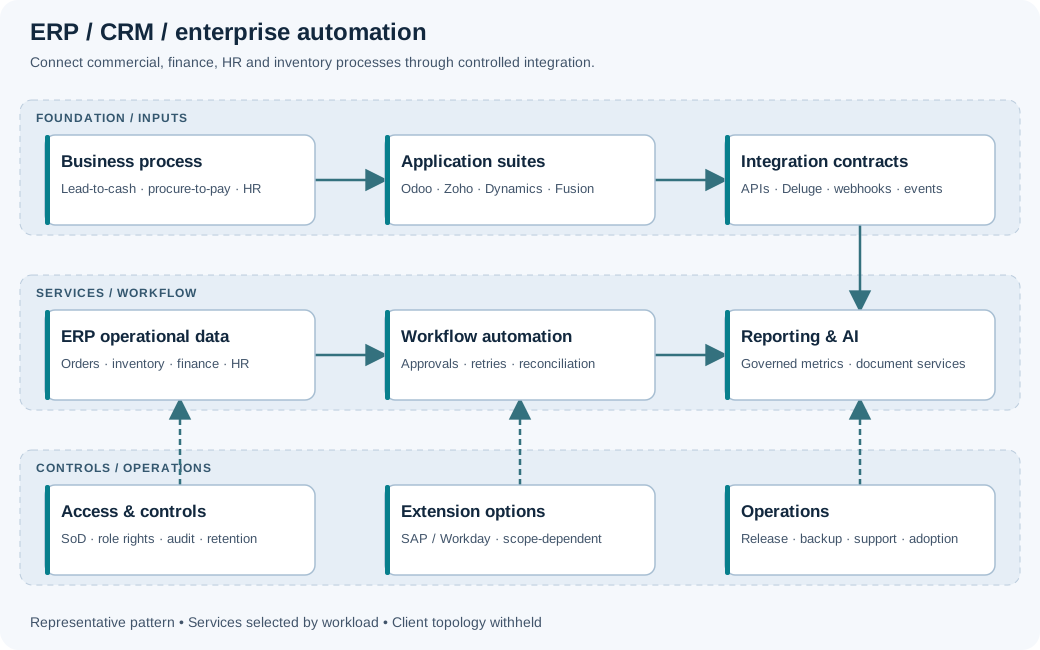
Odoo, Zoho, Dynamics 365, Oracle Fusion and Workday integration appear in the resume. SAP is a requested reference extension with engagement detail pending. Vendor application catalogs describe possible modules; they do not establish implementation of every module.
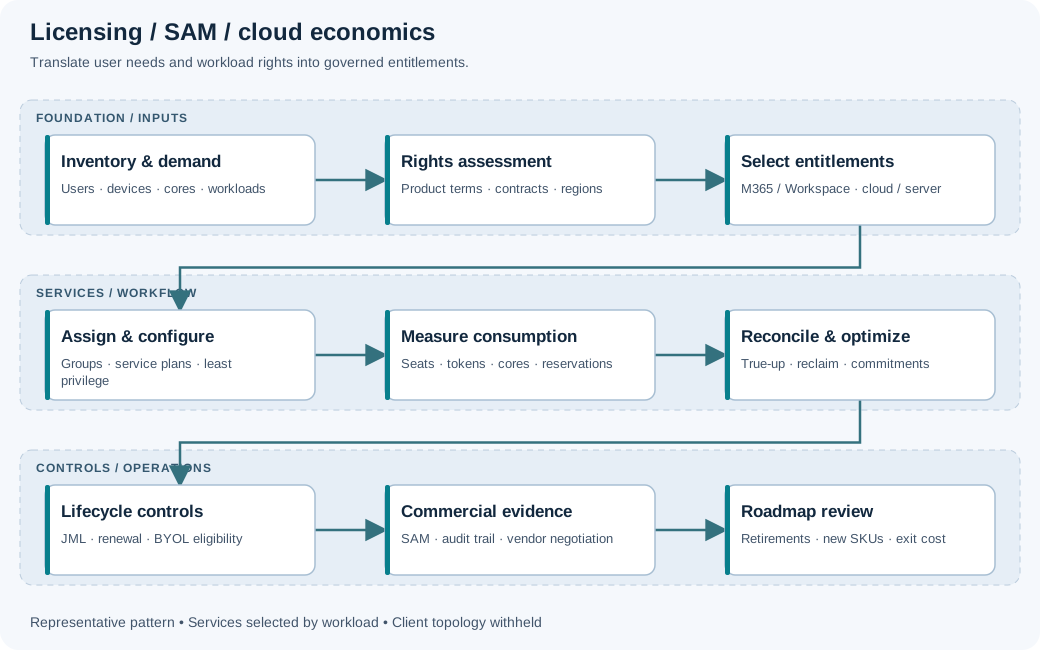
Resume-described Microsoft, Google, VMware and cloud-commercial work. E7 is an evaluation in the source. Subscription tiers, license metrics, BYOL, support rights and region-specific product terms are assessed per contract; no universal licensing entitlement is implied.
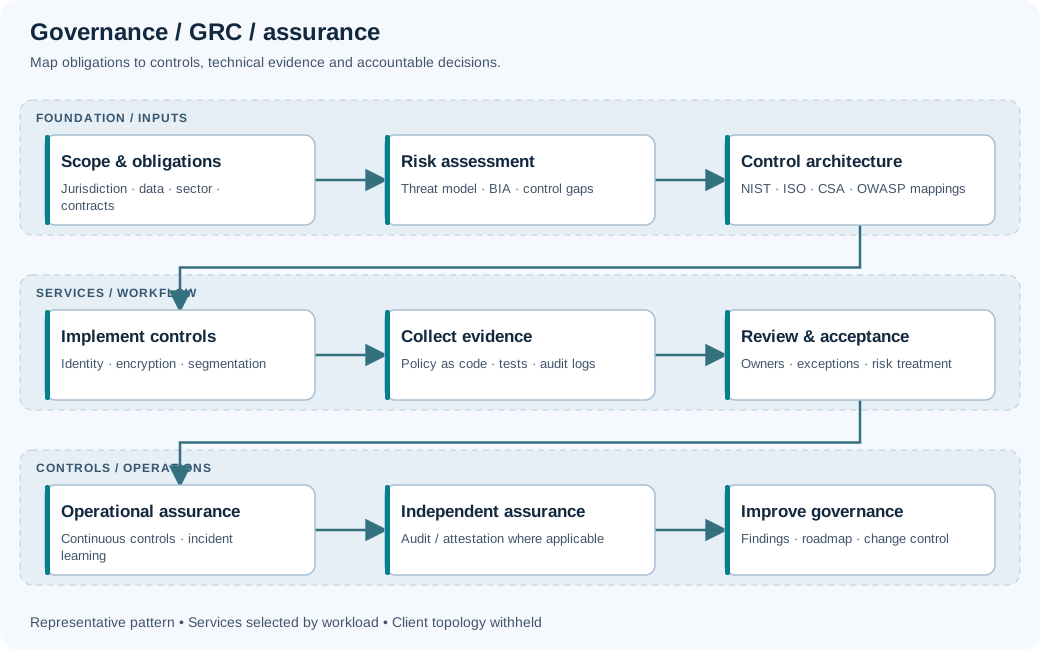
Resume-listed framework experience is not organizational certification or a legal compliance guarantee. Scope, jurisdiction, system boundary and independent assurance determine applicable obligations. Regulatory interpretation stays with the accountable business and legal functions.
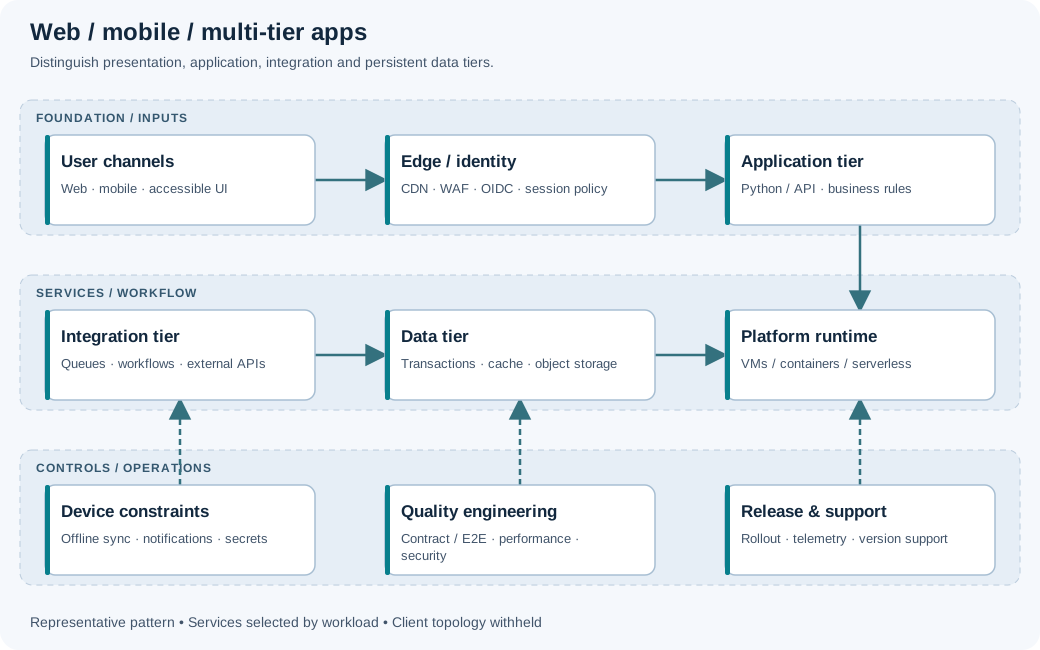
Representative application architecture. One-, two-, three- and four-tier deployment choices are different from datacentre Tier I–IV classifications and recovery criticality tiers. The resume supports web/API delivery; mobile-native implementation specifics remain unconfirmed.
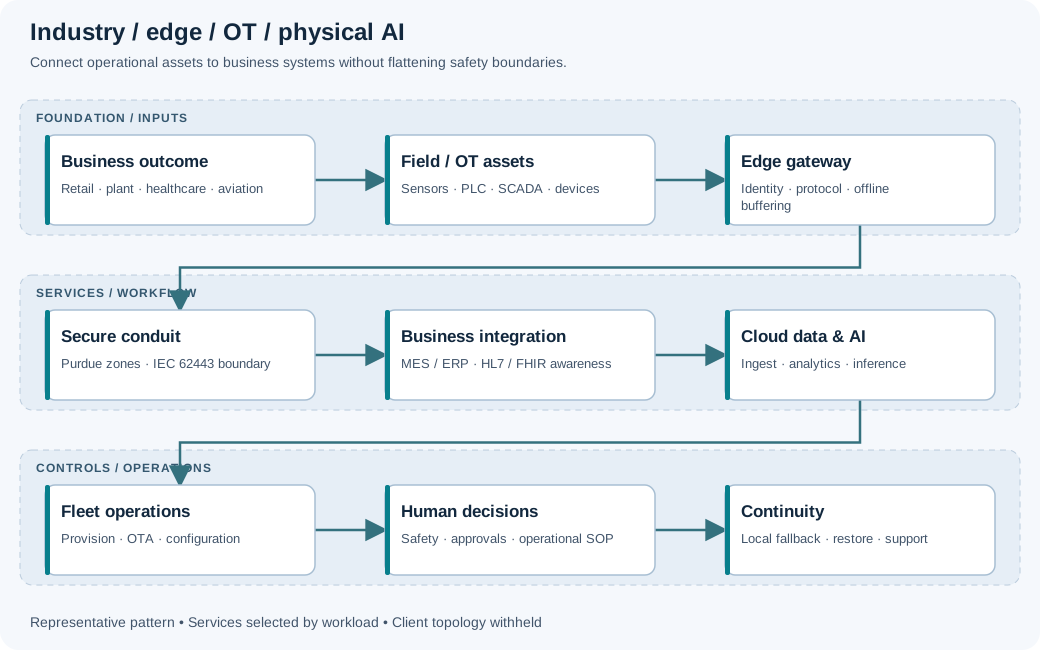
Resume evidence separates operational engineering from evaluated robotics, digital twins and physical AI. Domain protocols and regulatory needs vary by industry; the diagram is not a claim of clinical software ownership or safety certification.
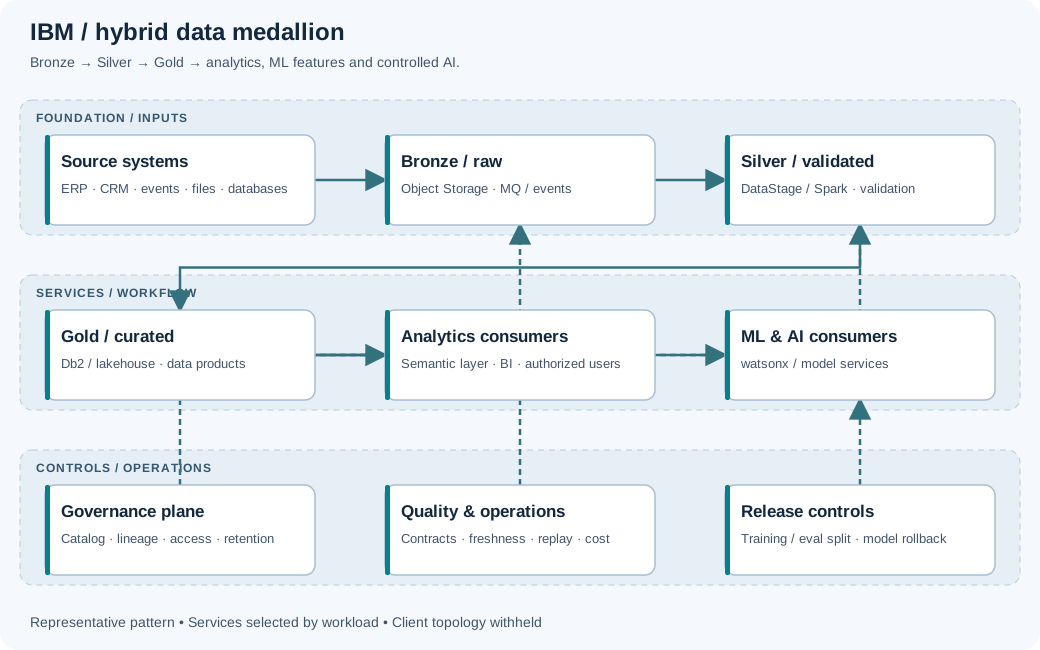
Medallion is a data-quality design pattern, not a compulsory vendor product. Raw data is retained, silver is validated and standardized, and gold is curated for business use. ML features and permission-aware retrieval consume approved data; not all raw data goes directly to a model. This provider mapping is representative, not a separate claimed deployment.
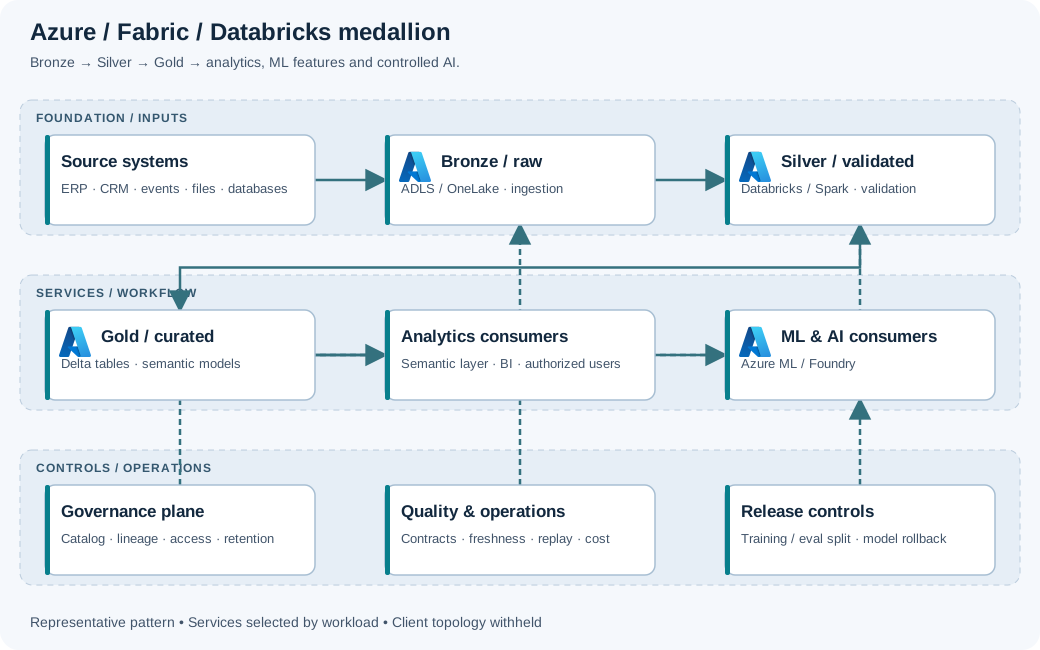
Medallion is a data-quality design pattern, not a compulsory vendor product. Raw data is retained, silver is validated and standardized, and gold is curated for business use. ML features and permission-aware retrieval consume approved data; not all raw data goes directly to a model. This provider mapping is representative, not a separate claimed deployment.
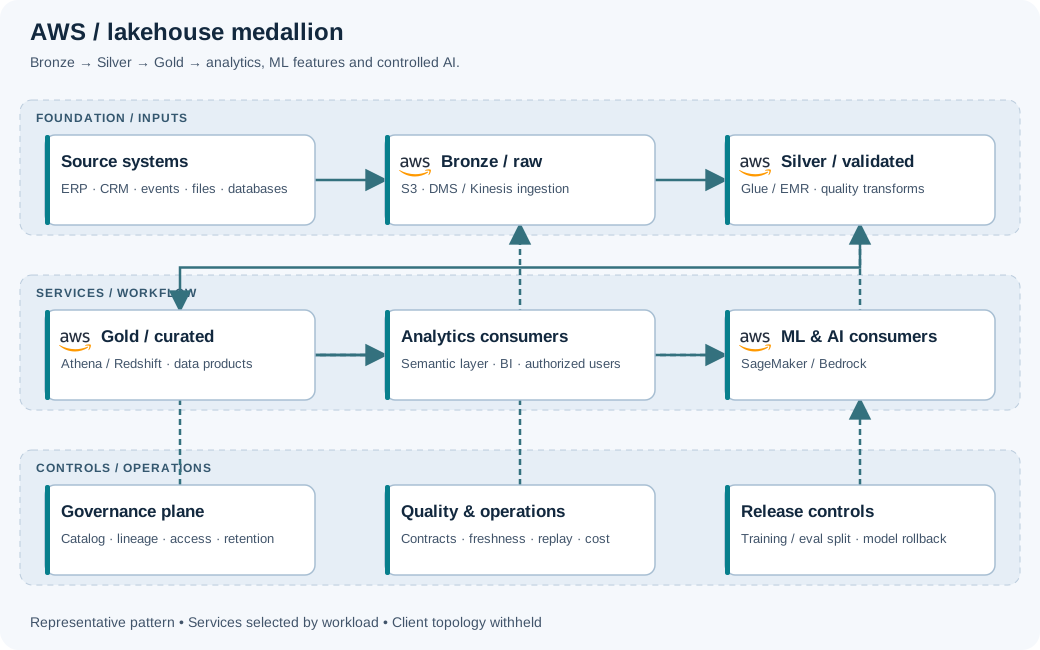
Medallion is a data-quality design pattern, not a compulsory vendor product. Raw data is retained, silver is validated and standardized, and gold is curated for business use. ML features and permission-aware retrieval consume approved data; not all raw data goes directly to a model. This provider mapping is representative, not a separate claimed deployment.
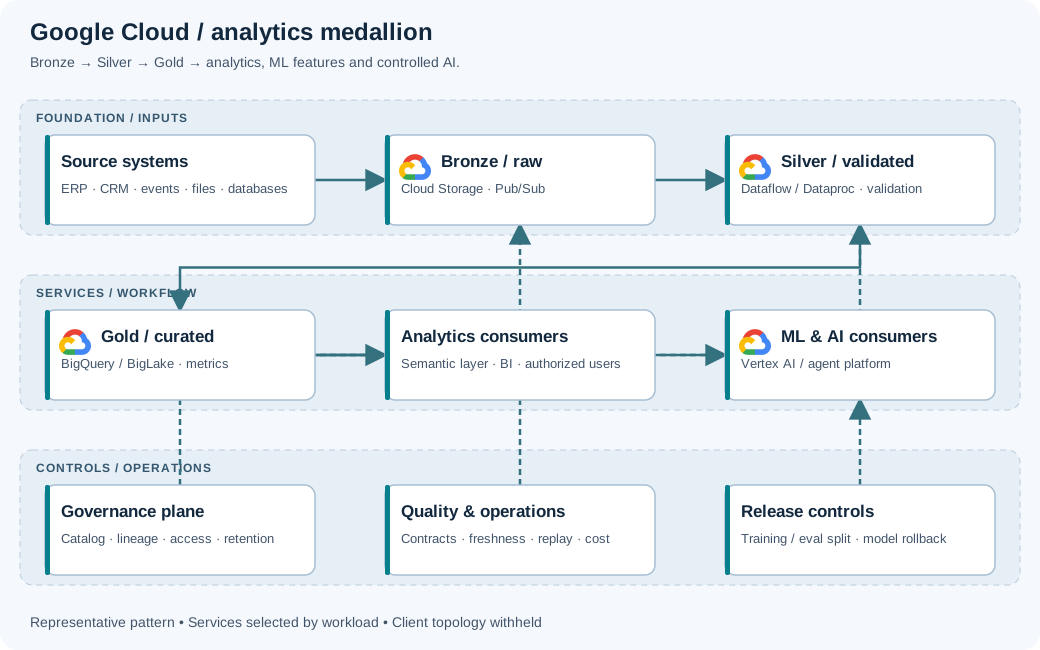
Medallion is a data-quality design pattern, not a compulsory vendor product. Raw data is retained, silver is validated and standardized, and gold is curated for business use. ML features and permission-aware retrieval consume approved data; not all raw data goes directly to a model. This provider mapping is representative, not a separate claimed deployment.
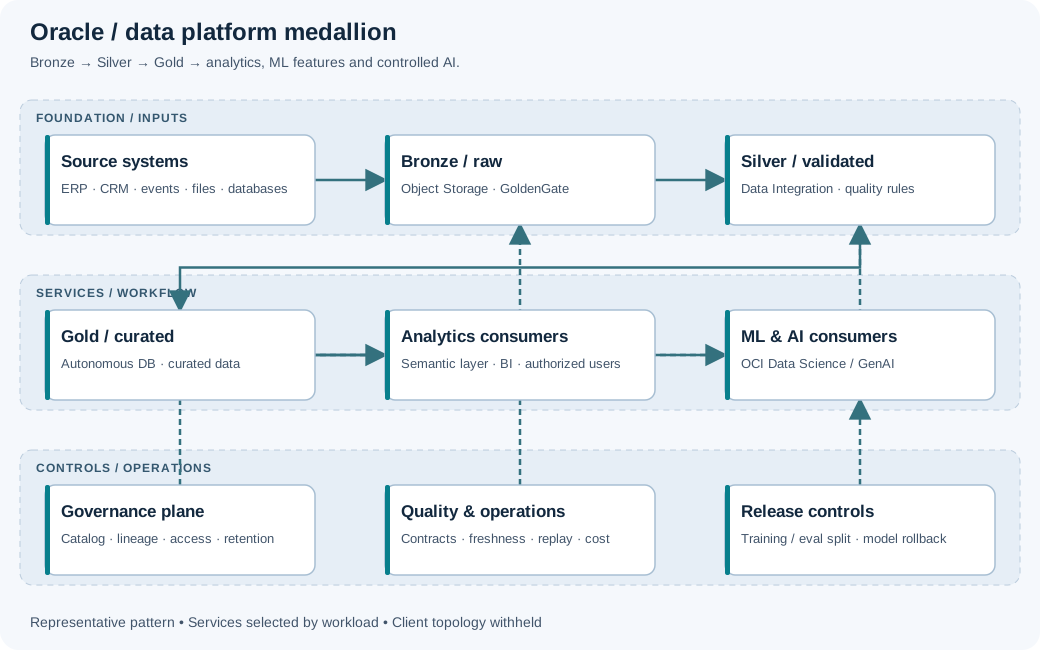
Medallion is a data-quality design pattern, not a compulsory vendor product. Raw data is retained, silver is validated and standardized, and gold is curated for business use. ML features and permission-aware retrieval consume approved data; not all raw data goes directly to a model. This provider mapping is representative, not a separate claimed deployment.
Product names remain visible beside platform marks. Brand marks are not certifications or endorsements. Icon sources and attribution.
03 / My approach
You should know what we are solving, what will be delivered, how success is measured and who owns the system afterward.
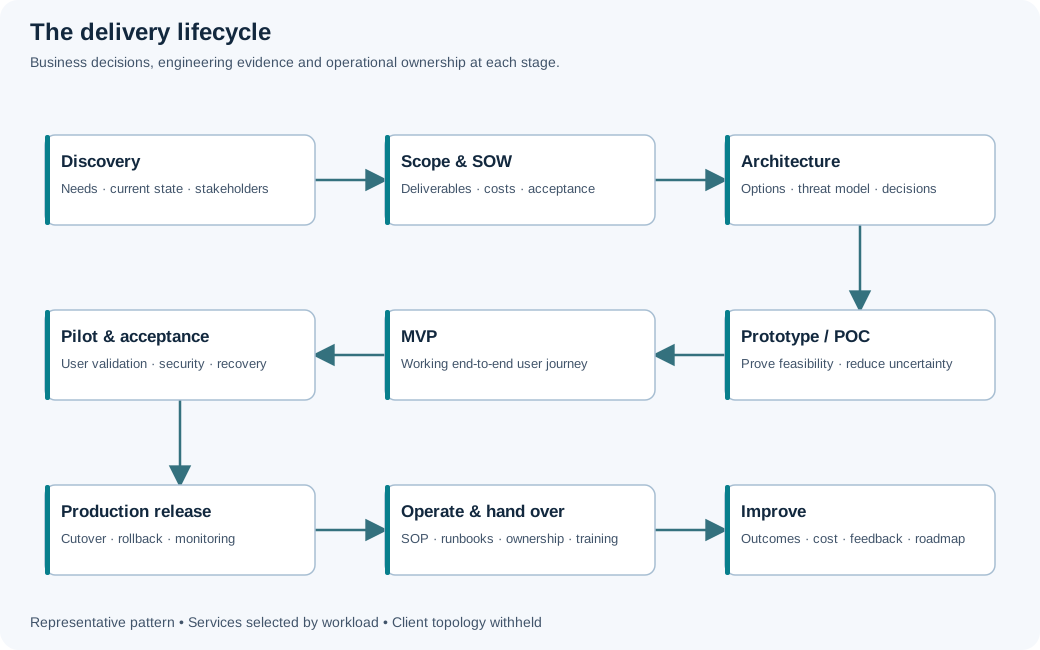
Listen to users and stakeholders. Map the current process, dependencies, constraints and business outcomes.
Outputs: discovery brief, scope of work, success criteria.Compare options, document architecture and test the uncertain parts through a prototype, POC or proof of value.
Outputs: architecture, decisions, threat model, evidence.Deliver the smallest useful end-to-end capability. Pilot with defined users, evaluate results and prepare for release.
Outputs: MVP, pilot report, test and readiness evidence.Deploy with recovery steps. Support adoption, document operations, train the receiving team and improve from feedback.
Outputs: as-built documentation, SOPs, runbooks, handover.Define the service: users, transaction paths, data classification, dependencies, capacity, business owner and measurable availability, latency and recovery objectives.
Control the release: access boundaries, security review, meaningful tests, restore validation, monitoring, versioned artifacts, cutover instructions and rollback criteria.
Transfer responsibility: current architecture, configuration references, standard operating procedures, incident and recovery runbooks, support ownership, known issues and practical knowledge transfer.
Close the loop: review adoption, service health, cost and business outcomes. A receiving team should be able to operate and recover the service. Stages are adapted to the engagement; an assessment or migration does not need an artificial product lifecycle.
04 / Technical depth
Explore 41 representative project families. Search a technology or discipline, then open a record for the engineering details and experience level.
Experience levels distinguish production delivery, architecture/design, prototypes or pilots, training and evaluation. A project family can span several engagements and levels; an evaluated tool is not presented as production experience. Detailed architecture and client evidence are discussed only within permitted confidentiality boundaries.
Production delivery · Architecture & design · Prototype / POC / pilot · Evaluation
Evaluated / explored—not a claim of production use: Microsoft Agent Framework, Google ADK, OpenAI Agents SDK, Claude Agent SDK, CrewAI, LlamaIndex, DSPy, Azure AI Foundry Agent Service, Databricks Agent Bricks, Qdrant, Pinecone, Weaviate, Neo4j, Langfuse, LangSmith, Arize Phoenix, Braintrust, RAGAS, Helicone, LiteLLM, Portkey, E2B, Modal.
Architecture & design · Prototype / POC / pilot · Evaluation
Evaluated / explored—not a claim of production use: vLLM, NVIDIA Triton Inference Server, TensorRT-LLM, NVIDIA NIM, KServe, Ray and Ray Serve.
Architecture & design · Prototype / POC / pilot · Training · Evaluation
Evaluated / explored—not a claim of production use: MLflow, Kubeflow, DVC, Feast, Evidently, Weights and Biases, SageMaker, Vertex AI Pipelines, Azure Machine Learning, scikit-learn, TensorFlow, PyTorch, federated learning, SHAP, LIME, explainable AI.
Production delivery · Architecture & design · Evaluation
Evaluated / explored—not a claim of production use: OWASP Top 10 for Agentic Applications, OWASP LLM Top 10, MITRE ATLAS, CSA MAESTRO, NIST AI RMF, NIST AI Agent Standards Initiative, EU AI Act, AI security posture management.
Production delivery · Architecture & design
Production delivery · Architecture & design · Prototype / POC / pilot
Production delivery · Architecture & design
Production delivery · Architecture & design · Prototype / POC / pilot
Production delivery · Architecture & design · Prototype / POC / pilot · Evaluation
Evaluated / explored—not a claim of production use: Crossplane, Karpenter, Kubernetes Gateway API, Knative, Dapr, WebAssembly and WASI, Kata Containers, confidential containers.
Production delivery · Architecture & design · Prototype / POC / pilot · Evaluation
Evaluated / explored—not a claim of production use: Port, Cortex, OpsLevel, Humanitec, Kratix, OpenTofu, Terragrunt, Pulumi.
Production delivery · Architecture & design
Evaluated / explored—not a claim of production use: Spinnaker, Harness, Octopus Deploy.
Production delivery · Architecture & design
Evaluated / explored—not a claim of production use: Tetragon, GitHub Advanced Security scanning depth.
Production delivery · Architecture & design
Production delivery · Architecture & design · Evaluation
Evaluated / explored—not a claim of production use: Mimir, Pyroscope continuous profiling, New Relic, Honeycomb.
Production delivery · Architecture & design · Prototype / POC / pilot
Evaluated / explored—not a claim of production use: k6, JMeter, Gatling.
Production delivery · Architecture & design · Evaluation
Evaluated / explored—not a claim of production use: Okta, Ping Identity, Saviynt, SPIFFE, SPIRE, Entra Private Access, Entra Internet Access, Entra Permissions Management, Entra Verified ID, Entra Workload ID.
Production delivery · Architecture & design
Production delivery · Architecture & design · Evaluation
Evaluated / explored—not a claim of production use: DSPM, SSPM, ITDR, AI-SPM, confidential computing and trusted execution environments.
Production delivery · Architecture & design
Architecture & design · Evaluation
Evaluated / explored—not a claim of production use: NIST post-quantum cryptography standards including Kyber and Dilithium, crypto-agility patterns.
Production delivery · Architecture & design
Evaluated / explored—not a claim of production use: NVMe over Fabrics fabric design.
Production delivery · Architecture & design · Prototype / POC / pilot
Evaluated / explored—not a claim of production use: Infoblox DDI, QUIC and HTTP/3 transport migration.
Production delivery · Architecture & design
Production delivery · Architecture & design
Production delivery · Architecture & design · Evaluation
Evaluated / explored—not a claim of production use: Microsoft 365 E7 Frontier Suite, Microsoft Agent 365, Microsoft 365 Copilot licensing.
Production delivery · Architecture & design
Evaluated / explored—not a claim of production use: Gemini Business and Enterprise, NotebookLM Enterprise.
Production delivery · Architecture & design
Production delivery · Architecture & design · Prototype / POC / pilot · Evaluation
Evaluated / explored—not a claim of production use: Apache Iceberg, DuckDB, Unity Catalog, Trino, ClickHouse, Confluent, Pulsar, NATS, ActiveMQ, Dagster, Fivetran, Airbyte, reverse ETL.
Architecture & design · Prototype / POC / pilot · Evaluation
Evaluated / explored—not a claim of production use: Great Expectations, Soda, Monte Carlo, Collibra, Alation, DataHub, OpenMetadata, master data management platforms, differential privacy, synthetic data generation.
Production delivery · Architecture & design
Evaluated / explored—not a claim of production use: Cassandra, Valkey, Elasticsearch and OpenSearch cluster operations.
Architecture & design · Prototype / POC / pilot
Evaluated / explored—not a claim of production use: Power BI Pro and Premium, Tableau, Looker deployment topology.
Production delivery · Architecture & design · Prototype / POC / pilot
Evaluated / explored—not a claim of production use: Go, TypeScript, Java, C# and Jupyter within polyglot delivery teams.
Production delivery · Architecture & design · Evaluation
Evaluated / explored—not a claim of production use: MuleSoft, Dell Boomi, Apigee, Kong, Tyk, enterprise service bus consolidation.
Production delivery · Architecture & design · Prototype / POC / pilot
Production delivery · Architecture & design · Prototype / POC / pilot · Evaluation
Evaluated / explored—not a claim of production use: UiPath agentic automation, Automation Anywhere, Workato.
Production delivery · Architecture & design · Evaluation
Evaluated / explored—not a claim of production use: ServiceNow ITSM and ITOM, Common Service Data Model alignment.
Production delivery · Architecture & design · Evaluation
Evaluated / explored—not a claim of production use: Apptio, CloudHealth, Cloudability, Kubecost, OpenCost, GreenOps and carbon-aware workload scheduling.
Production delivery · Architecture & design · Evaluation
Evaluated / explored—not a claim of production use: CMMC, FedRAMP, HITRUST, CSA Cloud Controls Matrix, OWASP SAMM, FFIEC, Basel III, Solvency II, SEC cybersecurity disclosure, EU Data Act, Digital Operational Resilience Act, ITAR and EAR obligations.
Production delivery · Architecture & design
Production delivery · Architecture & design
Production delivery · Architecture & design · Prototype / POC / pilot · Evaluation
Evaluated / explored—not a claim of production use: Azure IoT Hub, IoT Edge and IoT Operations, Azure Digital Twins, AWS IoT Core, Greengrass, SiteWise and TwinMaker, Google Distributed Cloud Edge, EdgeX Foundry, OPC UA, MQTT, Modbus, CAN bus, time-sensitive networking, private 5G, ROS 2, NVIDIA Jetson, Isaac and Omniverse, robotics and autonomous systems, physical and embodied artificial intelligence, spatial computing, digital twins, TinyML, ONNX Runtime, WebNN, ISA-95, product lifecycle management, predictive maintenance.
A broader index of historical platforms, implementation tools, architecture methods and evaluated technologies. Inclusion does not imply production use, certification or current product availability. Match these areas to a specific engagement in our technical discussion.
Across delivery, design, training and evaluation; ask for engagement-specific depth.
Microsoft 365 E1, E3, E5, F1, F3; Office 365 E1, E3, E5; Microsoft 365 licensing roadmap; Business Basic, Business Standard, Business Premium; Academic A1, A3, A5; Government G1, G3, G5; Microsoft 365 Apps for Enterprise; Microsoft 365 Copilot licensing; Entra ID P1 and P2; Entra ID Governance; Entra Suite; Entra Private Access; Entra Internet Access; Entra Permissions Management; Entra Verified ID; Entra Workload ID; Exchange Online Plan 1 and Plan 2; Exchange Online Protection; Defender for Office 365 Plan 1 and Plan 2; Defender for Endpoint Plan 1 and Plan 2; Defender for Identity; Defender for Cloud Apps; Defender Vulnerability Management; SharePoint Online Plan 1 and Plan 2; OneDrive Plan 1 and Plan 2; Microsoft Teams; Teams Phone; Teams Rooms Pro; Teams Premium; Microsoft Viva Suite; Viva Engage; Viva Insights; Microsoft Purview Information Protection; Purview Data Loss Prevention; Purview eDiscovery Premium; Purview Insider Risk Management; Purview Records Management; Purview Communication Compliance; Purview Compliance Manager; Purview Audit Premium; Microsoft Intune Plan 1 and Plan 2; Intune Suite; Endpoint Privilege Management; Windows Autopilot; Windows 365 Business and Enterprise; Azure Virtual Desktop; FSLogix; MECM and SCCM co-management; Power BI Pro and Premium; Power Apps and Power Automate premium connectors; Dynamics 365; Copilot Studio; Microsoft agent governance; Microsoft 365 Admin Center; Exchange Admin Center; Teams Admin Center; Security and Compliance Center; licence assignment, group-based licensing, service-plan control, tenant-to-tenant migration, multi-geo configuration and true-up negotiation.
Across delivery, design, training and evaluation; ask for engagement-specific depth.
Business Starter, Business Standard, Business Plus; Enterprise Essentials, Enterprise Essentials Plus, Enterprise Standard, Enterprise Plus; Frontline Starter and Standard; Education Fundamentals, Education Standard, Teaching and Learning Upgrade, Education Plus; Google Workspace for Nonprofits; Gemini Business, Gemini Enterprise; NotebookLM Enterprise; Google Vault; Google Workspace Migrate; Google Cloud Directory Sync; Google Admin Console; organisational units; Context-Aware Access; Cloud Identity Free and Premium; endpoint management; Drive shared drives; Gmail routing, compliance and retention rules; Google Meet; Google Chat; Chrome Enterprise; Chrome Enterprise Premium; Google Workspace Security Center; Alert Center; data-region policies; and coexistence with Microsoft 365 during phased migration.
Across delivery, design, training and evaluation; ask for engagement-specific depth.
Azure Resource Manager; Azure Landing Zones; Cloud Adoption Framework; Well-Architected Framework; Azure Arc; Azure Local; Azure Stack HCI; Azure VMware Solution; Management Groups; Azure Policy; Azure Blueprints successor patterns; Azure Virtual WAN; Virtual Network Manager; ExpressRoute; VPN Gateway; Route Server; Azure Firewall; Azure Bastion; Private Link; Private Endpoint; Azure DNS; Traffic Manager; Front Door; Application Gateway; Load Balancer; AKS; Azure Kubernetes Fleet Manager; Azure Container Apps; Container Instances; Container Registry; App Service; Azure Functions; Service Fabric; Azure Batch; Azure Storage; Blob lifecycle and tiering; Azure Files; Azure NetApp Files; Azure SQL; SQL Managed Instance; Cosmos DB; Database for PostgreSQL and MySQL; Azure Cache for Redis; Azure Data Factory; Synapse Analytics; Azure Databricks; Microsoft Fabric; OneLake; Event Hubs; Service Bus; Event Grid; Logic Apps; API Management; Azure Machine Learning; Microsoft Foundry; Azure OpenAI; Azure AI Search; AI Document Intelligence; AI Content Safety; Azure Monitor; Log Analytics; Application Insights; Azure Backup; Site Recovery; Azure Migrate; Defender for Cloud; Microsoft Sentinel; Key Vault; Managed HSM; Azure Government and sovereign-cloud patterns; cross-cloud migration; workload portability; cloud exit strategy and reversibility; vendor concentration risk; resilience economics.
Across delivery, design, training and evaluation; ask for engagement-specific depth.
Organizations; Control Tower; Landing Zone Accelerator; IAM; IAM Identity Center; Resource Access Manager; Service Control Policies; permission boundaries; VPC; Transit Gateway; Cloud WAN; VPC Lattice; PrivateLink; Direct Connect; Route 53; CloudFront; Global Accelerator; WAF; Shield; Network Firewall; EC2; Auto Scaling; ECS; EKS; Fargate; Lambda; App Runner; Elastic Beanstalk; S3; S3 Intelligent-Tiering; EBS; EFS; FSx; RDS; Aurora; DynamoDB; ElastiCache; OpenSearch Service; Redshift; Neptune; MSK; Kinesis; EventBridge; SQS; SNS; Step Functions; API Gateway; AppSync; Glue; Lake Formation; EMR; Athena; SageMaker; Bedrock; Bedrock AgentCore; Amazon Q; Amazon Nova; GuardDuty; Security Hub; Macie; Inspector; Detective; AWS Backup; Elastic Disaster Recovery; CloudTrail; CloudWatch; X-Ray; Systems Manager; Service Catalog; Outposts; Local Zones; GovCloud; Well-Architected Reviews.
Across delivery, design, training and evaluation; ask for engagement-specific depth.
Organization, Folders and Projects; Cloud IAM; Organization Policy Service; Shared VPC; VPC Service Controls; Cloud Interconnect; Cloud VPN; Cloud NAT; Cloud Load Balancing; Cloud CDN; Cloud Armor; Cloud DNS; GKE; GKE Autopilot; Cloud Run; Cloud Functions; Compute Engine; Cloud Storage; Filestore; AlloyDB; Cloud SQL; Spanner; Bigtable; Firestore; Memorystore; Pub/Sub; Dataflow; Dataproc; Dataplex; BigQuery; BigLake; Looker; Vertex AI; Vertex AI Search; Gemini Enterprise Agent Platform; Model Garden; Security Command Center; Cloud Logging; Cloud Monitoring; Cloud Trace; Assured Workloads. Oracle Cloud Infrastructure tenancy and compartment design; OCI IAM; VCN; Dynamic Routing Gateway; FastConnect; OKE; OCI Functions; Object Storage; Block Volume; Autonomous Database; Exadata Cloud Service; MySQL HeatWave; OCI Streaming; OCI Data Science; OCI Generative AI; Oracle Integration Cloud; Oracle Fusion Cloud; Oracle GoldenGate; Oracle Data Guard; Oracle RAC.
Across delivery, design, training and evaluation; ask for engagement-specific depth.
VMware vSphere, ESXi, vCenter, vMotion, Storage vMotion, DRS, HA, Fault Tolerance, vSAN, NSX, NSX-T, HCX, Site Recovery Manager; VMware Cloud Foundation; Dell VxRail; Dell PowerFlex; Cisco UCS; Nutanix AHV and Prism; Hyper-V; Failover Clustering; Storage Spaces Direct; SCVMM; SCOM; System Center Orchestrator; KVM; QEMU; Proxmox VE; oVirt and RHEV; OpenStack; Xen; Windows Server; Server Core; Active Directory multi-forest; Group Policy; AD CS and PKI; AD FS; DNS; DHCP; IIS; DFS-R; WSUS; PowerShell Desired State Configuration; Remote Desktop Services; RHEL; AlmaLinux; Rocky Linux; Ubuntu; Debian; SUSE Linux Enterprise; CentOS; Oracle Linux; Amazon Linux; Slackware; Kali Linux; Alpine; Flatcar; AIX; HP-UX; Solaris; IBM i and iSeries; systemd; SELinux; AppArmor; PAM; LDAP; LVM; Pacemaker; Corosync; Keepalived; HAProxy; kernel and NUMA tuning; SAN; NAS; DAS; Fibre Channel; iSCSI; NVMe over Fabrics; NetApp ONTAP; Dell PowerMax, PowerStore and Unity; Pure Storage FlashArray; HPE Alletra; Ceph; MinIO; object, block and file storage; RAID; replication; snapshots; deduplication; tiering; TCP/IP; IPv4 and IPv6; QUIC; HTTP/2 and HTTP/3; TLS 1.3; mTLS; BGP; OSPF; IS-IS; EVPN; VXLAN; MPLS; Segment Routing; SD-WAN; SASE; SSE; ZTNA; DNSSEC; DNS over HTTPS and TLS; BIND; PowerDNS; Infoblox patterns; Cisco; Arista; Juniper; F5 BIG-IP; Fortinet; Palo Alto; Cloudflare; Akamai; Fastly; Tailscale.
Across delivery, design, training and evaluation; ask for engagement-specific depth.
Kubernetes; AKS, EKS, GKE, OKE and OpenShift; Kubernetes Operators; Custom Resource Definitions; admission webhooks; Cluster API; cert-manager; External Secrets Operator; Velero; Cluster Autoscaler; KEDA; VPA and HPA; pod disruption budgets; topology spread constraints; pod-security admission; containerd; CRI-O; Docker; Podman; Helm; Kustomize; Harbor; JFrog Artifactory; Nexus; ECR, ACR and Artifact Registry; Terraform; OpenTofu; Terragrunt; Pulumi; Crossplane; Bicep; ARM; CloudFormation; AWS CDK; Ansible and Ansible Automation Platform; Puppet; Chef; SaltStack; Packer; HashiCorp Vault; Consul; Nomad; GitHub Enterprise; GitHub Actions; GitHub Advanced Security; GitLab CI/CD; Azure DevOps; Jenkins; Tekton; Argo CD; Argo Rollouts; Flux; Spinnaker; Harness; Octopus Deploy; feature flags; trunk-based development; progressive delivery; canary and blue-green deployment; Backstage; internal developer platforms; developer portals; software templates; service catalogues; scorecards; paved roads; platform-as-a-product; platform reliability engineering; platform security engineering; multi-cluster fleet governance; developer experience measurement; platform adoption metrics; DORA metrics; SPACE framework; Team Topologies; OPA and Gatekeeper; Kyverno; Falco; Tetragon; Cilium; eBPF; Istio; Istio Ambient Mesh; Linkerd; Envoy; Gateway API; Kong; Traefik; NGINX; Knative; Dapr; WebAssembly and WASI; Kata Containers; confidential containers.
Across delivery, design, training and evaluation; ask for engagement-specific depth.
Domain-Driven Design; bounded contexts; strategic and tactical DDD; event storming; Clean Architecture; Hexagonal and ports-and-adapters architecture; SOLID principles; design patterns; modular monolith; strangler-fig decomposition; evolutionary architecture; architecture fitness functions; twelve-factor applications; microservices; distributed systems design; CQRS; event sourcing; saga orchestration; transactional outbox; idempotency; circuit breakers; bulkheads; backpressure; load shedding; API-first design; REST; GraphQL; gRPC; OpenAPI; AsyncAPI; OAuth 2.0 and 2.1; OIDC; JWT; SCIM; SAML; schema registry; schema evolution; dead-letter queues; event replay; enterprise integration platform-as-a-service; enterprise service bus; MuleSoft; Dell Boomi; Apigee; Kong; Tyk; electronic data interchange; business-to-business integration; unit, integration, contract and end-to-end testing; pytest; test automation; test-driven development; code review; semantic versioning; Python; PowerShell; Bash; SQL; HCL; Go; TypeScript; JavaScript; Java; C#; Jupyter; Django; FastAPI; Flask; Streamlit; Jinja.
Across delivery, design, training and evaluation; ask for engagement-specific depth.
Zero Trust; NIST SP 800-207; secure-by-design and secure-by-default; security architecture review; threat modelling; attack-surface management; exposure management; breach-and-attack simulation; purple teaming; detection engineering; threat hunting; MITRE ATT&CK; MITRE D3FEND; MITRE ATLAS; vulnerability-management lifecycle; Entra ID; Active Directory; AWS IAM; Google Cloud IAM; federation; single sign-on; multifactor authentication; passwordless and FIDO2; passkeys; Privileged Identity Management; just-in-time access; just-enough administration; RBAC, ABAC and ReBAC; identity lifecycle and joiner-mover-leaver controls; identity governance and administration; entitlement review; segregation of duties; privileged session management; secrets rotation; certificate lifecycle management; machine and workload identity; non-human identity; CyberArk; BeyondTrust; Delinea; HashiCorp Vault; Key Vault; AWS KMS and Secrets Manager; Cloud KMS; hardware security modules; bring-your-own-key and hold-your-own-key; Microsoft Sentinel; Defender XDR; CrowdStrike Falcon; SentinelOne; Darktrace; Netskope; Zscaler; Splunk Enterprise Security; SIEM; SOAR; XDR; EDR; NDR; UEBA; CNAPP; CSPM; CWPP; CIEM; DSPM; SSPM; ITDR; SaaS identity governance; security validation engineering; continuous controls monitoring; CASB; DLP; WAF; DDoS protection; API security; microsegmentation; DevSecOps; secure software development lifecycle; SAST; DAST; IAST; SCA; secret scanning; container and image scanning; infrastructure-as-code scanning; software bill of materials; CycloneDX; SPDX; SLSA; Sigstore; Cosign; in-toto; artefact provenance; software supply-chain security; AI bill of materials; model bill of materials; policy-as-code; compliance-as-code; risk-as-code; continuous compliance; audit-evidence automation; control mapping; business impact analysis; criticality classification; game days; chaos engineering; fault injection; disaster-recovery exercises; production-readiness review; operational-readiness review; cyber resilience; ransomware resilience; immutable backup; clean-room recovery; cyber-recovery vault; recovery validation; post-quantum cryptography awareness including NIST PQC, Kyber and Dilithium, and harvest-now-decrypt-later exposure assessment.
Across delivery, design, training and evaluation; ask for engagement-specific depth.
Enterprise data architecture; data strategy; lakehouse; medallion architecture; open table formats; Delta Lake; Apache Iceberg; Databricks; Unity Catalog; Microsoft Fabric; OneLake; Synapse; Snowflake; BigQuery; Redshift; Trino; ClickHouse; DuckDB; Spark; Flink; Kafka; Kafka Connect; Kafka Streams; Confluent; Pulsar; NATS; RabbitMQ; ActiveMQ; Debezium; change data capture; Airflow; Dagster; dbt; Fivetran; Airbyte; reverse ETL; streaming and real-time analytics; PostgreSQL; pgvector; Patroni; pgBouncer; SQL Server Always On; Oracle; MySQL; MariaDB; MongoDB; Cassandra; Redis; Valkey; Elasticsearch; OpenSearch; query-plan analysis; indexing strategy; partitioning; sharding; replication; point-in-time recovery; transparent data encryption; data mesh; data products; data contracts; data quality testing; data observability; Great Expectations; Soda; Monte Carlo; master data management; metadata management; data catalogue; business glossary; data lineage; data stewardship; Collibra; Alation; DataHub; OpenMetadata; semantic and metrics layers; data product management; unstructured data pipelines; enterprise knowledge management; Power BI; Tableau; Looker; data classification; retention; residency; sovereignty; privacy-enhancing technologies; differential privacy; confidential computing; trusted execution environments including Intel SGX and AMD SEV; synthetic data.
Across delivery, design, training and evaluation; ask for engagement-specific depth.
Enterprise AI strategy; AI operating model; AI platform architecture; generative AI; agentic AI; Microsoft Foundry; Azure OpenAI; Azure AI Search; Amazon Bedrock; Bedrock AgentCore; Google Vertex AI; Gemini Enterprise Agent Platform; Anthropic Claude; Amazon Nova; OpenAI; Hugging Face; open-weight and proprietary models; small language models; multimodal and vision-language models; reasoning models; long-context models; retrieval-augmented generation; advanced, agentic, corrective and multimodal RAG; GraphRAG; knowledge graphs; semantic and lexical search; BM25; dense and sparse retrieval; hybrid retrieval; reranking; cross-encoders; ColBERT; late interaction; semantic chunking; contextual retrieval; embeddings; vector search; Chroma; FAISS; pgvector; LangChain; LangGraph; Semantic Kernel; AutoGen; Copilot Studio; Model Context Protocol; MCP clients, servers and authorisation; Agent-to-Agent protocol; agent orchestration; agent runtime; agent registry; agent lifecycle management; agent identity; agent authorisation; tool registry; tool discovery; tool-execution policy; agent sandboxing and isolation; multi-agent orchestration; supervisor-worker and planner-executor patterns; agent delegation; computer-use and browser-use agents; agent simulation environments; agent reliability engineering; long-horizon agent evaluation; AI gateway and LLM gateway architecture; AI control plane; AI workload identity; AI access governance; agent memory including short-term, long-term, episodic and semantic; context engineering; enterprise context management; knowledge lifecycle management; data-centric AI engineering; real-time and event-driven AI architecture; ontology engineering; knowledge-graph operations; context and prompt caching; prompt lifecycle management; prompt registry and versioning; structured generation; constrained decoding; model registry; model cards; system cards; model lineage and provenance; model-risk management; AI governance; responsible AI; content safety; human-in-the-loop and human-on-the-loop design; bounded autonomy; LLM and agent evaluation; trajectory and tool-use evaluation; golden and adversarial datasets; groundedness and faithfulness; citation accuracy; hallucination rate and hallucination mitigation; content moderation and toxicity detection; drift detection; continuous AI evaluation and regression testing; synthetic evaluation data; AI observability; agent tracing; token telemetry; AI incident response; AI red teaming; prompt-injection and indirect-injection defence; retrieval poisoning; excessive agency; model extraction and inversion; adversarial machine learning; AI security posture management; LLMOps; MLOps; AgentOps; DataOps; AIOps; vLLM; NVIDIA Triton Inference Server; TensorRT-LLM; NVIDIA NIM; KServe; Ray and Ray Serve; model serving; inference gateways; model routing and cascading; speculative decoding; continuous batching; KV-cache optimisation; quantisation; distillation; pruning; fine-tuning; supervised fine-tuning; direct preference optimisation; reinforcement fine-tuning; LoRA and QLoRA; parameter-efficient fine-tuning; RLHF; federated learning; explainable AI; SHAP; LIME; MLflow; Kubeflow; DVC; Feast; Evidently; Weights and Biases; SageMaker; Vertex AI Pipelines; Azure Machine Learning; scikit-learn; TensorFlow; PyTorch; GPU scheduling; GPU partitioning; Multi-Instance GPU; accelerator capacity planning; token economics; inference economics; AI FinOps.
Across delivery, design, training and evaluation; ask for engagement-specific depth.
Edge computing; edge artificial-intelligence inference; distributed edge fleet management; disconnected and offline-first operation; Azure IoT Hub; Azure IoT Edge; Azure IoT Operations; Azure Digital Twins; AWS IoT Core; AWS IoT Greengrass; AWS IoT SiteWise; AWS IoT TwinMaker; Google Distributed Cloud Edge; EdgeX Foundry; device identity and attestation; secure device provisioning; over-the-air update; telemetry ingestion; MQTT; AMQP; OPC UA; Modbus; CAN bus; industrial Ethernet; time-sensitive networking; private 5G; operational-technology and information-technology convergence; Purdue Enterprise Reference Architecture; IEC 62443; supervisory control and data acquisition; industrial control systems; manufacturing execution systems; programmable logic controllers; product lifecycle management; ISA-95; predictive maintenance; computer vision; visual inspection; robotics; autonomous systems; ROS 2; NVIDIA Jetson; NVIDIA Isaac; NVIDIA Omniverse; digital twins; physical artificial intelligence; embodied artificial intelligence; spatial computing; TinyML; on-device inference; ONNX Runtime; WebNN; federated learning at the edge; inventory automation; smart-store and shelf analytics.
Across delivery, design, training and evaluation; ask for engagement-specific depth.
TOGAF; ArchiMate; Zachman; capability-based planning; business architecture; value-stream mapping; operating-model design; target operating model; architecture principles; reference architectures; architecture decision records and their lifecycle; architecture repository; architecture runway; architecture debt; technical-debt governance; application portfolio management; portfolio rationalisation; non-functional requirements; quality-attribute scenarios; scenario planning; option analysis; architecture conformance review; design authority; architecture review board; high-level and low-level design; C4 modelling; Mermaid diagram-as-code; merger and acquisition technology due diligence; divestiture and carve-out; post-merger integration; ITIL 4; ITSM; ITOM; CMDB; Common Service Data Model; ServiceNow; Jira; Confluence; service catalogue; configuration management; asset management; change enablement; problem management; release management; major incident management; service continuity management; site reliability engineering; service-level indicators, objectives and agreements; error budgets; incident command; blameless postmortems; on-call engineering; alert-quality and alert-fatigue management; runbook engineering; RED and USE methods; synthetic and real-user monitoring; continuous profiling; load, stress, soak and spike testing; k6; JMeter; Gatling; OpenTelemetry; Prometheus; Grafana; Loki; Tempo; Mimir; Pyroscope; Jaeger; Fluent Bit; Datadog; Dynatrace; New Relic; Honeycomb; Splunk; Elastic; PagerDuty; Opsgenie; FinOps Framework; FOCUS; unit economics; cost allocation; showback and chargeback; tagging strategy; forecasting; anomaly detection; rightsizing; commitment and reservation management; Savings Plans; spot capacity; egress optimisation; software asset management; Technology Business Management; Apptio; CloudHealth; Cloudability; Kubecost; OpenCost; GreenOps; carbon-aware computing; sustainable information technology.
Across delivery, design, training and evaluation; ask for engagement-specific depth.
NIST Cybersecurity Framework 2.0; NIST SP 800-53; NIST SP 800-171; NIST SP 800-207; NIST AI Risk Management Framework; NIST AI Agent Standards Initiative; CMMC; FedRAMP; ISO/IEC 27001; ISO/IEC 27017; ISO/IEC 27018; ISO/IEC 27701; ISO/IEC 42001; SOC 1 and SOC 2; PCI DSS; HIPAA and HITECH; HITRUST; PIPEDA; PHIPA; GDPR; UK GDPR; EU AI Act; EU Data Act; Digital Operational Resilience Act; CSA Cloud Controls Matrix; CSA MAESTRO; OWASP Top 10 for Agentic Applications; OWASP Top 10 for Large Language Model Applications; OWASP Non-Human Identity Top 10; OWASP SAMM; FFIEC; Basel III; Solvency II; SEC cybersecurity disclosure; ITAR and EAR awareness; sovereign cloud; digital sovereignty; data residency; jurisdiction-aware architecture; Azure Government; AWS GovCloud; Google Assured Workloads; air-gapped and disconnected operations; legal hold; eDiscovery; records retention; privilege protection.
Across delivery, design, training and evaluation; ask for engagement-specific depth.
Board and executive reporting; executive storytelling; investment-committee facilitation; business-case development; financial modelling; benefits realisation; value-stream economics; portfolio governance; transformation office; procurement strategy; vendor negotiation; contract and statement-of-work governance; pursuit leadership; proposal defence; pre-sales and solution selling; client advisory; trusted-adviser positioning; customer discovery; expectation management; difficult conversations; principled negotiation; BATNA and ZOPA framing; conflict resolution; influence without authority; organisational influence; strategic prioritisation; narrative leadership; executive presence; customer empathy; decision ownership; commercial judgement; ambiguity reduction; decision facilitation; consensus building; organisational design; organisational transformation; change leadership; culture change; communities of practice; talent development; coaching; succession planning; interviewing and hiring; distributed and cross-geography team leadership; cultural stewardship; systems thinking; first-principles reasoning; pattern recognition across technology generations; architecture trade-off analysis; second-order thinking; MECE problem structuring; Pyramid Principle communication; pre-mortem analysis; weighted decision matrices; cognitive-bias mitigation; decision-making under uncertainty; scenario foresight; learning agility; intellectual humility; ethical judgement; technical writing; documentation excellence; knowledge management; facilitation; mentorship.
No matching project families. Try a broader term or clear the filters.
This is an experience catalog, not a claim that every technology was used in every engagement. Historical platforms are retained where they explain modernization experience. Public GitHub repositories are separate from confidential client implementations.
05 / Experience & perspective
My career connects the physical systems that keep services running with the cloud, software and AI platforms that move businesses forward.
I work at both levels: explaining an investment decision to a business owner and working through a technical problem with the engineering team.
Systems, software and infrastructure foundations; continuous learning across successive technology generations.
Hands-on operations through architecture: carrier networks, hosted services, storage, virtualization, recovery and hybrid modernization.
Messaging, collaboration, identity, information governance and service transition in professional services.
Customer and partner delivery across cloud, datacentres, cybersecurity, migrations, platform engineering and operations.
Product strategy, open-source software, multi-tenancy, APIs, data, AI and iterative delivery through Alfalah.app.
Microsoft/Azure enterprise architecture and AWS/SaaS advisory, connecting executive priorities with engineering and AI delivery.
Experience across large estates includes 5,000+ virtual machines, 1,000+ physical servers, millions of directory objects and identities, and 25,000+ mailbox migrations across engagements. These describe different estate and career measures—not one client deployment.
Vertical and horizontal scaling connect compute, memory, storage, replicas, load balancing, partitioning and asynchronous workloads. Capacity planning, bottleneck analysis, failover, recovery and cost determine the right approach.
Banking & insurance · Manufacturing · Government & public services · Legal & professional services · Retail & supply chain · Healthcare · Aviation & transportation · Telecom & ISP · SaaS & enterprise software · Media · Nonprofit · Recruitment
B2B · B2C · B2B2C · IaaS · PaaS · SaaS · Managed, cloud and security services
Industry and service-model experience spans different engagements; it does not imply each model was delivered for every client.
Full-stack delivery
IaaS, PaaS and SaaS describe responsibility boundaries—not three labels for the same implementation.
| Environment | IaaS / infrastructure | PaaS / application platform | SaaS / business application | Cross-cutting controls |
|---|---|---|---|---|
| Azure | VMs / VMSS · VNet · disks / storage | AKS · App Service · Functions · Azure SQL | Custom SaaS tenancy / APIs; M365 & Dynamics integration | Entra · Policy · Monitor · Defender · Backup / ASR |
| AWS | EC2 · VPC · EBS / EFS / S3 | EKS / ECS · Lambda · RDS / Aurora | Custom SaaS control/data planes; billing & entitlements | IAM · Organizations · CloudWatch · Backup / DRS |
| Google Cloud | Compute Engine · VPC · disks / storage | GKE · Cloud Run · Cloud SQL / BigQuery | Custom SaaS services; Workspace integration | IAM · Org Policy · Monitoring · Backup and DR |
| Oracle OCI | Bare metal / VMs · VCN · storage | OKE · Functions · Autonomous Database | Custom SaaS / WebLogic services; Fusion integration | Compartments · IAM · Cloud Guard · Vault · recovery |
| IBM / hybrid | Bare metal · Power VS · VPC · storage | OpenShift · Kubernetes · managed databases | Enterprise apps and custom SaaS; MQ integration | IAM · secrets · security governance · monitoring |
| Cloudflare | Edge/network services; not a generic VM estate | Workers · Durable Objects · R2 / D1 / KV | Edge SaaS APIs, tenancy, metering and model routing | Access · WAF · DDoS · logs · export/restore design |
| Private / hybrid cloud | Servers · SAN / NAS · carrier / LAN | VMware · Hyper-V · AHV · OpenStack · Kubernetes | Hosted applications, multi-tenant services and APIs | Directory · segmentation · NOC / SOC · DR site |
| Alibaba — reference | ECS · VPC · OSS | ACK · managed database / serverless options | Potential SaaS deployment; personal evidence pending | RAM · monitoring · backup · regional requirements |
Every design also covers provisioning, tenant lifecycle, capacity, availability, security, data lifecycle, licensing, release, monitoring, support, recovery and exit. The research extension is clearly identified; product alternatives are not asserted as one combined deployment.
Commercial and operational ownership
A product list is only the starting point: inventory, rights, consumption and lifecycle decisions must connect.
| Portfolio area | Source-aligned product families | Delivery responsibilities |
|---|---|---|
| Microsoft 365 / Office 365 | E1 / E3 / E5; F1 / F3; Business Basic / Standard / Premium; A1 / A3 / A5; G1 / G3 / G5 | Group licensing, service plans, true-up, coexistence, tenant migration. E7 / Agent 365 / Copilot are source-described evaluations. |
| Microsoft security / endpoint | Entra P1/P2 / Governance / Suite; Defender plans; Purview; Intune; Windows 365 / AVD | Map users, devices, workloads and add-ons to rights; separate historical product names from current offers. |
| Microsoft business apps | Power BI; Power Apps / Automate premium; Dynamics 365; Copilot Studio | Environment, connector, capacity, user and consumption requirements; selected terms determine rights. |
| Google Workspace | Business / Enterprise / Essentials / Frontline / Education / Nonprofits; Cloud Identity; Chrome Enterprise | Seat allocation, OU policy, security, Vault, data regions, Gemini-era edition changes and renewals. |
| Cloud / server / database | Microsoft EA; AWS EDP; VMware; Windows Server / SQL; Oracle; Linux subscriptions | SAM inventory, core/device/user metrics, BYOL eligibility, support, audit evidence, reservations and usage. |
| Open source / managed SaaS | Community and commercial editions; hosting, support, redistribution and model licenses | License compatibility, obligations, portability, TCO and entitlement review. Open source is not synonymous with zero operating cost. |
Credentials and continuing development
The complete resume-listed record, with pending exams and development plans kept distinct from earned credentials.
These are owner-supplied resume records, not independently verified active badges. Issue dates, expiry dates and transcripts are not present. Google Professional Cloud Architect is marked examination-ready; SC-100 and CISSP exams are pending. EX200/EX294 are exam identifiers, not proof of an earned RHCSA/RHCE credential.
Master of Science, Information Systems Security and Information Assurance, University of the People
Bachelor of Science, Computer Science, University of the People
Postgraduate Diploma and Diploma, Software Engineering, Abaseen Institute and AIMMS, Trade Testing Board KPK
AZ-305 Azure Solutions Architect Expert; AZ-104 Azure Administrator Associate; SC-200 Security Operations Analyst; SC-300 Identity and Access Administrator; SC-400 Information Protection Administrator; Microsoft 365 Enterprise Administrator Expert; AI-900; AZ-900; MS-900; SC-900; MCSE Cloud Platform and Infrastructure, charter member; MCSA Windows Server 2012; Microsoft Certified Professional; Entra ID fundamentals; Windows 10 administration; Microsoft 365 Teams and messaging administration.
Solutions Architect Professional; DevOps Engineer Professional; Solutions Architect Associate; Developer Associate; Security Specialty; Advanced Networking Specialty; Database Specialty; SysOps Administrator Associate; Cloud Practitioner; AWS Concepts; AWS Security Fundamentals.
Google Cloud Digital Leader; Professional Cloud Architect, examination-ready; Google Cloud Platform Fundamentals; ISO/IEC 27001 Lead Implementer; CompTIA Security+, Network+, Linux+, Cloud+ and A+; ITIL 4; ISC2 Certified in Cybersecurity; Certified Ethical Hacker; CyberArk Defender; Fortinet NSE 2; CISM; CISA; CCSP; CySA+.
VMware Certified Professional Data Center Virtualization 6.5, 6.0 and 5.5; VMware vSphere Install, Configure and Manage; Red Hat EX200 and EX294; Google Ads Search, Display, Video, Apps and Shopping; Display and Video 360; Search Ads 360; Campaign Manager; Creative; Google Analytics Individual Qualification.
Anthropic Academy twenty-two-course catalogue: Claude Platform 101; Building with the Claude API; Claude Code 101; Claude Code in Action; Introduction to Model Context Protocol; Model Context Protocol Advanced Topics; Introduction to Agent Skills; Introduction to Subagents; Claude in Amazon Bedrock; Claude with Vertex AI; Claude 101; Introduction to Claude Cowork; AI Capabilities and Limitations; AI Fluency Framework and Foundations for Builders, Educators, Students, Nonprofits, Small Businesses and K-12 educators. Oracle Agentic AI Foundations Associate 1Z0-1157-26. Microsoft AI Skills Fest. Microsoft Innovation Challenge Hackathon. Women in Cloud AI Innovation Challenge.
First place, Microsoft AI Innovation Hackathon 2025. SC-100 and CISSP preparation complete; examinations pending. Microsoft and Google Cloud architect track targeted December 2026. Google Professional Machine Learning Engineer targeted Q1 2027. The resume’s Q1 2027 AWS Machine Learning Specialty exam target is retained as a historical plan requiring revision: that exam retired March 31, 2026. GenAI Fundamentals, LLM Foundations and Agent Development certifications in progress. CKA, CKS, HashiCorp Terraform Associate, FinOps Certified Practitioner, AZ-400 and OCI Architect under evaluation.
Rackspace CloudU; NEC Express Cluster; Linux introduction and advanced administration; Oracle 9i Database Administrator OCP track; BrainBench HTML, web and electronic-commerce concepts; Certified Internet Webmaster and NHIPP; hypertext, scripting and client-side programming; personal-computer maintenance; office productivity and computer-aided design training; foundational operating-system training; higher-secondary pre-engineering.
The source names training and hackathon programs but does not provide a complete webinar/seminar attendance log. Exact event title, organizer, date, role and evidence are needed to add those records. The AWS ML Specialty 2027 plan requires revision; see the dated lifecycle review below.
Business environments
The technical work is tied to business processes, continuity and information needs, while client identities remain confidential.
Banking: core-platform infrastructure, availability engineering, identity and privileged access, segmentation, backup/recovery and audit evidence. Integration awareness includes AML, KYC, payment networks and ISO 20022; specialist application ownership is not implied.
Insurance: policy and claims platform infrastructure, disaster recovery, records retention, identity federation and continuity engineering; solvency, actuarial reporting and privacy dependencies.
Public administration: secure networks, directories, identity, citizen-facing platform infrastructure, records retention, residency and continuity.
Defence and security-sensitive environments: infrastructure, network segmentation, controlled access, hardened endpoints and servers, and continuity. Facility, classification and clearance details are withheld.
Aviation and critical infrastructure: resilient infrastructure, OT/IT segmentation, availability and continuity for operational systems.
Healthcare: clinical-adjacent infrastructure, identity, endpoint governance, encryption, retention and continuity; integration awareness includes HL7 FHIR, DICOM and picture-archiving dependencies.
Legal, immigration and taxation services: Microsoft 365 migration, eDiscovery, legal hold, matter-centric access, privilege protection, retention and hybrid identity.
Manufacturing: plant-adjacent infrastructure, OT segmentation, recovery and enterprise application support; COBOL, IBM iSeries and AIX dependency mapping for lakehouse modernization.
MSP, CSP, MSSP, ISP and hosting: tenant-isolated landing zones, security operations, service-level governance and continuous support.
Software and business platforms: ERP, CRM, messaging, platform integration, process automation, partner enablement, advisory and founder-led engineering.
Retail: commerce, catalogue, real-time inventory integration, point-of-sale adjacency, containerized services and controlled AI pilots.
Media, travel, recruitment, nonprofit and agencies: content delivery, booking/payment integration, campaigns, analytics, donation processing and web platforms.
Complete source coverage
Read beyond summaries: responsibilities, platforms, methods, project tiers, leadership, training and historical experience.
725 source records accounted for
SHAHZAD MS
Principal Enterprise Cloud & AI Architect | Forward-Deployed Engineer (FDE) | Fractional CTO/CIO
AI/ML & Agentic AI | Enterprise Architecture | AWS · Azure · GCP · Hybrid Cloud | Platform Engineering | SRE · DevSecOps | Cybersecurity | Data · Datacenter | Customer Engineering
Canada · USA | shahzad.ms@yahoo.com | linkedin.com/in/shahzadms | shahzadms7.github.io | C2C USA | Incorporated Canada | Available Immediately | Remote
EXECUTIVE VALUE PROPOSITION
Principal enterprise architect, forward-deployed engineer and fractional technology executive with 34 years in technology, 20+ years in architecture/technical leadership, 50+ enterprise engagements and delivery across 8+ countries. Leads ambiguous, high-consequence programs from executive discovery, current-state assessment, SOW/SOC/SOP and success criteria through business case, target architecture, hands-on prototype/POC/POV, MVP, pilot, production rollout, SRE operations, FinOps optimization and value realization. Combines C-suite advisory, customer engineering and hands-on builder depth across AI/ML and agentic systems, Python, AWS/Azure/GCP/hybrid cloud, Kubernetes/platform engineering, DevSecOps/SRE, cybersecurity/Zero Trust, data platforms/databases, networking and Tier I-IV datacenter infrastructure.
Builds and governs B2B, B2C and B2B2C products and enterprise platforms across SaaS, PaaS, IaaS, CaaS, FaaS/serverless, DBaaS, AI/Model-as-a-Service, managed services, public/private/hybrid cloud and edge patterns; translates business constraints into reference architectures, working code, APIs, automation, migration factories, security controls, operating models, runbooks and measurable customer outcomes.
ENTERPRISE SCALE & OUTCOMES
Reduced infrastructure expenditure while modernizing Azure/AKS services and establishing measurable RPO/RTO controls.
Modernized manufacturing dependencies from COBOL, IBM iSeries and AIX to an Azure Databricks lakehouse, improving operational continuity.
Recovered $2M+ through Microsoft EA optimization, AWS commercial strategy, VMware licensing rationalization, consumption governance and vendor negotiation.
Migrated enterprise mailboxes and Exchange/SharePoint content with reconciliation and loss-prevention controls.
Transformed 5,000+ VMs and 1,000+ physical servers across Tier I-IV datacenters, hybrid cloud and government/defence environments; operated 99.99%-class services.
Governed 2M+ Active Directory objects and 2M+ hybrid Entra identities; administered thousands of DNS zones across ISP, datacenter, enterprise and cloud estates.
Designed a retail data foundation using Databricks medallion architecture, data contracts, lineage and API-first integration for inventory visibility.
Mentored 50+ engineers/architects through design reviews, workshops, incident escalation, production-readiness gates and technical enablement; 1st Place, Microsoft AI Innovation Hackathon 2025.
DISCOVERY-TO-PRODUCTION DELIVERY MODEL
Customer/business discovery → problem framing → stakeholder map → requirements/NFRs → current-state assessment → dependency/risk register → feasibility → architecture options → build-vs-buy → TCO/ROI/FinOps business case → SOW/SOC/SOP → target/reference architecture → backlog/roadmap.
Prototype → POC/POV → measurable success criteria → MVP → pilot → security/privacy/compliance gates → threat modeling → performance/load/resilience testing → production-readiness review → migration/cutover → adoption/change enablement → SRE/on-call/runbooks → observability → FinOps → optimization → value realization → product/roadmap feedback.
AI, AGENTIC AI, ML, PYTHON & AUTOMATION - PRODUCTION PROOF
Engineered enterprise RAG/agentic solutions in Python using FastAPI/Django, LangGraph/LangChain/LlamaIndex/Semantic Kernel/AutoGen patterns, Azure OpenAI/Microsoft Foundry, Amazon Bedrock/AgentCore, Vertex AI/Gemini and open-weight models; connected governed enterprise knowledge through embeddings, pgvector/FAISS/Chroma, hybrid lexical+dense retrieval, metadata filters, reranking, citation grounding, GraphRAG and permission-aware retrieval.
Designed AgentOps controls spanning agent runtime, registry, identity, short/long-term memory, session/state management, checkpoints, durable execution, retries/backoff, idempotency, tool registry/authorization, MCP gateways/servers, A2A interoperability, supervisor-worker/planner-executor orchestration, deterministic workflow boundaries, human approval gates, audit trails, kill switches, prompt/model/version management and rollback.
Built AI evaluation and release gates using golden/eval datasets, groundedness, faithfulness, relevance, answer correctness, retrieval precision/recall, hallucination/refusal checks, tool-selection/tool-call success, trajectory/final-response evaluation, deterministic regression tests, LLM-as-judge/human review patterns, red-team/adversarial testing, shadow/canary evaluation and continuous production feedback.
Optimized AI production economics through model selection/routing, fallback models, semantic/context caching, token budgets, batching, autoscaling, quantization and latency/quality/cost trade-offs; instrumented sessions, model/tool/retrieval traces, token usage, latency, throughput, errors and cost signals with OpenTelemetry-compatible observability patterns.
Applied Python to AI agents, APIs, automation, ETL/data pipelines, infrastructure tooling, evaluation and test harnesses using Python 3.x, asyncio/concurrency, typing/dataclasses, Pydantic, FastAPI, Django, SQLAlchemy/Alembic patterns, pytest, Jupyter, NumPy/pandas/PyArrow, Redis/Celery-style workers, REST/gRPC/WebSockets, SDK/CLI integration, profiling and performance tuning where project scope required.
Designed workflow/event automation using serverless functions, queues, pub/sub, webhooks, state machines and human approvals across Azure Functions/Logic Apps/Service Bus/Event Hubs, AWS Lambda/EventBridge/Step Functions/SQS/SNS, GCP Cloud Run/Functions/Pub/Sub/Workflows, Kafka and enterprise orchestration/automation patterns.
PLATFORM ENGINEERING, DEVOPS, DEVSECOPS & SRE - PRODUCTION PROOF
Built governed internal-platform patterns across AKS/EKS/GKE/OpenShift, Docker, Helm/Kustomize, Terraform/OpenTofu/Terragrunt, Bicep/ARM, CloudFormation/CDK, Pulumi and Ansible; delivered self-service infrastructure, golden paths/paved roads, service catalogs, workload identity, secrets, policy-as-code, GitOps, ephemeral environments and platform-as-a-product operating models.
Implemented commit-to-production controls across GitHub Actions, GitLab CI/CD, Azure DevOps, Jenkins, Argo CD/Flux and progressive delivery: build/test, SAST/DAST/SCA, IaC/secrets/container scanning, SBOM/SLSA provenance, signing, artifact promotion, policy/admission controls, blue-green/canary rollout, automated rollback and release orchestration.
Operated SRE/production engineering with SLIs/SLOs/SLAs, error budgets, RED/USE/golden signals, capacity/performance/load/stress testing, autoscaling, graceful degradation, circuit breakers, rate limits, retries, chaos/fault injection, incident command, on-call, runbooks/playbooks, RCA/postmortems and MTTR/MTTD/toil-reduction programs.
Instrumented distributed systems with OpenTelemetry, Prometheus, Grafana, Loki/Tempo/Jaeger, Datadog, Dynatrace, Splunk, Azure Monitor/Application Insights, AWS CloudWatch/X-Ray and Google Cloud Operations; correlated application, infrastructure, Kubernetes, security and AI telemetry for production troubleshooting and reliability.
HYPERSCALER ARCHITECTURE FAMILIES - APPLIED ACROSS ENTERPRISE PROGRAMS
AWS: Organizations/Control Tower/IAM Identity Center/SCPs; EC2/Auto Scaling/Lambda/ECS/EKS/Fargate; VPC/Transit Gateway/Cloud WAN/Direct Connect/PrivateLink/Route 53/CloudFront/ELB; S3/EBS/EFS/FSx/RDS/Aurora/DynamoDB/ElastiCache/Redshift/Glue/Lake Formation/Athena/OpenSearch/MSK/Kinesis; API Gateway/EventBridge/Step Functions/SQS/SNS; IAM/KMS/Secrets Manager/WAF/Shield/GuardDuty/Inspector/Macie/Security Hub; CloudWatch/Systems Manager/X-Ray/CloudTrail; CloudFormation/CDK/Terraform; Bedrock/Knowledge Bases/Guardrails/Agents/AgentCore/SageMaker AI.
Microsoft/Azure: Management Groups/Subscriptions/Policy/CAF Landing Zones; Entra ID/RBAC/PIM/Conditional Access; VMs/VMSS/Functions/App Service/AKS/Container Apps; VNet/Virtual WAN/ExpressRoute/Private Link/Front Door/App Gateway/Firewall/DNS; Azure SQL/Cosmos DB/PostgreSQL/Storage/ADLS/Redis; Service Bus/Event Grid/Event Hubs/Logic Apps/APIM; Key Vault/Defender/Sentinel/Purview; Monitor/Log Analytics/Application Insights; Bicep/ARM/Terraform/Azure DevOps; Databricks/Synapse/Fabric/OneLake; Azure OpenAI/Microsoft Foundry/Foundry Agent Service/Azure AI Search agentic retrieval/Copilot Studio.
Google Cloud: Organizations/folders/projects/IAM/Shared VPC/VPC Service Controls; Compute Engine/GKE/Cloud Run/Functions; Cloud Interconnect/DNS/CDN/Load Balancing/Cloud Armor; GCS/Cloud SQL/AlloyDB/Spanner/Firestore/Memorystore/BigQuery/BigQuery ML/Dataflow/Dataproc/Pub/Sub/Composer; Artifact Registry/Cloud Build/Cloud Deploy/Workflows/Apigee/API Gateway; Secret Manager/KMS/Security Command Center; Cloud Logging/Monitoring/Trace; Vertex AI/Gemini/Model Garden/Agent Engine/ADK/Gen AI Evaluation/A2A/MCP patterns; GCVE.
Oracle/IBM/hybrid: OCI landing-zone/IAM/network/compute/database/container patterns, Oracle Database/Exadata/RAC/Data Guard/GoldenGate/WebLogic, IBM Cloud/Power/AIX/iSeries/Db2/WebSphere/MQ, VMware/Nutanix/Hyper-V/OpenShift; integrated legacy estates with modern API, event, data, cloud and AI platforms through phased modernization and coexistence.
DATA, DATABASE, INTEGRATION & SECURITY ARCHITECTURE
Architected OLTP/OLAP/HTAP, relational/NoSQL/document/key-value/graph/vector/time-series and lake/warehouse/lakehouse patterns across SQL Server, Oracle, PostgreSQL, MySQL, Db2, MongoDB, Redis, Cosmos DB, DynamoDB, Aurora, BigQuery, Redshift, Snowflake and Databricks; implemented ETL/ELT, CDC, batch/streaming, medallion, data contracts, schema evolution, catalog/lineage, retention and governance.
Designed API-first and event-driven integration using REST, GraphQL, gRPC, WebSockets, webhooks, OpenAPI/AsyncAPI, API gateways, service mesh, microservices/modular-monolith/serverless patterns, queues/pub-sub/streaming, OAuth2/OIDC/JWT/mTLS, throttling/rate limiting, caching, versioning, idempotency and circuit breakers; extended agent integrations through MCP/A2A/tool APIs.
Embedded Zero Trust and defence-in-depth across identity, network, workload, data, application, cloud and AI layers using Entra/AWS/GCP IAM, workload identity, PAM, ZTNA/SASE/SSE, CNAPP/CSPM/CWPP/CIEM, SIEM/SOAR/XDR, WAF/DDoS, encryption/key management, DLP, secrets and supply-chain controls; applied AI threat modeling for prompt injection, tool poisoning, excessive agency, data exfiltration, memory poisoning, model/tool supply-chain risk and human approval.
COMMERCIAL, EXECUTIVE & CUSTOMER ENGINEERING
Led discovery workshops, technical qualification, architecture whiteboarding, demonstrations, POC/POV, RFP/RFI, SOW/SOC/SOP, estimates, assumptions, acceptance criteria, delivery governance, risk/issue/change control, executive steering, vendor/partner management, technical due diligence, build-vs-buy and investment roadmaps.
Translated customer pain into architecture and production adoption; aligned CIO/CTO/CISO/business owners, product, engineering, security, operations, vendors and partners; connected technical decisions to time-to-value, adoption, reliability, risk reduction, developer productivity, unit economics, cost optimization and value realization.
Supported B2B, B2C, B2B2C, enterprise SaaS, multi-tenant platforms, API-first products, managed services, marketplace/channel and consumption/subscription models across regulated and commercial industries.
PROFESSIONAL EXPERIENCE & PROJECT EVIDENCE
Principal Enterprise Cloud & AI Architect | Solutions Engineering | Zero Trust
Employer, location and engagement dates withheld.
Governed enterprise architecture and technology strategy as sole architect spanning Azure, hybrid estate, artificial intelligence, cybersecurity and platform engineering across multiple locations and a distributed workforce, aligning technology investment, architecture standards, security, resilience, platform strategy and business outcomes.
Operated as Forward-Deployed Architect, Customer Engineer and Strategic Technical Adviser, leading customer discovery, technical discovery, architecture, executive workshops, proof of value, production adoption, value realization, technical enablement and adoption acceleration.
Led the complete technical lifecycle: discovery → qualification → architecture → demonstration → POC/POV → success criteria → technical validation → security review → procurement → deployment → adoption → value realization → expansion.
Architected Azure Landing Zones across multiple sites using Management Groups, Azure Policy, Microsoft Entra ID, RBAC, managed identities, Key Vault, hub-and-spoke topology, Private Link, Defender for Cloud, Microsoft Sentinel and Microsoft Purview, aligned with the Azure Cloud Adoption Framework.
Designed enterprise Azure and hybrid-cloud architecture spanning identity, networking, governance, security, platform engineering, Kubernetes, private connectivity, observability, resilience, migration and operational readiness.
Reduced infrastructure expenditure by 30% while sustaining estate-wide RPO <1 hour and RTO <2 hours, balancing architecture modernization, resilience, operational efficiency and cost optimization.
Engineered AKS platform architecture supporting containerized services using Helm, Horizontal Pod Autoscaler, KEDA, workload identity, network policies, Pod Security Admission and Gatekeeper constraint templates.
Constructed the internal developer platform and paved-road engineering patterns using Terraform, Bicep, GitOps and policy-as-code, reducing environment provisioning from days to hours while introducing software templates, platform scorecards and adoption metrics.
Treated the internal developer platform as a product, measuring adoption, provisioning time, developer experience, platform reliability, standardization and engineering outcomes.
Instrumented DORA metrics and Team Topologies interaction modes to quantify deployment frequency, lead time for changes, change-failure rate and mean time to restore, connecting engineering performance to platform investment.
Embedded DevSecOps and software supply-chain security across CI/CD through static analysis, dynamic analysis, software-composition analysis, secret scanning, container scanning, SBOM generation, SLSA provenance and Sigstore signing.
Designed governed agentic AI from proof of concept through a limited production pilot using Python, FastAPI, LangGraph, RAG, Chroma and FAISS, translating experimental AI into controlled customer-facing production capability.
Designed the AI model gateway, agent-governance model, tool-execution policy, agent identity, authorization boundaries and human-in-the-loop escalation path, governing agent behavior, tool access, data access and operational risk.
Evaluated agentic AI architecture against OWASP Top 10 for Agentic Applications, MITRE ATLAS, CSA MAESTRO and NIST AI Risk Management Framework, incorporating threat modeling, bounded autonomy, authorization, auditability and human oversight.
Designed AI gateway and LLM access architectures incorporating provider abstraction, model routing, identity-aware access, workload identity, model authorization, token metering, telemetry, policy enforcement, auditability, latency/cost controls and availability-based routing.
Architected enterprise AI access across Microsoft Foundry, Azure OpenAI, Amazon Bedrock, Bedrock AgentCore, Google Vertex AI, OpenAI, Anthropic Claude, Gemini and Amazon Nova, evaluating models/providers against quality, latency, cost, capability, availability, security and risk.
Designed agent security covering Model Context Protocol (MCP), agent identity, tool identity, tool authorization, scoped permissions, tool registries, tool discovery, sandboxing, prompt injection, indirect prompt injection, retrieval poisoning, excessive agency, bounded autonomy, audit trails and human oversight.
Instituted LLM and agent evaluation using golden datasets, adversarial cases, groundedness and faithfulness scoring, citation verification, drift detection and OpenTelemetry trace instrumentation across model, retrieval and tool calls.
Designed enterprise RAG and GraphRAG architectures using Azure AI Search, Microsoft Foundry, Amazon Bedrock, Vertex AI, PostgreSQL/pgvector, Chroma, FAISS, hybrid retrieval, BM25, embeddings, reranking, citation validation and tenant isolation.
Underpinned a multi-SKU retail catalogue with an Azure Databricks cloud data foundation, applying medallion architecture, data contracts, lineage capture and API-first integration to support real-time inventory visibility across every location.
Designed data and AI platform architecture spanning Databricks, data lakehouse patterns, structured/unstructured data, data contracts, lineage, retrieval pipelines, APIs, model serving, evaluation and observability.
Formalized Zero Trust architecture through Microsoft Entra ID, Conditional Access, Privileged Identity Management, just-in-time elevation, CNAPP, CSPM, CIEM, workload identity and microsegmentation.
Architected enterprise Zero Trust networking using NIST SP 800-207, ZTNA, SASE, SSE, identity-aware access, least privilege, device trust, application-level access, private application access and policy-based segmentation.
Engineered networking across TCP/IP, IPv4/IPv6, DNS, DHCP, BGP, OSPF, IS-IS, EVPN, VXLAN, MPLS, SD-WAN, VPN, IPsec, NAT, NAT traversal, MTU/MSS, TLS 1.3, mTLS, HTTP/2, HTTP/3, QUIC and DNSSEC.
Designed hybrid connectivity across Azure Virtual WAN, ExpressRoute, AWS Transit Gateway, Cloud WAN, Direct Connect, Google Cloud Interconnect, VPN Gateway, PrivateLink, Private Endpoint, Cloud NAT, subnet routing and private connectivity.
Designed privileged-access architecture across PAM, PIM, JIT, JEA, CyberArk, BeyondTrust, Delinea, HashiCorp Vault, Entra Private Access, secrets rotation, certificate lifecycle management and workload identity.
Evaluated Tailscale, WireGuard, Cloudflare Zero Trust, Zscaler, Palo Alto Prisma Access, Netskope, VPN, IPsec, SD-WAN, SASE and SSE against enterprise requirements for identity integration, security, scalability, deployment complexity, operational overhead, user experience and TCO.
Engineered Tailscale/WireGuard-aligned mesh networking using tailnets, nodes, users, groups, tags, ACLs, grants, device authorization, device posture, MagicDNS, subnet routers, exit nodes, NAT traversal, DERP relays, Tailscale SSH, Kubernetes Operator and site-to-site connectivity.
Delivered multi-cloud enterprise architecture across Azure, AWS and Google Cloud, including landing zones, organizations, identity, networking, Kubernetes, security controls, private connectivity, observability, resilience and workload migration.
Built Kubernetes platform architectures across AKS, EKS, GKE, OpenShift and OKE, covering networking, ingress, Gateway API, service discovery, workload identity, secrets, policy enforcement, autoscaling, cluster lifecycle and multi-cluster governance.
Constructed reusable reference architectures, HLDs, LLDs, C4 models, ADRs, threat models, dependency maps, migration plans, POC plans, technical validation plans and production-readiness criteria.
Led technical qualification and solution discovery across business objectives, technical constraints, security requirements, integration dependencies, compliance obligations, operating model, cost model, deployment topology and measurable success criteria.
Supported complex enterprise pursuits through technical discovery, solution positioning, competitive assessment, build-versus-buy analysis, RFP/RFI responses, vendor evaluation, technical proposal defence, POC acceptance criteria and procurement support.
Operated across MSP, VAR, reseller, systems integrator, technology alliance and enterprise partner ecosystems, supporting co-selling, partner activation, partner enablement, partner autonomy, technical qualification, POC conversion and adoption.
Developed partner technical enablement through architecture blueprints, reference architectures, certification programs, demo environments, implementation guides, deployment guides, troubleshooting playbooks, competitive battlecards, migration guides, reusable POC environments and technical documentation.
Measured technical and commercial effectiveness through technical win rate, POC conversion, time-to-value, deployment time, partner activation, certification completion, deployment independence, escalation reduction, adoption, expansion readiness, renewal readiness and revenue influence.
Translated complex cloud, networking, cybersecurity and AI architectures into measurable business outcomes including risk reduction, cost optimization, resilience, operational simplification, productivity, adoption, time-to-value and value realization.
Rationalized Microsoft 365 licensing across E3, E5 and F3 using group-based assignment and service-plan control, reconciling entitlement against actual consumption ahead of true-up negotiation.
Appraised Microsoft 365 E7 Frontier Suite and Agent 365 for agent identity governance following the May 2026 release, mapping licensing and governance capability against incumbent E3/E5 entitlement baselines.
Consolidated full-stack observability using Azure Monitor, Prometheus, Grafana and OpenTelemetry, applying RED and USE methods, alert-quality tuning, distributed tracing, telemetry correlation and runbook automation to sustain continuous operations.
Integrated security and observability through Microsoft Defender XDR, Microsoft Sentinel, CrowdStrike Falcon, Splunk, CNAPP, CSPM, CWPP, CIEM, DSPM, SSPM, ITDR, SIEM, SOAR, XDR, EDR, NDR, DLP, CASB, WAF and DDoS controls.
Conducted architecture and security assessments aligned with NIST SP 800-207, NIST CSF 2.0, ISO/IEC 27001, SOC 2, PCI DSS, HIPAA/HITECH, PIPEDA, PHIPA and cloud-security best practices.
Automated infrastructure and technical validation using Terraform, OpenTofu, Terragrunt, Bicep, Ansible, Python, PowerShell, Bash and Go.
Built cloud-native demonstrations and POC environments using Python, FastAPI, Go, Docker, Kubernetes, Helm, REST, gRPC, OpenAPI, GitHub Actions, GitLab CI/CD, Azure DevOps, Argo CD, Flux and GitOps.
Designed enterprise migration and modernization programs across on-premises datacentres, VMware, Hyper-V, Nutanix, physical infrastructure, Azure, AWS and GCP, including discovery, dependency mapping, 6R/7R strategy, migration waves, cutover, hypercare and operational handoff.
Managed infrastructure estates containing large Active Directory object estates and several thousand DNS zones, spanning DNS, DHCP, Active Directory, routing, switching, firewalls, VPN, storage, virtualization, Kubernetes and cloud connectivity.
Delivered infrastructure transformation across large virtual-machine estates and physical-server estates, including hybrid-cloud, datacentre and Tier I–IV environments operating against 99.99% availability requirements.
Recovered material value in vendor spend, created material value client value and delivered infrastructure-cost reduction through architecture modernization, vendor optimization, cloud transformation and platform engineering.
Led technical escalation and root-cause resolution across Sales, Channel, Partners, Engineering, Product, Security, Customer Success, Support and Operations, converting field requirements into architecture remediation, product feedback and delivery improvements.
Mentored 50+ engineers and architects through architecture reviews, technical workshops, enablement, troubleshooting, design validation and production-readiness reviews.
Architected solutions across retail, banking, insurance, government, defence, healthcare, manufacturing, aviation, legal, SaaS, ISP, datacentre and managed-service environments.
Operated effectively across remote-first, asynchronous and geographically distributed environments, using documentation-first communication, written decision records, virtual workshops, autonomous execution and cross-time-zone stakeholder management.
Applied systems thinking, first-principles analysis, structured problem solving, executive communication, technical storytelling, customer empathy, negotiation, consensus building, influence without authority, continuous learning and architecture trade-off analysis.
Fractional technology leadership; employer and dates withheld.
Directed technology strategy, SaaS modernisation roadmap, architecture governance and investment sequencing across AWS cloud infrastructure, generative AI, agentic AI, data platforms, cybersecurity, platform engineering, DevSecOps, SRE, observability and FinOps, balancing technical debt, business priorities, risk, resilience, delivery velocity and total cost of ownership.
Appraised the SaaS estate end-to-end and established the current-state architecture, capability map, application portfolio, technical-debt register, architecture backlog, dependency map, risk register, security posture, operating-model assessment, target-state architecture, migration roadmap, investment case and transformation sequencing.
Architected AWS multi-account enterprise landing zones using AWS Organizations, organizational units, AWS Control Tower, Account Factory, IAM Identity Center, IAM, Service Control Policies, Resource Control Policies, AWS Config, CloudTrail, CloudFormation, StackSets, Systems Manager, tagging standards and centralized governance, establishing repeatable account provisioning, guardrails, separation of duties and policy-as-code.
Designed AWS enterprise networking across Amazon VPC, Transit Gateway, Cloud WAN, VPC peering, AWS PrivateLink, VPC endpoints, Route 53, Route 53 Resolver, Route 53 Resolver DNS Firewall, NAT Gateway, Internet Gateway, Network Firewall, Direct Connect and Site-to-Site VPN, supporting centralized, distributed, hybrid and multi-region connectivity patterns.
Architected secure AWS workload platforms across EC2, Auto Scaling, Elastic Load Balancing, ECS, EKS, Fargate, Lambda, API Gateway, App Runner and Elastic Beanstalk, selecting compute architecture according to workload characteristics, operational model, scaling profile, latency, resilience and cost.
Designed container platforms using Amazon EKS, ECS, Fargate, ECR, Helm, Kubernetes, KEDA, cluster autoscaling, horizontal pod autoscaling, workload identity, network policies, admission controls, secrets management and GitOps, establishing reusable application-platform patterns for SaaS engineering teams.
Architected AWS data platforms across Amazon S3, S3 Glacier, Lake Formation, Glue, Athena, Redshift, Redshift Serverless, EMR, Kinesis, MSK, OpenSearch, DynamoDB, Aurora PostgreSQL, RDS PostgreSQL, ElastiCache and EventBridge, applying data-lake, lakehouse, warehouse, streaming, transactional and event-driven patterns according to business requirements.
Established S3-based cloud data foundations using partitioning, lifecycle policies, encryption, cataloguing, schema governance, data-quality controls, lineage, cross-account access, Lake Formation permissions and event-driven ingestion to support analytics, AI/ML and operational workloads.
Architected SaaS persistence strategies across Aurora PostgreSQL, RDS, DynamoDB, ElastiCache and S3, evaluating relational, NoSQL, cache, object-storage and serverless persistence patterns for transaction volume, consistency, scalability, availability, recovery objectives and cost.
Designed highly available and resilient AWS architectures using Availability Zones, multi-AZ deployments, multi-region strategies, Route 53 health checks, failover routing, Global Accelerator, backup/restore, AWS Backup, cross-region replication, S3 replication and disaster-recovery patterns, aligning resilience design with defined RPO/RTO and business-criticality tiers.
Applied AWS Well-Architected Framework principles across Operational Excellence, Security, Reliability, Performance Efficiency, Cost Optimization and Sustainability, converting review findings into prioritized architecture remediation and investment roadmaps.
Architected enterprise cybersecurity using AWS IAM, IAM Identity Center, Organizations, SCPs, KMS, Secrets Manager, CloudTrail, Config, GuardDuty, Security Hub, Inspector, Macie, Detective, WAF, Shield, Network Firewall and Firewall Manager, integrating preventive, detective, responsive and governance controls.
Formalised AWS Zero Trust patterns using identity-centric access, least privilege, IAM roles, temporary credentials, workload identity, resource policies, permission boundaries, SCPs, private connectivity, security groups, network ACLs, segmentation, centralized inspection and continuous configuration monitoring.
Designed privileged-access and secrets architecture using IAM, IAM Identity Center, permission boundaries, role assumption, STS, temporary credentials, KMS, Secrets Manager, Systems Manager Session Manager and centralized CloudTrail auditing, reducing standing privilege and improving access traceability.
Architected cloud-native security and compliance controls using GuardDuty, Security Hub, Inspector, Macie, Config, CloudTrail, Audit Manager, Detective, WAF, Shield and Firewall Manager, establishing centralized security findings, configuration compliance, threat detection and remediation workflows.
Directed AWS FinOps and cloud-economics practice across compute, storage, networking, database, Kubernetes and AI inference workloads using Cost Explorer, AWS Budgets, Cost and Usage Reports, Savings Plans, Reserved Instances, Graviton evaluation, rightsizing, tagging, chargeback/showback and unit-economics analysis.
Established AI inference-cost governance measuring model utilization, token consumption, latency, throughput, cache effectiveness, request volume, model-selection economics and cost per business transaction, enabling model-routing decisions based on quality, latency, availability and cost.
Architected enterprise generative and agentic AI platforms using Amazon Bedrock, Bedrock AgentCore, Anthropic Claude, Amazon Nova, Amazon Titan models, Bedrock Knowledge Bases, Bedrock Agents, Guardrails for Amazon Bedrock, model evaluation, prompt management and enterprise tool integration.
Designed multi-model AI routing across Amazon Bedrock model providers, selecting models according to reasoning quality, task complexity, latency, throughput, context requirements, availability, safety profile and inference cost, with controlled fallback and provider abstraction.
Architected AI gateway and inference-control-plane patterns providing centralized model access, authentication, authorization, model routing, prompt controls, guardrails, usage metering, token accounting, audit logging, telemetry, rate limiting, quota management and policy enforcement.
Designed agentic-AI architecture across Bedrock AgentCore, agents, tools, APIs, enterprise data, memory, retrieval, scoped permissions, workload identity, session isolation, sandboxed execution, human approval and bounded autonomy, separating agent reasoning from privileged tool execution.
Applied Model Context Protocol (MCP) patterns for controlled agent-to-tool and agent-to-data connectivity, including MCP servers, tool discovery, tool authorization, scoped credentials, enterprise API access, policy enforcement, auditability and controlled execution boundaries.
Architected AWS-native RAG solutions using Amazon Bedrock Knowledge Bases, Amazon OpenSearch Service, Aurora PostgreSQL with pgvector, S3, Bedrock embeddings, hybrid retrieval, metadata filtering, reranking, chunking, document ingestion and citation grounding, selecting retrieval architecture according to corpus size, latency, tenancy and security requirements.
Evaluated vector and retrieval architectures across Amazon OpenSearch, Aurora PostgreSQL/pgvector, S3-based knowledge stores and Bedrock Knowledge Bases, balancing semantic search, lexical retrieval, hybrid search, metadata filtering, operational complexity and cost.
Designed enterprise AI data flows using S3 → Glue/Lake Formation → Bedrock/OpenSearch/Aurora → agent/model runtime, incorporating encryption, access controls, tenant isolation, data classification, retention, lineage and auditability.
Instituted AI assurance and model-risk governance covering model inventory, model registry concepts, model evaluation, golden datasets, benchmark suites, adversarial testing, prompt-injection testing, groundedness, faithfulness, relevance, toxicity, safety, citation verification, regression testing, drift monitoring and production quality gates.
Applied AI security controls aligned to OWASP Top 10 for LLM Applications, OWASP Top 10 for Agentic Applications, MITRE ATLAS, NIST AI Risk Management Framework, CSA AI security guidance and threat-model-driven controls, addressing prompt injection, indirect injection, data poisoning, excessive agency, insecure tool use, sensitive-data exposure and supply-chain risk.
Designed agent observability using Amazon CloudWatch, CloudWatch Logs, CloudWatch Application Signals, AWS X-Ray, OpenTelemetry, structured application telemetry, model latency, token usage, tool-call traces, error rates, evaluation scores and business-level outcome metrics.
Established production AI operational controls covering model/version management, prompt/version control, evaluation gates, rollback strategies, guardrails, rate limits, circuit breakers, fallback models, human-in-the-loop escalation, incident response and post-deployment quality monitoring.
Architected event-driven SaaS platforms using Amazon EventBridge, SQS, SNS, Kinesis, MSK, Lambda, Step Functions and API Gateway, selecting synchronous, asynchronous, streaming and workflow-orchestration patterns according to transaction, integration and reliability requirements.
Designed API and integration platforms using API Gateway, Application Load Balancer, Network Load Balancer, Lambda, ECS/EKS, Step Functions, EventBridge, SQS, SNS, AppSync and AWS PrivateLink, supporting REST, event-driven, asynchronous and service-to-service integration models.
Established CI/CD and DevSecOps architecture using AWS CodePipeline, CodeBuild, CodeDeploy, CodeArtifact, ECR, CloudFormation, CDK, Terraform, GitHub Actions and GitOps, integrating automated testing, security scanning, infrastructure validation, artifact governance and controlled production promotion.
Embedded software-supply-chain security through SBOM generation, dependency analysis, container-image scanning, secret detection, artifact signing, provenance, immutable artifacts, ECR scanning, least-privilege CI/CD roles and controlled deployment pipelines, supporting auditable software delivery.
Designed infrastructure-as-code standards across Terraform, AWS CloudFormation, AWS CDK, CloudFormation StackSets and policy-as-code, creating reusable modules, environment templates, account baselines, security guardrails and standardized platform patterns.
Established platform-engineering practices around golden paths, reusable infrastructure modules, service templates, self-service provisioning, developer experience, platform APIs, automated guardrails, environment standardization, scorecards and adoption metrics, treating the internal platform as a product.
Applied SRE principles using service-level objectives, service-level indicators, error budgets, availability targets, latency objectives, saturation monitoring, incident management, capacity planning, resilience testing, post-incident reviews and automated remediation.
Instrumented full-stack AWS observability using CloudWatch, CloudWatch Logs, CloudWatch Metrics, X-Ray, OpenTelemetry, Prometheus, Grafana and OpenSearch, applying RED, USE and golden-signal methodologies to infrastructure, platform, application and AI workloads.
Established operational metrics spanning deployment frequency, lead time for changes, change-failure rate, mean time to restore, availability, latency, error rate, infrastructure utilization, AI inference cost, platform adoption, incident volume and customer-impact metrics, linking engineering performance to business outcomes.
Designed SaaS tenancy models across single-tenant, pooled multi-tenant and hybrid tenancy architectures, addressing tenant isolation, account isolation, database isolation, row-level security, encryption boundaries, tenant-aware authorization, noisy-neighbour controls, provisioning, onboarding, offboarding and tenant-specific observability.
Evaluated AWS modernization strategies across rehost, relocate, replatform, refactor, repurchase, retain and retire, sequencing modernization according to business criticality, technical debt, dependency complexity, security exposure, migration risk, engineering capacity and economic return.
Modernized legacy workloads toward containers, serverless, managed databases, event-driven architecture, managed messaging, infrastructure-as-code and cloud-native observability, reducing undifferentiated operational overhead while improving scalability and deployment velocity.
Conducted architecture trade-off analysis across EC2 vs ECS vs EKS vs Fargate vs Lambda; RDS vs Aurora vs DynamoDB; SQS vs SNS vs EventBridge vs Kinesis vs MSK; OpenSearch vs Aurora pgvector; synchronous APIs vs event-driven integration; single-region vs multi-region; centralized vs decentralized networking.
Evaluated AWS-native versus third-party architecture choices based on capability, operational complexity, vendor concentration, portability, security, performance, developer experience, support model, licensing and total cost of ownership.
Led executive technology advisory covering AWS investment strategy, AI adoption, SaaS modernization, architecture risk, cybersecurity, cloud economics, vendor concentration, technical debt, platform operating model, organizational capability, delivery sequencing and ROI.
Counseled founders, executives and technical leaders through architecture reviews, investment decisions, vendor evaluations, build-versus-buy analysis, roadmap prioritization, risk acceptance, modernization sequencing and technology operating-model design.
Operated as Fractional CTO, AI/Cloud Practice Lead, Enterprise Architect and Strategic Technical Adviser, owning the lifecycle from executive strategy → discovery → current-state assessment → target architecture → investment case → proof of concept → platform implementation → production readiness → operationalization → optimization.
AWS TECHNOLOGY ALIGNMENT
AWS Enterprise / Governance:AWS Organizations, Organizational Units, Control Tower, Account Factory, IAM Identity Center, IAM, STS, SCP, RCP, AWS Config, CloudTrail, Systems Manager, CloudFormation, StackSets, AWS Service Catalog, Resource Groups, Tagging, Service Quotas, AWS Well-Architected Framework.
AWS Networking:Amazon VPC, Transit Gateway, Cloud WAN, VPC Peering, PrivateLink, VPC Endpoints, Route 53, Route 53 Resolver, DNS Firewall, NAT Gateway, Internet Gateway, Network Firewall, Firewall Manager, Direct Connect, Site-to-Site VPN, Client VPN, Elastic Load Balancing, ALB, NLB, Global Accelerator.
AWS Compute / Containers / Serverless:EC2, Auto Scaling, ECS, EKS, Fargate, Lambda, App Runner, Elastic Beanstalk, ECR, Batch, Helm, Kubernetes, KEDA, HPA, Cluster Autoscaler, workload identity, admission controls, GitOps.
AWS Data:S3, Glacier, Lake Formation, Glue, Athena, Redshift, Redshift Serverless, EMR, OpenSearch, Kinesis, MSK, DynamoDB, Aurora PostgreSQL, RDS, ElastiCache, DMS, DataSync, Database Migration Service.
AWS Integration / Application:API Gateway, EventBridge, SQS, SNS, Step Functions, AppSync, Lambda, CloudFront, Route 53, ALB, NLB, PrivateLink.
AWS AI / GenAI / Agentic AI:Amazon Bedrock, Bedrock AgentCore, Bedrock Agents, Bedrock Knowledge Bases, Bedrock Guardrails, Bedrock Model Evaluation, Amazon Titan, Amazon Nova, Anthropic Claude, model routing, inference gateway, RAG, agent orchestration, MCP, agent identity, tool authorization, AI governance, AI observability, AI evaluation, human-in-the-loop.
AWS Security:IAM, IAM Identity Center, KMS, Secrets Manager, CloudTrail, Config, GuardDuty, Security Hub, Inspector, Macie, Detective, Audit Manager, WAF, Shield, Network Firewall, Firewall Manager, Systems Manager Session Manager, PrivateLink, Security Groups, NACLs.
AWS DevSecOps / Platform Engineering:CodeCommit, CodeBuild, CodeDeploy, CodePipeline, CodeArtifact, ECR, CloudFormation, CDK, Terraform, GitHub Actions, GitOps, infrastructure-as-code, policy-as-code, SBOM, artifact provenance, container security, secret scanning, dependency scanning.
AWS Observability / SRE:CloudWatch, CloudWatch Logs, CloudWatch Metrics, CloudWatch Application Signals, X-Ray, OpenTelemetry, Prometheus, Grafana, OpenSearch, SLI, SLO, SLA, error budgets, RED, USE, distributed tracing, incident management.
AWS Resilience / DR:AWS Backup, Backup Vault Lock, Elastic Disaster Recovery, S3 replication, Aurora Global Database, DynamoDB Global Tables, Route 53 failover, Global Accelerator, multi-AZ, multi-region, active-active, active-passive, pilot-light, warm standby, backup-and-restore.
AWS FinOps:AWS Cost Explorer, AWS Budgets, Cost and Usage Reports, Savings Plans, Reserved Instances, rightsizing, Graviton, tagging, chargeback, showback, unit economics, cost allocation, workload economics, AI inference-cost governance.
Architecture / Operating Model: AWS Well-Architected, Enterprise Architecture, Solution Architecture, Cloud Center of Excellence, Platform Engineering, SRE, DevSecOps, FinOps, Zero Trust, SaaS modernization, multi-account architecture, multi-region architecture, event-driven architecture, serverless architecture, microservices, platform-as-a-product, technical strategy, technology roadmap, investment sequencing, TCO, ROI, vendor strategy and executive advisory. Founder-led product engineering follows.
Founder-led multi-tenant product engineering.
Founded, architected and continuously engineered a multilingual, multi-tenant AI SaaS platform designed for international users, owning product strategy, enterprise architecture, software engineering, AI/ML, data engineering, cybersecurity, DevSecOps, cloud infrastructure, automation, observability, FinOps, product operations, go-to-market and production support.
Designed and coded the platform end-to-end using Python, Django, FastAPI, REST, PostgreSQL, pgvector, Redis, Celery, Docker, Linux, Git, GitHub, GitHub Actions, Cloudflare and infrastructure-as-code, applying domain-driven design, modular architecture, API-first contracts, twelve-factor principles, asynchronous processing, background workers, caching, rate limiting, structured logging and automated deployment.
Engineered open-source-first AI/ML architecture using PyTorch, TensorFlow, scikit-learn, Hugging Face Transformers, Datasets, Tokenizers, Accelerate, PEFT, LoRA, QLoRA, sentence-transformers, spaCy, NLTK, OpenCV, Jupyter, NumPy, pandas, SciPy and MLflow, supporting experimentation, fine-tuning, embeddings, NLP, classification, ranking, recommendation, document intelligence and model evaluation.
Built model-provider abstraction supporting OpenAI GPT-family models, Anthropic Claude, Google Gemini, Meta Llama, Mistral/Mixtral, Google Gemma, Qwen, Microsoft Phi, DeepSeek, Amazon Nova/Titan and Hugging Face/open-weight models, selecting models according to reasoning, context window, latency, quality, availability, privacy, throughput and cost rather than coupling application logic to one provider.
Implemented local/self-hosted inference patterns using Ollama, llama.cpp, vLLM, Hugging Face Transformers and OpenAI-compatible APIs, enabling development and evaluation against open-weight models while retaining portability to managed inference providers.
Architected LLM and agent orchestration using LangChain, LangGraph, LlamaIndex, Haystack, Semantic Kernel, AutoGen and direct Python orchestration patterns, implementing agent loops, state machines, graph workflows, planners, routers, supervisors, sub-agents, tool calling, structured outputs, retries, checkpoints, memory, human approval and deterministic workflow boundaries.
Engineered production RAG pipelines covering document ingestion, file processing, OCR, parsing, normalization, metadata extraction, semantic chunking, recursive chunking, overlap strategies, embeddings, vector indexing, lexical search, BM25, hybrid retrieval, metadata filtering, reranking, contextual compression, citation grounding and answer verification.
Implemented vector and retrieval architectures across PostgreSQL/pgvector, Chroma, FAISS, Qdrant, Milvus, Weaviate, Elasticsearch/OpenSearch and Cloudflare Vectorize, evaluating HNSW, IVF, cosine similarity, Euclidean distance, metadata filtering, hybrid retrieval, scale, latency, persistence and operating cost.
Built permission-aware RAG with tenant isolation, document-level authorization, user/group permissions, metadata security filters, PostgreSQL Row-Level Security, application RBAC and scoped retrieval, preventing cross-tenant information leakage.
Engineered enterprise document intelligence using PyMuPDF, pdfplumber, Apache Tika, Unstructured, OCR/Tesseract, python-docx, openpyxl, BeautifulSoup, Pandas and custom parsers, processing PDF, DOC/DOCX, XLS/XLSX, CSV, HTML, TXT, Markdown, images and structured/unstructured enterprise content.
Built embedding and semantic-search pipelines using sentence-transformers, Hugging Face embedding models, BGE-family embeddings, E5-family embeddings, multilingual embeddings and provider-managed embeddings, benchmarking retrieval precision, recall, relevance, latency and cost.
Architected AI evaluation and quality engineering using golden datasets, benchmark suites, adversarial prompts, regression datasets, retrieval evaluation, groundedness, faithfulness, relevance, answer correctness, citation verification, hallucination analysis, prompt-injection testing and model comparison.
Instrumented AI systems using OpenTelemetry, Langfuse, Arize Phoenix, structured traces, token telemetry, latency metrics, model/provider usage, retrieval traces, tool-call traces, failure analysis and cost-per-request measurement.
Designed AI gateway and model-routing architecture supporting provider abstraction, API authentication, authorization, rate limiting, quotas, retries, caching, fallback models, circuit breakers, request tracing, token metering, cost controls and model selection. Cloudflare AI Gateway supports multi-provider routing, caching, rate limiting and analytics.
Implemented agentic AI security covering agent identity, tool identity, scoped credentials, tool authorization, tool registry, MCP, MCP servers, tool discovery, sandboxing, human-in-the-loop approval, bounded autonomy, session isolation, audit logging and least-privilege execution.
Applied AI threat modelling against OWASP Top 10 for LLM Applications, OWASP Top 10 for Agentic Applications, MITRE ATLAS, NIST AI RMF and CSA AI-security guidance, addressing prompt injection, indirect injection, retrieval poisoning, insecure tool use, excessive agency, sensitive-data disclosure, model extraction, data exfiltration and supply-chain risks.
Built Model Context Protocol (MCP) integration patterns for agent-to-tool, agent-to-data and agent-to-service connectivity, implementing tool discovery, typed schemas, authorization boundaries, scoped execution, auditability and controlled enterprise API access.
Engineered AI workflow automation across resume intelligence, job matching, document analysis, career recommendations, multilingual generation, content transformation, classification, extraction, summarization, ranking, semantic search, recommendation, notification, scheduled processing and human-review workflows.
Implemented asynchronous automation using Celery, Redis, scheduled jobs, background workers, queues, webhooks, event-driven processing, retries, dead-letter handling, idempotency, task prioritization and failure recovery.
Designed enterprise automation using n8n, Apache Airflow, Prefect, Dagster, Temporal and Python-based workflow orchestration patterns, evaluating workflow engines according to durability, retries, scheduling, observability, state management, deployment model and operational complexity.
Built REST, OpenAPI and webhook-driven integrations connecting AI services, authentication, payment systems, job platforms, content services, external APIs, notification services and internal microservices.
Engineered SaaS identity and access architecture using Django authentication, JWT, OAuth 2.0, OpenID Connect, SAML, RBAC, ABAC, MFA, session management, API keys, service accounts, tenant-aware authorization and PostgreSQL Row-Level Security.
Evaluated Supabase for managed PostgreSQL, pgvector, authentication, JWT, RLS, storage, REST APIs, Edge Functions, database triggers and enterprise SSO, including SAML-based integration with external identity providers.
Architected single-tenant, pooled multi-tenant and hybrid tenancy models, implementing tenant identifiers, tenant-aware authorization, database isolation, row-level security, storage isolation, encryption boundaries, quota management, subscription entitlements, onboarding, offboarding and tenant-specific observability.
Built SaaS subscription, billing and entitlement architecture using Stripe, Checkout, Products, Prices, subscriptions, signed webhooks, idempotency keys, metering, quotas, trial periods, upgrades, downgrades, cancellation, grace periods, entitlement enforcement and subscription-state reconciliation.
Engineered Cloudflare edge architecture using DNS, CDN, WAF, DDoS protection, SSL/TLS, Workers, Pages, R2, KV, D1, Queues, Durable Objects, Workers AI, Vectorize, AI Gateway, Cache Rules, Access and Zero Trust controls. Cloudflare's current platform combines these edge, storage, workflow, vector and AI components into a full application platform.
Designed Cloudflare-based AI edge patterns combining Workers → AI Gateway → model provider/Workers AI → Vectorize → R2/D1/PostgreSQL, supporting low-latency inference, caching, retrieval, document storage, session state and multi-provider model access.
Built cloud-portable storage and database architecture across PostgreSQL, MySQL, SQLite, Redis, MongoDB, Elasticsearch/OpenSearch, DynamoDB-compatible patterns, object storage and vector databases, selecting persistence according to transactionality, consistency, scale, latency, cost, availability and retrieval requirements.
Implemented PostgreSQL architecture covering schemas, migrations, indexes, composite indexes, full-text search, JSONB, transactions, constraints, foreign keys, views, materialized views, stored procedures, triggers, connection pooling, query optimization, backups, restore testing and pgvector.
Engineered caching and session architecture using Redis, Django caching, application-level caching, semantic caching, response caching, TTL policies, distributed locks, rate limiting and task queues.
Built AI/ML data pipelines covering data collection, cleaning, normalization, deduplication, labelling, transformation, feature extraction, embedding generation, vector indexing, evaluation datasets, model inference and analytics.
Applied MLOps lifecycle patterns covering experiment tracking, dataset versioning, model/version tracking, evaluation, reproducibility, deployment promotion, rollback, monitoring and drift detection, using open-source tooling such as MLflow, DVC, Git, GitHub and containerized environments.
Implemented GitHub-based software engineering including repositories, branching, pull requests, code review, issues, project boards, release tagging, semantic versioning, GitHub Actions, reusable workflows, secrets, environments, CI/CD, automated testing, security scanning and deployment automation.
Built automated testing across pytest, unittest, Django Test Framework, integration testing, API testing, unit testing, regression testing, end-to-end testing, mock testing, contract testing and AI evaluation testing.
Embedded application security using OWASP practices, dependency scanning, SAST, secret scanning, container scanning, SBOM generation, dependency pinning, secure headers, CSRF protection, CORS controls, input validation, output validation, authentication controls and least-privilege service accounts.
Containerized the platform using Docker, Docker Compose, multi-stage builds, health checks, environment separation, secrets injection, image hardening, container networking, persistent volumes and reproducible development environments.
Built deployment automation using GitHub Actions, Docker, Terraform/OpenTofu, shell scripting and Cloudflare tooling, supporting development → test → staging → production promotion, automated validation, rollback and environment configuration.
Implemented application observability using OpenTelemetry, Prometheus, Grafana, structured logging, health endpoints, application metrics, database metrics, infrastructure metrics, error tracking, distributed tracing and alerting.
Designed SRE operating practices around SLIs, SLOs, availability, latency, error rates, saturation, incident response, root-cause analysis, postmortems, backup validation, rollback and operational runbooks.
Engineered backup, disaster recovery and resilience across application code, PostgreSQL, object storage, uploaded documents, vector indexes, configuration, secrets and deployment artifacts, including backup verification, restore testing, recovery procedures and rollback planning.
Implemented privacy-by-design and data-governance controls covering consent, data minimization, retention, deletion, account lifecycle, audit trails, access control, tenant isolation, encryption, secrets management and controlled processing of user-provided documents.
Designed multilingual AI architecture supporting multilingual content ingestion, language detection, translation, multilingual embeddings, multilingual retrieval, localized generation, Unicode-safe processing and internationalization across multilingual user requirements.
Engineered API reliability using timeouts, retries, exponential backoff, circuit breakers, idempotency, rate limiting, pagination, validation, schema contracts, authentication, authorization, structured errors and observability.
Designed production SaaS security boundaries across browser → CDN/WAF → edge/API → application → worker/queue → database/vector store → object storage → model provider, applying authentication, authorization, validation, isolation and audit controls at each layer.
Evaluated open-source versus managed services across AI inference, vector databases, databases, authentication, storage, workflow orchestration, observability and deployment, balancing license, portability, vendor lock-in, operational burden, performance, security, scalability and total cost of ownership.
Built and evaluated AI systems across LLM, NLP, embeddings, RAG, agents, classification, extraction, summarization, recommendation, semantic search, document intelligence, ranking, translation and automation rather than treating generative AI as a standalone chatbot capability.
Maintained an open-source-first architecture using freely available frameworks, libraries and self-hostable components wherever practical, while selectively integrating commercial services such as OpenAI, Anthropic, Google, Cloudflare, Supabase and Stripe where managed capability, scale, reliability or business requirements justified the dependency.
Operated as Founder, Principal Solutions Architect, Forward-Deployed AI Engineer, Product Architect, AI/ML Engineer, Cloud Architect, Platform Engineer, DevSecOps Engineer, Data/AI Architect and technical product owner, carrying the lifecycle from idea → discovery → architecture → prototype → MVP → POC → pilot → SaaS release → production operations → security hardening → optimization → continuous iteration.
Technology alignment
AI / LLM / Models:OpenAI GPT-3.5/4/4o/o-series, Anthropic Claude 2/3/3.5/3.7/4, Google Gemini, Meta Llama 2/3/3.1/3.2/3.3, Mistral/Mixtral, Google Gemma, Qwen, Microsoft Phi, DeepSeek, Amazon Nova/Titan, Hugging Face models, open-weight LLMs, local inference, model routing, provider abstraction, structured output, function/tool calling.
AI / Agent Frameworks:LangChain, LangGraph, LlamaIndex, Haystack, Semantic Kernel, AutoGen, MCP, agent loops, state machines, planners, routers, supervisors, sub-agents, tool calling, memory, checkpoints, human-in-the-loop, workflow orchestration.
RAG / Search:RAG, GraphRAG, hybrid search, BM25, semantic search, embeddings, reranking, contextual retrieval, chunking, metadata filtering, citation grounding, pgvector, FAISS, Chroma, Qdrant, Milvus, Weaviate, OpenSearch, Elasticsearch, Cloudflare Vectorize.
ML / Open Source:Python, PyTorch, TensorFlow, scikit-learn, Hugging Face Transformers, Datasets, Tokenizers, Accelerate, PEFT, LoRA, QLoRA, sentence-transformers, spaCy, NLTK, NumPy, pandas, SciPy, OpenCV, MLflow, DVC, Jupyter.
Inference:Ollama, llama.cpp, vLLM, Hugging Face Transformers, GPU/CPU inference, quantization, GGUF, batching, streaming, OpenAI-compatible APIs.
Data:PostgreSQL, pgvector, MySQL, SQLite, Redis, MongoDB, Elasticsearch, OpenSearch, Supabase, Cloudflare D1, R2, KV, object storage, relational databases, NoSQL, vector databases, JSON/JSONB, full-text search.
Cloud / Edge:Cloudflare Workers, Pages, Workers AI, AI Gateway, Vectorize, R2, D1, KV, Queues, Durable Objects, WAF, CDN, DNS, SSL/TLS, Zero Trust, Access.
SaaS / Identity:Django, FastAPI, REST, OpenAPI, OAuth 2.0, OIDC, SAML, JWT, RBAC, ABAC, MFA, SSO, RLS, multi-tenancy, tenant isolation, subscription management, Stripe, metering, quotas, entitlements.
Automation / Workflow:Celery, Redis, n8n, Airflow, Prefect, Dagster, Temporal, cron, background workers, queues, webhooks, event-driven automation, retries, idempotency, scheduling.
Engineering / DevOps:Git, GitHub, GitHub Actions, Docker, Docker Compose, Terraform, OpenTofu, Linux, Bash, PowerShell, CI/CD, IaC, policy-as-code, automated testing, release management, environment promotion.
Security:OWASP, AI threat modelling, prompt injection, indirect injection, retrieval poisoning, excessive agency, tool authorization, secrets management, encryption, least privilege, SAST, DAST, SCA, secret scanning, SBOM, supply-chain security, audit logging, privacy-by-design.
Observability / MLOps:OpenTelemetry, Langfuse, Arize Phoenix, Prometheus, Grafana, MLflow, DVC, distributed tracing, model evaluation, golden datasets, regression testing, drift detection, groundedness, faithfulness, hallucination evaluation, token/cost telemetry.
Principal Cloud & Infrastructure Architect | MSP / CSP / MSSP / OEM / Channel | Multi-Cloud | Data Centre | Zero Trust, an anonymized service provider
Managed, cloud and security service-provider environment; client counts withheld.
Governed enterprise cloud, infrastructure, datacentre, cybersecurity, networking and technology architecture across Azure, AWS, Google Cloud/GCP, Oracle Cloud Infrastructure (OCI), IBM Cloud, hybrid cloud, colocation, on-premises and managed-service environments, supporting MSP, CSP, MSSP, OEM, VAR, reseller, systems-integrator and technology-alliance operating models.
Served as Principal / Enterprise / Solutions / Cloud Infrastructure Architect, leading technical discovery → infrastructure assessment → architecture → solution design → vendor evaluation → demonstration → POC/POV → migration → implementation → production readiness → cutover → hypercare → operational handoff → optimization across customer and partner environments.
Enabled and supported MSPs, CSPs, MSSPs, OEMs, VARs, resellers, distributors, systems integrators and technology-alliance partners through technical qualification, joint discovery, co-selling, solution positioning, architecture workshops, partner enablement, marketplace solutions, reference architectures, POC/POV development, RFP/RFI responses, technical proposals, competitive positioning and implementation handoff.
Supported partner-led and partner-influenced opportunities across networking, cybersecurity, cloud infrastructure, datacentre modernization, managed services, backup/DR, identity, Zero Trust, Kubernetes and AI infrastructure; translated partner capabilities into deployable enterprise architectures.
Architected multi-tenant MSP/CSP/MSSP environments covering tenant onboarding/offboarding, delegated administration, RBAC, tenant isolation, centralized policy, shared services, customer-specific policies, service catalogues, standardized deployment, fleet management, monitoring, security operations, SLA/OLA, escalation and L1/L2/L3 operating models.
MULTI-CLOUD ARCHITECTURE
Architected cross-cloud solutions spanning Microsoft Azure, Amazon Web Services (AWS), Google Cloud Platform (GCP), Oracle Cloud Infrastructure (OCI) and IBM Cloud, selecting cloud services according to workload characteristics, compliance, sovereignty, latency, availability, resilience, security, portability, licensing, skills, vendor concentration and TCO.
Designed Azure architectures across Azure Resource Manager, Management Groups, Subscriptions, Azure Policy, RBAC, Entra ID, Managed Identity, Key Vault, Virtual Network, VNet Peering, Virtual WAN, ExpressRoute, VPN Gateway, Private Link, Private Endpoint, Azure Firewall, Application Gateway/WAF, Load Balancer, Front Door, DNS, Azure Monitor, Log Analytics, Defender for Cloud, Sentinel, Azure Backup, Site Recovery, Azure Storage, Azure SQL, SQL Managed Instance, Cosmos DB, AKS, App Service, Functions, Container Registry, API Management and Azure DevOps.
Designed AWS architectures across Organizations, Control Tower, IAM, IAM Identity Center, SCPs, VPC, Transit Gateway, Direct Connect, Site-to-Site VPN, Route 53, CloudFront, PrivateLink, EC2, Auto Scaling, ECS, EKS, Fargate, Lambda, Elastic Load Balancing, API Gateway, S3, EBS, EFS, FSx, RDS, Aurora, DynamoDB, ElastiCache, Redshift, OpenSearch, Kinesis, MSK, EventBridge, SQS, SNS, Step Functions, CloudFormation, Systems Manager, CloudWatch, CloudTrail, Config, GuardDuty, Security Hub, Inspector, Macie, KMS, Secrets Manager, WAF, Shield, AWS Backup and Elastic Disaster Recovery.
Designed Google Cloud/GCP architectures across Organizations, Folders, Projects, IAM, Cloud Identity, VPC, Shared VPC, VPC Peering, Cloud VPN, Cloud Interconnect, Cloud Router, Cloud Load Balancing, Cloud DNS, Compute Engine, Managed Instance Groups, GKE, Cloud Run, Cloud Functions, Artifact Registry, Cloud Storage, Persistent Disk, Filestore, Cloud SQL, AlloyDB, Spanner, BigQuery, Pub/Sub, Dataflow, Dataproc, Dataplex, Secret Manager, Cloud KMS, Security Command Center, Cloud Armor, Cloud Logging, Cloud Monitoring and Backup for GKE.
Designed Oracle Cloud Infrastructure architectures across OCI tenancy, compartments, IAM, dynamic groups, policies, VCN, subnets, security lists, NSGs, DRG, FastConnect, IPSec VPN, DNS, Load Balancer, Compute, Bare Metal, VM, Block Volume, Object Storage, File Storage, Autonomous Database, Oracle Database, Exadata Cloud Service, OKE, Container Registry, Functions, API Gateway, Logging, Monitoring, Cloud Guard, Vault and OCI Backup/Recovery.
Designed IBM Cloud architectures across IBM Cloud IAM, resource groups, VPC, Direct Link, VPN, Transit Gateway, DNS Services, Load Balancer, Virtual Servers, Bare Metal, Power Virtual Server, IBM Kubernetes Service, Red Hat OpenShift on IBM Cloud, Container Registry, Cloud Object Storage, Block Storage, File Storage, Databases for PostgreSQL, Databases for MySQL, Db2, Cloud Databases, Event Streams/Kafka, MQ, Key Protect, Secrets Manager, Security and Compliance Center, Activity Tracker, Log Analysis and Monitoring.
Designed hybrid and multi-cloud connectivity using combinations of ExpressRoute, Direct Connect, Cloud Interconnect, FastConnect, IBM Direct Link, VPN/IPsec, Transit Gateway, Virtual WAN, Cloud WAN, VPC/VCN/VNet peering, private endpoints, PrivateLink, load balancing, DNS forwarding, SD-WAN and Zero Trust private access.
DATACENTRE / SYSTEMS / INFRASTRUCTURE
Operated and architected physical, virtual, private-cloud, public-cloud, hybrid and colocation datacentre infrastructure across Tier I, Tier II, Tier III and Tier IV facilities, including high-availability, mission-critical, regulated, government and defence-grade environments with elevated physical security and vetted-access requirements.
Covered the complete infrastructure stack: rack/stack, power, UPS, generators, PDU, cooling, cabling, structured fibre, SAN, NAS, DAS, storage fabric, FC/iSCSI, switching, routing, firewalls, load balancers, servers, virtualization, operating systems, databases, backup, monitoring, identity, DNS/DHCP, security and application platforms.
Architected VMware vSphere/ESXi, vCenter, vSAN, NSX, Hyper-V, Windows Server, Linux, Red Hat Enterprise Linux, Ubuntu, SUSE, physical servers, blade infrastructure, HCI, SAN/NAS and virtualized datacentre platforms.
Designed infrastructure across Dell EMC, HPE, Lenovo, Cisco UCS, NetApp, Pure Storage, Nutanix, VMware, Cisco, Arista, Juniper, Palo Alto, Fortinet, F5 and equivalent enterprise OEM ecosystems, integrating compute, storage, networking, virtualization and security.
Designed Tier I–IV datacentre service architectures, mapping workload criticality to redundancy, power, cooling, network paths, storage paths, clustering, backup, replication, geographic separation, maintenance windows, failover and recovery requirements.
Supported 99.99% availability-class environments, mission-critical infrastructure, critical business applications, government workloads, regulated environments and infrastructure requiring controlled change, documented recovery procedures and operational readiness.
ACTIVE DIRECTORY / IDENTITY / ACCESS
Stewarded large Active Directory object estates across concurrent client tenants, covering AD DS, Entra ID, domain services, forests, trusts, organizational units, Group Policy, DNS integration, RBAC, Conditional Access, MFA, PIM, JIT elevation, managed identities, service accounts, privileged accounts and joiner-mover-leaver lifecycle controls.
Architected identity across Azure/Entra ID, AWS IAM/IAM Identity Center, Google Cloud IAM/Cloud Identity, OCI IAM and IBM Cloud IAM, integrating enterprise identity with cloud resources, Kubernetes, SaaS, infrastructure and privileged access.
Implemented SSO, SAML, OAuth 2.0, OIDC, SCIM, MFA, FIDO2/security keys, RBAC, ABAC, workload identity, service identities, certificate-based authentication, privileged access, entitlement review and segregation of duties.
Implemented privileged-access architectures using CyberArk, BeyondTrust, Delinea, Microsoft PIM, JIT/JEA, vaulting, session recording, credential rotation, privileged session auditing and least-privilege controls.
DNS / NETWORK / ZERO TRUST
Administered DNS estates spanning thousands of client domains, using BIND, PowerDNS, Azure DNS, Amazon Route 53, Google Cloud DNS and Cloudflare, covering authoritative DNS, recursive DNS, forwarding, delegation, split-horizon DNS, DNSSEC, signing, key rollover, migration, health checks and disaster recovery.
Architected enterprise networking across TCP/IP, IPv4, IPv6, DNS, DHCP, VLAN, VXLAN, EVPN, MPLS, BGP, OSPF, IS-IS, STP, SD-WAN, VPN, IPsec, NAT, firewalls, WAF, load balancing, reverse proxies, TLS, mTLS, HTTP/2, HTTP/3, QUIC, MTU/MSS, routing and packet analysis.
Designed Zero Trust architectures based on identity-aware access, least privilege, device posture, workload identity, microsegmentation, application-level access, private connectivity, ZTNA, SASE, SSE and policy-based access.
Standardized Tailscale/WireGuard-based encrypted mesh connectivity for appropriate customer environments, replacing persistent VPN exposure with identity-aware, least-privilege private connectivity patterns.
KUBERNETES / CONTAINERS / PLATFORM
Architected portable Kubernetes platforms across AKS, EKS, GKE, OKE and IBM Kubernetes Service/OpenShift, supporting cloud, hybrid, on-premises and managed-service deployment models.
Covered Kubernetes control plane, worker nodes, containerd, Docker, CRI, CNI, CSI, ingress, Gateway APIs, service discovery, CoreDNS, network policies, RBAC, namespaces, Helm, operators, admission controls, secrets, certificates, autoscaling, HPA, cluster autoscaler, workload identity, pod security, node pools, upgrades and multi-cluster governance.
Implemented Velero-based Kubernetes backup/recovery, persistent-volume protection, cluster recovery, namespace recovery and disaster-recovery validation.
Built platform-engineering and IaC patterns using Terraform, Bicep, CloudFormation, AWS CDK, Ansible, PowerShell, Bash, Python, GitHub Enterprise, GitHub Actions, GitLab CI/CD, Azure DevOps, Jenkins, Argo CD and GitOps, including reusable modules, templates, drift detection and automated remediation.
DATABASE / DATA PLATFORM
Architected and migrated enterprise databases across Microsoft SQL Server, Oracle Database, PostgreSQL, MySQL/MariaDB, IBM Db2, MongoDB, Redis, Cassandra, DynamoDB, Cosmos DB, Amazon Aurora, Amazon RDS, Azure SQL, Cloud SQL, AlloyDB, Oracle Autonomous Database, OCI Exadata, IBM Cloud Databases and cloud-native NoSQL platforms.
Designed database HA/DR patterns using SQL Server Always On/Failover Clustering, Oracle Data Guard/RAC, PostgreSQL replication, MySQL replication, Aurora replication, DynamoDB global replication, Cosmos DB multi-region replication and managed-cloud database failover.
Executed database modernization using assessment, dependency mapping, schema conversion, replication, CDC, data validation, performance testing, cutover, rollback, synchronization and post-migration optimization.
Architected enterprise data platforms across data lakes, data warehouses, lakehouse, object storage, relational databases, NoSQL, streaming and analytics, using S3, Azure Data Lake/Storage, Google Cloud Storage, OCI Object Storage, IBM Cloud Object Storage, Redshift, Synapse, BigQuery, Databricks, Snowflake, PostgreSQL, OpenSearch and Kafka where appropriate.
MIGRATION / MODERNIZATION
Led datacentre-to-cloud, cloud-to-cloud, datacentre-to-datacentre, VMware-to-cloud, physical-to-virtual, database modernization, application modernization and hybrid-cloud migration programs.
Applied 6R/7R migration strategies: rehost, replatform, refactor/re-architect, repurchase, retain, retire and relocate, aligning migration waves with business criticality, dependencies, licensing, security, RTO/RPO, application coupling and financial objectives.
Covered migration lifecycle: discovery → inventory → dependency mapping → application assessment → data assessment → target architecture → landing zone → network connectivity → identity → security → migration factory → pilot → wave migration → cutover → validation → rollback readiness → hypercare → decommissioning.
Used Azure Migrate, AWS Application Migration Service/Elastic Disaster Recovery, AWS Database Migration Service, Azure Database Migration Service, Google Migrate to Virtual Machines, Google Database Migration Service, VMware HCX, Veeam, Rubrik, Commvault, Zerto and equivalent migration/replication tooling according to source/target architecture.
BACKUP / DISASTER RECOVERY / CYBER RESILIENCE
Architected business continuity and disaster recovery across primary datacentres, secondary datacentres, colocation facilities, cloud regions, availability zones, geographically separated recovery sites and isolated cyber-recovery environments.
Designed RPO/RTO tiers from near-zero/low-minute recovery through sub-hour and multi-hour recovery, mapping application criticality to synchronous/asynchronous replication, backup frequency, replication topology, recovery infrastructure and business continuity requirements.
Implemented recovery architecture using Azure Backup, Azure Site Recovery, AWS Backup, AWS Elastic Disaster Recovery, Google Cloud Backup and DR, Backup for GKE, OCI Backup, IBM Cloud backup capabilities, Veeam, Rubrik and Commvault.
Designed 3-2-1/3-2-1-1-0 backup strategies, immutable backups, air-gapped/offline protection, object-lock retention, backup vaults, cross-region replication, clean-room recovery, ransomware recovery, isolated recovery networks, recovery runbooks and scheduled failover/failback rehearsals.
Conducted BIA, application criticality classification, recovery dependency mapping, RTO/RPO definition, DR design, tabletop exercises, technical recovery tests, failover, failback, recovery validation, evidence capture and post-test remediation.
SECURITY / SOC / MSSP
Built security operations across Microsoft Sentinel, Microsoft Defender XDR, CrowdStrike Falcon, SentinelOne, Darktrace, Netskope, Zscaler, Splunk, IBM QRadar, IBM Resilient, Palo Alto Cortex XSOAR, ArcSight, SIEM, SOAR, XDR, EDR, NDR, DLP, CASB, CSPM, CWPP, CIEM, CNAPP and vulnerability-management platforms.
Developed detection engineering, threat hunting, ATT&CK-mapped hypotheses, correlation rules, alert triage, incident-response playbooks, SOAR automation, forensic investigation, root-cause analysis and security operations runbooks.
Integrated cloud security across Defender for Cloud, AWS Security Hub, GuardDuty, Inspector, Macie, Google Security Command Center, Cloud Armor, OCI Cloud Guard, IBM Security and third-party security platforms.
OBSERVABILITY / SRE
Unified observability across Datadog, Dynatrace, Prometheus, Grafana, OpenTelemetry, Azure Monitor, CloudWatch, Google Cloud Operations, OCI Monitoring, IBM Monitoring, Splunk and OpenSearch.
Implemented metrics, logs, traces, distributed tracing, RED/USE methods, golden signals, SLI/SLO/SLA, error budgets, alert-quality engineering, on-call optimization, incident command, root-cause analysis, problem management and blameless postmortems.
Automated operational response through runbooks, event-driven remediation, infrastructure healing, alert correlation, escalation workflows and knowledge capture, reducing repeat incidents and alert fatigue.
MICROSOFT 365 / GOOGLE WORKSPACE
Administered multiple Microsoft 365 tenants across E1, E3, E5, F3 and Business Premium, including Exchange Online, SharePoint Online, Teams, OneDrive, Intune, Entra ID, Purview retention/compliance and Defender workloads.
Administered Google Workspace Business and Enterprise environments, including Gmail, Drive, Shared Drives, Groups, Admin Console, identity, security policies, endpoint controls and Microsoft 365 coexistence/migration scenarios.
CHANNEL / MARKETPLACE / COMMERCIAL
Supported MSP, CSP, MSSP, OEM, VAR, reseller, distributor, system-integrator and technology-alliance motions across cloud infrastructure, networking, cybersecurity, Zero Trust, datacentre, backup/DR and managed services.
Enabled partner ecosystems through technical workshops, architecture blueprints, reference architectures, demo environments, POC/POV kits, implementation guides, deployment runbooks, troubleshooting guides, certification/enablement content, competitive battlecards and solution briefs.
Supported AWS Marketplace, Azure Marketplace, Google Cloud Marketplace and partner-led solution motions, including solution packaging, technical validation, deployment architecture, customer qualification, POC conversion and production handoff.
Supported co-selling, partner-sourced opportunities, partner-influenced pipeline, technical qualification, opportunity qualification, competitive positioning, build-versus-buy analysis, RFP/RFI response, technical proposal defence and executive technical presentations.
Measured technical/channel outcomes through technical win rate, POC conversion, time-to-value, partner activation, deployment independence, adoption, escalation reduction, renewal readiness, expansion readiness and revenue influence.
ENTERPRISE SCALE / OPERATING ENVIRONMENT
Supported environments spanning concurrent client tenants, large Active Directory object estates, thousands of DNS zones/domains, large virtual-machine estates, physical-server estates, multi-site datacentres, Tier I–IV facilities, hybrid cloud, regulated workloads, government/defence environments and managed-service estates.
Delivered infrastructure transformation with outcomes including infrastructure-cost reduction, material value vendor-spend recovery, material value client value creation, large-scale datacentre/cloud migrations and 99.99%-class availability requirements.
Led technical governance across Sales, Channel, Partners, OEMs, Vendors, Engineering, Product, Security, Operations, Service Delivery, Customer Success and Support, converting field requirements into architecture decisions, product feedback, delivery standards and operational improvements.
Applied enterprise architecture, systems thinking, first-principles analysis, technical storytelling, executive communication, stakeholder alignment, negotiation, influence without authority, vendor management, architecture trade-off analysis, risk management, cost optimization and business-value engineering.
TECHNOLOGY
Cloud: Azure | AWS | Google Cloud/GCP | Oracle Cloud Infrastructure | IBM Cloud | Hybrid Cloud | Multi-Cloud | Private Cloud | Public Cloud | Cloud Migration | Cloud Modernization
Datacentre: Tier I | Tier II | Tier III | Tier IV | Mission Critical | Defence Grade | Government | Colocation | DR Site | Primary/Secondary Site | HCI | SAN | NAS | Storage | Compute | Networking | Virtualization | VMware | Hyper-V | Nutanix
Infrastructure: Windows Server | Linux | RHEL | Ubuntu | SUSE | Active Directory | DNS | DHCP | Group Policy | PKI | Certificates | SMTP | NTP | File Services | Print Services | Storage | Backup | Monitoring
Networking: TCP/IP | IPv4 | IPv6 | DNS | DHCP | BGP | OSPF | IS-IS | EVPN | VXLAN | MPLS | SD-WAN | VLAN | VPN | IPsec | NAT | Firewall | WAF | Load Balancer | F5 | Cisco | Juniper | Arista | Palo Alto | Fortinet | Cloudflare
Identity: Entra ID | Active Directory | AWS IAM | AWS IAM Identity Center | Google Cloud IAM | Cloud Identity | OCI IAM | IBM IAM | SSO | SAML | OIDC | OAuth | SCIM | MFA | FIDO2 | RBAC | ABAC | PIM | PAM | JIT | JEA | CyberArk | BeyondTrust | Delinea
Containers: Kubernetes | AKS | EKS | GKE | OKE | IBM Kubernetes Service | OpenShift | Docker | containerd | Helm | CNI | CSI | Ingress | Gateway API | HPA | KEDA | Velero | GitOps
IaC / DevOps: Terraform | Bicep | CloudFormation | CDK | Ansible | PowerShell | Bash | Python | GitHub Enterprise | GitHub Actions | GitLab CI/CD | Azure DevOps | Jenkins | Argo CD | CI/CD | DevSecOps | Policy-as-Code | Drift Detection
Databases: SQL Server | Oracle | PostgreSQL | MySQL | MariaDB | Db2 | MongoDB | Cassandra | Redis | DynamoDB | Cosmos DB | Aurora | RDS | Azure SQL | Cloud SQL | AlloyDB | Autonomous Database | Exadata | BigQuery | Redshift | Snowflake | Databricks
DR/BC: RTO | RPO | BIA | BCP | DR | HA | Multi-AZ | Multi-Region | Active/Active | Active/Passive | Warm Standby | Pilot Light | Backup/Restore | Replication | Failover | Failback | Veeam | Rubrik | Commvault | Zerto | Azure Site Recovery | AWS Elastic Disaster Recovery | AWS Backup | Google Backup/DR | OCI Backup | IBM Backup
Security: Zero Trust | ZTNA | SASE | SSE | SIEM | SOAR | XDR | EDR | NDR | CNAPP | CSPM | CWPP | CIEM | DLP | CASB | WAF | DDoS | EDR | Threat Hunting | ATT&CK | Incident Response | Vulnerability Management
Observability/SRE: Datadog | Dynatrace | Prometheus | Grafana | OpenTelemetry | CloudWatch | Azure Monitor | Google Cloud Operations | OCI Monitoring | IBM Monitoring | Splunk | OpenSearch | SLI | SLO | SLA | Error Budget | RED | USE | MTTR | MTTD | RCA | Incident Command
Cloud Partner Ecosystem: MSP | CSP | MSSP | OEM | VAR | Reseller | Distributor | System Integrator | Technology Alliance | Co-Sell | Marketplace | Partner Enablement | Technical Qualification | POC | POV | RFP | RFI | Solution Selling | Reference Architecture | Partner Playbook | Technical Win Rate | Pipeline Influence | Adoption | Expansion
Architecture: Enterprise Architecture | Solution Architecture | Cloud Architecture | Infrastructure Architecture | Network Architecture | Security Architecture | Data Architecture | Platform Architecture | HLD | LLD | C4 | ADR | Threat Modeling | Capacity Planning | Dependency Mapping | Migration Factory | Production Readiness | Operational Readiness | SRE | DevSecOps | FinOps | ITIL | Governance | TCO | ROI. Senior infrastructure, systems, network and datacentre engineering follows.
ISP, hosting and government-datacentre environment; location and subscriber count withheld.
Progressed through systems administration, L3/L4 engineering, network engineering, datacenter operations, virtualization, storage, automation, private-cloud, public-cloud and enterprise solution architecture, maintaining 24×7 production accountability and 99.99% availability across successive technology generations.
Architected and operated enterprise, ISP, co-hosting and government infrastructure spanning physical servers, operating systems, networks, storage, virtualization, databases, applications, security, backup, disaster recovery, monitoring and emerging cloud platforms.
Engineered infrastructure supporting large virtual-machine estates and physical-server estates, progressing from physical-server consolidation into VMware ESX/ESXi, VirtualCenter/vCenter, vMotion, HA, DRS and later vSAN, NSX, VxRail, Hyper-V and Nutanix AHV/Prism as those platforms matured.
Designed and operated multi-floor datacenter and colocation facilities containing thousands of racks and cabinets, covering rack elevation, structured cabling, copper/fibre, A/B power, UPS, PDU, generator-backed infrastructure, precision cooling, environmental monitoring, cross-connects, carrier handoff, capacity planning and physical security.
Supported Tier I–IV datacenter environments, applying differentiated availability, redundancy and recovery architectures across compute, storage, network, power and facility infrastructure, including N+1, N+N, active/standby and geographically separated recovery designs.
Engineered carrier-grade ISP infrastructure serving a large subscriber base, supporting multi-tenant web, mail, DNS, database, hosting, backup and Internet-connectivity services for enterprise, banking, government and commercial customers.
Engineered Internet and carrier networking across TCP/IP, IPv4/IPv6, Ethernet, VLANs, trunking, STP/RSTP, routing, OSPF, BGP, MPLS, NAT, DHCP, DNS, VPN, IPsec, firewalls, load balancing, Internet transit, peering and carrier interconnects.
Designed redundant Internet edge and datacenter connectivity, including BGP peering, upstream transit, route filtering, prefix management, IP addressing, subnet allocation, redundant circuits, traffic engineering and carrier failover.
Administered large-scale DNS and DHCP infrastructure using BIND, Microsoft DNS and later PowerDNS/cloud-integrated DNS, supporting authoritative zones, recursive resolution, delegation, reverse DNS, zone transfers, TTL management, DNS migration and high-availability services.
Operated high-volume email and collaboration infrastructure using generation-appropriate platforms including Sendmail, Postfix, Exim, Dovecot, Zimbra, IMAP/POP3, SMTP, LDAP and webmail, supporting large multi-tenant subscriber populations.
Operated Internet-facing application and web platforms across Apache HTTP Server, IIS, Tomcat, PHP/application stacks, NGINX and load-balanced web architectures, introducing newer platforms as the environment modernized.
Administered Windows Server, Active Directory, Group Policy, DNS, DHCP, IIS, certificate services and enterprise authentication, alongside Linux and UNIX estates including Red Hat, RHEL, CentOS, Ubuntu, Debian, SUSE, Solaris, AIX, HP-UX and IBM i.
Engineered enterprise storage across DAS, NAS and SAN, including Fibre Channel, iSCSI, NFS, SMB/CIFS, RAID, LUN provisioning, multipathing, snapshots, replication, deduplication, tiering, capacity planning and storage-performance engineering.
Designed and supported database infrastructure across Microsoft SQL Server, Oracle Database, MySQL and PostgreSQL, covering installation, connectivity, storage dependencies, backup/restore, replication, performance analysis, migration and availability.
Built backup and recovery architectures across multiple technology generations using Veritas Backup Exec, Veritas NetBackup, IBM Tivoli Storage Manager, Veeam, Commvault, Acronis and later Zerto/cloud-integrated recovery, incorporating retention, off-site copies, replication and recovery validation.
Designed business-continuity and disaster-recovery strategies across backup-and-restore, cold standby, warm standby, active/passive, replicated infrastructure and geographically separated recovery sites, defining RPO, RTO, recovery tiers, application dependencies, failover sequencing and failback procedures.
Executed physical-to-virtual, virtual-to-virtual, datacenter-to-datacenter and later on-premises-to-cloud migration programs, covering discovery, dependency mapping, capacity planning, migration waves, testing, cutover, rollback, hypercare and operational handoff.
Progressively introduced infrastructure automation using shell scripting, Perl, PowerShell, batch automation, VMware PowerCLI, Puppet, Chef, Ansible and later Terraform, using each technology within its appropriate generation rather than applying modern tooling retrospectively across the entire tenure.
Developed repeatable infrastructure provisioning, configuration and lifecycle standards across Windows, Linux, VMware, network devices, applications and cloud resources, improving consistency and reducing manual administration.
Implemented VMware infrastructure architecture including ESX/ESXi, VirtualCenter/vCenter, vMotion, HA, DRS, templates, clusters, resource pools, workload placement, maintenance migration and capacity management. VMware's server virtualization began with ESX Server in 2001, while VirtualCenter and VMotion arrived in 2003, making these technologies particularly appropriate to the middle/later portion of the tenure.
Modernized virtualization and software-defined infrastructure during the later period through VMware vSAN, NSX, VxRail, Nutanix AHV/Prism and Hyper-V, applying software-defined compute, networking, storage and lifecycle-management patterns.
Supported private-cloud and hybrid-cloud architecture as cloud infrastructure matured, integrating virtualized datacenters with later AWS and Microsoft Azure workloads, including workload connectivity, DNS, identity, backup, monitoring and recovery.
Applied AWS capabilities during the later portion of the engagement, including EC2, S3, EBS, VPC, Elastic Load Balancing, Auto Scaling, CloudWatch, RDS and related infrastructure services where appropriate to the period. AWS launched S3 and EC2 in 2006, with VPC, RDS, CloudWatch, Elastic Load Balancing and Auto Scaling arriving during the following years.
Applied cloud adoption, hybrid connectivity and infrastructure modernization without treating public cloud as a replacement for datacenter engineering, integrating cloud workloads with established identity, DNS, network, storage, backup, security and operational-control planes.
Designed high-availability architectures across compute, virtualization, storage, network, database, application and Internet-edge layers, eliminating single points of failure and aligning infrastructure design with service-level requirements.
Performed capacity planning, performance engineering and infrastructure optimization across CPU, memory, storage IOPS, network throughput, database utilization, virtualization density, power and datacenter capacity.
Conducted L3/L4 troubleshooting across application → operating system → compute → virtualization → storage → network → firewall → routing → carrier → datacenter fault domains.
Used Wireshark, tcpdump, packet captures, routing tables, ARP analysis, DNS diagnostics, interface statistics, firewall logs, system logs, performance counters and protocol analysis to isolate complex production failures.
Led root-cause analysis, problem management, corrective-action planning and preventative engineering, converting recurring incidents into monitoring improvements, infrastructure standards, automation and architectural remediation.
Established operational monitoring across SNMP, syslog, Windows Event Logs, Linux/UNIX logging, VMware monitoring, network monitoring, storage monitoring and application monitoring, developing alerting, capacity thresholds and operational runbooks.
Supported 24×7 incident, problem, change, configuration and service-management processes, coordinating maintenance windows, emergency changes, vendor escalation, production recovery and post-incident reviews.
Managed complete infrastructure lifecycle across requirements → architecture → procurement → installation → configuration → integration → testing → production → monitoring → maintenance → migration → decommissioning.
Coordinated with OEMs, hardware vendors, software vendors, carriers, technology partners and systems integrators for infrastructure procurement, architecture validation, implementation, support, warranty escalation and complex production remediation.
Evaluated enterprise technologies across Cisco, Juniper, Dell, EMC, HPE, IBM, Microsoft, VMware, Nutanix and carrier ecosystems, balancing performance, availability, interoperability, supportability, lifecycle and total cost of ownership.
Supported banking, government, ISP, telecommunications, enterprise, co-hosting and security-sensitive environments, adapting architecture, availability, operational controls and recovery requirements to workload criticality.
Operated within federally owned and security-sensitive datacenter facilities, following controlled physical-access, infrastructure-security, change-management and operational procedures.
Designed customer-isolated multi-tenant hosting environments, separating compute, network, storage, identity and application resources while maintaining centralized operations and standardized service delivery.
Supported service-provider operating models encompassing customer onboarding, provisioning, technical qualification, architecture, implementation, monitoring, L3 escalation, incident management, SLA management, vendor coordination and service transition.
Delivered infrastructure modernization through successive technology generations while maintaining production continuity, avoiding unnecessary platform disruption and balancing technical debt, lifecycle risk, availability, capital expenditure, operating expenditure and business requirements.
Maintained 99.99% production availability across critical infrastructure while executing migrations, hardware refreshes, virtualization programs, network changes, storage upgrades, application changes and disaster-recovery exercises.
Combined hands-on engineering with architecture leadership across datacenter, infrastructure, systems, network, virtualization, storage, database, cloud, security, automation, backup and disaster recovery.
Technology alignment
Datacenter: Tier I–IV, colocation, rack/stack, structured cabling, fibre, copper, A/B power, UPS, PDU, generators, cooling, environmental monitoring, cross-connects, carrier handoff, physical security, capacity planning.
Compute: x86 servers, physical servers, blades, Windows Server, Linux, UNIX, RHEL, CentOS, Ubuntu, SUSE, Solaris, AIX, HP-UX, IBM i.
Virtualization: VMware ESX/ESXi, VirtualCenter/vCenter, vMotion, HA, DRS, VMware Infrastructure, Hyper-V, Nutanix AHV/Prism, vSAN, NSX, VxRail.
Networking: TCP/IP, IPv4/IPv6, Ethernet, VLAN, trunking, STP/RSTP, OSPF, BGP, MPLS, NAT, DHCP, DNS, VPN, IPsec, firewalls, load balancing, Internet transit, peering, carrier connectivity.
DNS / Internet: BIND, Microsoft DNS, PowerDNS, authoritative DNS, recursive DNS, reverse DNS, zone transfers, delegation, DHCP, SMTP, IMAP, POP3, LDAP.
Web / Application: Apache, IIS, NGINX, Tomcat, PHP/application platforms, load balancing, web hosting, application hosting.
Email: Sendmail, Postfix, Exim, Dovecot, Zimbra, SMTP, IMAP, POP3, LDAP, webmail.
Storage: SAN, NAS, DAS, Fibre Channel, iSCSI, NFS, SMB/CIFS, RAID, LUNs, multipathing, snapshots, replication, deduplication, tiering, storage performance.
Databases: Microsoft SQL Server, Oracle, MySQL, PostgreSQL, backup/restore, replication, performance, migration, availability.
Backup / DR: Veritas Backup Exec, NetBackup, IBM Tivoli Storage Manager, Veeam, Commvault, Acronis, Zerto, backup/restore, replication, off-site recovery, failover, failback, RPO, RTO, business continuity, DR testing.
Automation: Shell, Bash, Perl, PowerShell, batch, VMware PowerCLI, Puppet, Chef, Ansible, Terraform, configuration management, provisioning, orchestration.
Cloud — later tenure: AWS, Microsoft Azure, EC2, S3, EBS, VPC, ELB, Auto Scaling, CloudWatch, RDS, hybrid cloud, cloud migration, cloud connectivity, cloud disaster recovery. AWS's public-cloud infrastructure began in 2006, so these belong specifically to the later part of the 2000–2019 story rather than the early years.
Security: Firewalls, ACLs, VPN, IPsec, network segmentation, OS hardening, patch management, certificates, PKI, Active Directory security, access control, logging, vulnerability remediation, physical datacenter security.
Operations: 24×7 production operations, L3/L4 escalation, incident management, problem management, change management, configuration management, RCA, capacity management, SLA, monitoring, alerting, runbooks, vendor management.
Architecture: Enterprise infrastructure architecture, datacenter architecture, network architecture, systems architecture, virtualization architecture, storage architecture, cloud architecture, hybrid architecture, high availability, business continuity, disaster recovery, migration, modernization, lifecycle management, TCO.
Senior systems architecture, cloud infrastructure and migration engineering in professional services.
Multi-entity professional-services environment; client-specific scale withheld.
Migrated mailboxes and enterprise content to Exchange Online and SharePoint Online using BitTitan, Quest, SkyKick and CloudM, completing large-scale Microsoft 365 migration without loss of mailbox or SharePoint content.
Architected Microsoft 365 migration strategy across multiple legal entities, sequencing discovery, inventory, dependency analysis, identity readiness, directory synchronization, coexistence, pilot validation, staged migration waves, data reconciliation, cutover, rollback contingency, hypercare and operational handoff.
Designed hybrid identity and directory integration using Active Directory, Azure Active Directory (now Microsoft Entra ID), directory synchronization, authentication, RBAC, MFA and least-privilege access, aligning identity architecture with Microsoft 365 adoption.
Implemented and administered Microsoft 365, Exchange Online, SharePoint Online, OneDrive for Business and Microsoft Teams, establishing controlled collaboration, document access, mailbox migration and cloud-service adoption across multiple users and multiple legal entities.
Architected Azure Arc integration for hybrid infrastructure management, extending Azure governance and management patterns across supported on-premises resources.
Implemented cloud security and monitoring using Azure Sentinel, Microsoft Defender, Splunk Enterprise Security, Azure Key Vault, Azure Front Door and Web Application Firewall, integrating security telemetry, threat detection, centralized monitoring, secrets protection and application-layer security.
Established Microsoft 365 E3/E5 entitlement governance, aligning licensing, security capabilities, collaboration workloads and administrative controls with user and business requirements.
Architected legal-sector eDiscovery, legal hold, retention, information governance, controlled document access, privileged-access protection and auditability, supporting professional-conduct, confidentiality, regulatory and litigation requirements.
Designed SharePoint Online information architecture and controlled-access patterns across legal entities, applying permissions, site governance, document lifecycle controls, retention requirements and separation of sensitive legal information.
Engineered Exchange Online migration controls covering mailbox discovery, migration batches, coexistence, synchronization, throttling considerations, validation, item reconciliation, DNS/mail-flow transition, cutover and post-migration support.
Managed DNS, identity, authentication and mail-flow dependencies associated with Microsoft 365 migration, coordinating domain configuration, service readiness and production cutover across multiple legal entities.
Applied L3/L4 troubleshooting and root-cause analysis across identity, Microsoft 365, Exchange, SharePoint, networking, security, authentication and hybrid-infrastructure layers, isolating service, configuration, connectivity and migration failures.
Coordinated technical discovery, architecture, migration planning, vendor/tool evaluation, implementation, validation, executive/stakeholder communication and production handoff, operating as senior technical owner across the engagement.
Produced migration runbooks, architecture documentation, dependency maps, implementation plans, validation procedures, rollback plans, operational procedures and knowledge-transfer documentation supporting repeatable migration and post-production operations.
Systems Engineer, Network Operations and Technology Consultant, International Contract Engagements
Early systems, networking and consulting engagements; location combination withheld.
Engineered multi-site infrastructure and network estates across five countries over eight years on Windows, UNIX, Linux, TCP/IP, local and wide-area networking, DNS and directory services underpinning business-critical regulated applications.
Sustained legacy enterprise platforms including COBOL, IBM i, AS/400, AIX, HP-UX, Oracle, Informix, Novell NetWare and Lotus Notes Domino, developing the dependency literacy later applied to modernisation programmes.
Delivered customer-facing installation, fault resolution, training, documentation and knowledge transfer across geographically dispersed sites under audit and confidentiality constraint.
INDUSTRY PORTFOLIO
Fifty-plus engagements delivered across eight countries under contract, freelance, fractional-executive, equity-partnership and founder arrangements. Client identities are withheld under executed non-disclosure agreements and are described here by sector, scale and delivered scope. Architecture walkthroughs and redacted artefacts can be furnished under mutual confidentiality.
Banking and Capital Markets
Banking: core-platform infrastructure, availability engineering, identity and privileged access, segmentation, backup/recovery and audit evidence. Integration awareness includes AML, KYC, payment networks and ISO 20022; specialist application ownership is not implied.
Insurance and Reinsurance
Insurance: policy and claims platform infrastructure, disaster recovery, records retention, identity federation and continuity engineering; solvency, actuarial reporting and privacy dependencies.
Federal Government, Ministries and Public Administration
Public administration: secure networks, directories, identity, citizen-facing platform infrastructure, records retention, residency and continuity.
Defence and National Security
Defence and security-sensitive environments: infrastructure, network segmentation, controlled access, hardened endpoints and servers, and continuity. Facility, classification and clearance details are withheld.
Aviation and Critical Infrastructure
Aviation and critical infrastructure: resilient infrastructure, OT/IT segmentation, availability and continuity for operational systems.
Healthcare and Life Sciences
Healthcare: clinical-adjacent infrastructure, identity, endpoint governance, encryption, retention and continuity; integration awareness includes HL7 FHIR, DICOM and picture-archiving dependencies.
Legal, Immigration and Taxation Practice
Legal, immigration and taxation services: Microsoft 365 migration, eDiscovery, legal hold, matter-centric access, privilege protection, retention and hybrid identity.
Manufacturing and Heavy Industry
Manufacturing: plant-adjacent infrastructure, OT segmentation, recovery and enterprise application support; COBOL, IBM iSeries and AIX dependency mapping for lakehouse modernization.
Managed, Cloud and Security Service Providers
MSP, CSP, MSSP, ISP and hosting: tenant-isolated landing zones, security operations, service-level governance and continuous support.
Software, SaaS and Technology Vendors
Software and business platforms: ERP, CRM, messaging, platform integration, process automation, partner enablement, advisory and founder-led engineering.
Retail, eCommerce and Consumer
Retail: commerce, catalogue, real-time inventory integration, point-of-sale adjacency, containerized services and controlled AI pilots.
Media, Travel, Recruitment, Nonprofit and Agency
Media, travel, recruitment, nonprofit and agencies: content delivery, booking/payment integration, campaigns, analytics, donation processing and web platforms.
EDUCATION
Master of Science, Information Systems Security and Information Assurance, University of the People
Bachelor of Science, Computer Science, University of the People
Postgraduate Diploma and Diploma, Software Engineering, Abaseen Institute and AIMMS, Trade Testing Board KPK
CERTIFICATION
Microsoft
AZ-305 Azure Solutions Architect Expert; AZ-104 Azure Administrator Associate; SC-200 Security Operations Analyst; SC-300 Identity and Access Administrator; SC-400 Information Protection Administrator; Microsoft 365 Enterprise Administrator Expert; AI-900; AZ-900; MS-900; SC-900; MCSE Cloud Platform and Infrastructure, charter member; MCSA Windows Server 2012; Microsoft Certified Professional; Entra ID fundamentals; Windows 10 administration; Microsoft 365 Teams and messaging administration.
Amazon Web Services
Solutions Architect Professional; DevOps Engineer Professional; Solutions Architect Associate; Developer Associate; Security Specialty; Advanced Networking Specialty; Database Specialty; SysOps Administrator Associate; Cloud Practitioner; AWS Concepts; AWS Security Fundamentals.
Google Cloud, Security and Governance
Google Cloud Digital Leader; Professional Cloud Architect, examination-ready; Google Cloud Platform Fundamentals; ISO/IEC 27001 Lead Implementer; CompTIA Security+, Network+, Linux+, Cloud+ and A+; ITIL 4; ISC2 Certified in Cybersecurity; Certified Ethical Hacker; CyberArk Defender; Fortinet NSE 2; CISM; CISA; CCSP; CySA+.
Virtualisation, Platform and Analytics
VMware Certified Professional Data Center Virtualization 6.5, 6.0 and 5.5; VMware vSphere Install, Configure and Manage; Red Hat EX200 and EX294; Google Ads Search, Display, Video, Apps and Shopping; Display and Video 360; Search Ads 360; Campaign Manager; Creative; Google Analytics Individual Qualification.
Artificial Intelligence
Anthropic Academy twenty-two-course catalogue: Claude Platform 101; Building with the Claude API; Claude Code 101; Claude Code in Action; Introduction to Model Context Protocol; Model Context Protocol Advanced Topics; Introduction to Agent Skills; Introduction to Subagents; Claude in Amazon Bedrock; Claude with Vertex AI; Claude 101; Introduction to Claude Cowork; AI Capabilities and Limitations; AI Fluency Framework and Foundations for Builders, Educators, Students, Nonprofits, Small Businesses and K-12 educators. Oracle Agentic AI Foundations Associate 1Z0-1157-26. Microsoft AI Skills Fest. Microsoft Innovation Challenge Hackathon. Women in Cloud AI Innovation Challenge.
Distinction and Credential Roadmap
First place, Microsoft AI Innovation Hackathon 2025. SC-100 and CISSP preparation complete; examinations pending. Microsoft and Google Cloud architect track targeted December 2026. Google Professional Machine Learning Engineer targeted Q1 2027. The resume’s Q1 2027 AWS Machine Learning Specialty exam target is retained as a historical plan requiring revision: that exam retired March 31, 2026. GenAI Fundamentals, LLM Foundations and Agent Development certifications in progress. CKA, CKS, HashiCorp Terraform Associate, FinOps Certified Practitioner, AZ-400 and OCI Architect under evaluation.
Foundational and Vendor Training
Rackspace CloudU; NEC Express Cluster; Linux introduction and advanced administration; Oracle 9i Database Administrator OCP track; BrainBench HTML, web and electronic-commerce concepts; Certified Internet Webmaster and NHIPP; hypertext, scripting and client-side programming; personal-computer maintenance; office productivity and computer-aided design training; foundational operating-system training; higher-secondary pre-engineering.
CORE SKILLS
Microsoft 365 Licensing and Administration
Microsoft 365 E1, E3, E5, F1, F3; Office 365 E1, E3, E5; Microsoft 365 E7 Frontier Suite; Business Basic, Business Standard, Business Premium; Academic A1, A3, A5; Government G1, G3, G5; Microsoft 365 Apps for Enterprise; Microsoft 365 Copilot licensing; Entra ID P1 and P2; Entra ID Governance; Entra Suite; Entra Private Access; Entra Internet Access; Entra Permissions Management; Entra Verified ID; Entra Workload ID; Exchange Online Plan 1 and Plan 2; Exchange Online Protection; Defender for Office 365 Plan 1 and Plan 2; Defender for Endpoint Plan 1 and Plan 2; Defender for Identity; Defender for Cloud Apps; Defender Vulnerability Management; SharePoint Online Plan 1 and Plan 2; OneDrive Plan 1 and Plan 2; Microsoft Teams; Teams Phone; Teams Rooms Pro; Teams Premium; Microsoft Viva Suite; Viva Engage; Viva Insights; Microsoft Purview Information Protection; Purview Data Loss Prevention; Purview eDiscovery Premium; Purview Insider Risk Management; Purview Records Management; Purview Communication Compliance; Purview Compliance Manager; Purview Audit Premium; Microsoft Intune Plan 1 and Plan 2; Intune Suite; Endpoint Privilege Management; Windows Autopilot; Windows 365 Business and Enterprise; Azure Virtual Desktop; FSLogix; MECM and SCCM co-management; Power BI Pro and Premium; Power Apps and Power Automate premium connectors; Dynamics 365; Copilot Studio; Microsoft Agent 365; Microsoft 365 Admin Center; Exchange Admin Center; Teams Admin Center; Security and Compliance Center; licence assignment, group-based licensing, service-plan control, tenant-to-tenant migration, multi-geo configuration and true-up negotiation.
Google Workspace Licensing and Administration
Business Starter, Business Standard, Business Plus; Enterprise Essentials, Enterprise Essentials Plus, Enterprise Standard, Enterprise Plus; Frontline Starter and Standard; Education Fundamentals, Education Standard, Teaching and Learning Upgrade, Education Plus; Google Workspace for Nonprofits; Gemini Business, Gemini Enterprise; NotebookLM Enterprise; Google Vault; Google Workspace Migrate; Google Cloud Directory Sync; Google Admin Console; organisational units; Context-Aware Access; Cloud Identity Free and Premium; endpoint management; Drive shared drives; Gmail routing, compliance and retention rules; Google Meet; Google Chat; Chrome Enterprise; Chrome Enterprise Premium; Google Workspace Security Center; Alert Center; data-region policies; and coexistence with Microsoft 365 during phased migration.
Microsoft Azure
Azure Resource Manager; Azure Landing Zones; Cloud Adoption Framework; Well-Architected Framework; Azure Arc; Azure Local; Azure Stack HCI; Azure VMware Solution; Management Groups; Azure Policy; Azure Blueprints successor patterns; Azure Virtual WAN; Virtual Network Manager; ExpressRoute; VPN Gateway; Route Server; Azure Firewall; Azure Bastion; Private Link; Private Endpoint; Azure DNS; Traffic Manager; Front Door; Application Gateway; Load Balancer; AKS; Azure Kubernetes Fleet Manager; Azure Container Apps; Container Instances; Container Registry; App Service; Azure Functions; Service Fabric; Azure Batch; Azure Storage; Blob lifecycle and tiering; Azure Files; Azure NetApp Files; Azure SQL; SQL Managed Instance; Cosmos DB; Database for PostgreSQL and MySQL; Azure Cache for Redis; Azure Data Factory; Synapse Analytics; Azure Databricks; Microsoft Fabric; OneLake; Event Hubs; Service Bus; Event Grid; Logic Apps; API Management; Azure Machine Learning; Microsoft Foundry; Azure OpenAI; Azure AI Search; AI Document Intelligence; AI Content Safety; Azure Monitor; Log Analytics; Application Insights; Azure Backup; Site Recovery; Azure Migrate; Defender for Cloud; Microsoft Sentinel; Key Vault; Managed HSM; Azure Government and sovereign-cloud patterns; cross-cloud migration; workload portability; cloud exit strategy and reversibility; vendor concentration risk; resilience economics.
Amazon Web Services
Organizations; Control Tower; Landing Zone Accelerator; IAM; IAM Identity Center; Resource Access Manager; Service Control Policies; permission boundaries; VPC; Transit Gateway; Cloud WAN; VPC Lattice; PrivateLink; Direct Connect; Route 53; CloudFront; Global Accelerator; WAF; Shield; Network Firewall; EC2; Auto Scaling; ECS; EKS; Fargate; Lambda; App Runner; Elastic Beanstalk; S3; S3 Intelligent-Tiering; EBS; EFS; FSx; RDS; Aurora; DynamoDB; ElastiCache; OpenSearch Service; Redshift; Neptune; MSK; Kinesis; EventBridge; SQS; SNS; Step Functions; API Gateway; AppSync; Glue; Lake Formation; EMR; Athena; SageMaker; Bedrock; Bedrock AgentCore; Amazon Q; Amazon Nova; GuardDuty; Security Hub; Macie; Inspector; Detective; AWS Backup; Elastic Disaster Recovery; CloudTrail; CloudWatch; X-Ray; Systems Manager; Service Catalog; Outposts; Local Zones; GovCloud; Well-Architected Reviews.
Google Cloud and Oracle Cloud Infrastructure
Organization, Folders and Projects; Cloud IAM; Organization Policy Service; Shared VPC; VPC Service Controls; Cloud Interconnect; Cloud VPN; Cloud NAT; Cloud Load Balancing; Cloud CDN; Cloud Armor; Cloud DNS; GKE; GKE Autopilot; Cloud Run; Cloud Functions; Compute Engine; Cloud Storage; Filestore; AlloyDB; Cloud SQL; Spanner; Bigtable; Firestore; Memorystore; Pub/Sub; Dataflow; Dataproc; Dataplex; BigQuery; BigLake; Looker; Vertex AI; Vertex AI Search; Gemini Enterprise Agent Platform; Model Garden; Security Command Center; Cloud Logging; Cloud Monitoring; Cloud Trace; Assured Workloads. Oracle Cloud Infrastructure tenancy and compartment design; OCI IAM; VCN; Dynamic Routing Gateway; FastConnect; OKE; OCI Functions; Object Storage; Block Volume; Autonomous Database; Exadata Cloud Service; MySQL HeatWave; OCI Streaming; OCI Data Science; OCI Generative AI; Oracle Integration Cloud; Oracle Fusion Cloud; Oracle GoldenGate; Oracle Data Guard; Oracle RAC.
Infrastructure, Virtualisation, Storage and Network
VMware vSphere, ESXi, vCenter, vMotion, Storage vMotion, DRS, HA, Fault Tolerance, vSAN, NSX, NSX-T, HCX, Site Recovery Manager; VMware Cloud Foundation; Dell VxRail; Dell PowerFlex; Cisco UCS; Nutanix AHV and Prism; Hyper-V; Failover Clustering; Storage Spaces Direct; SCVMM; SCOM; System Center Orchestrator; KVM; QEMU; Proxmox VE; oVirt and RHEV; OpenStack; Xen; Windows Server; Server Core; Active Directory multi-forest; Group Policy; AD CS and PKI; AD FS; DNS; DHCP; IIS; DFS-R; WSUS; PowerShell Desired State Configuration; Remote Desktop Services; RHEL; AlmaLinux; Rocky Linux; Ubuntu; Debian; SUSE Linux Enterprise; CentOS; Oracle Linux; Amazon Linux; Slackware; Kali Linux; Alpine; Flatcar; AIX; HP-UX; Solaris; IBM i and iSeries; systemd; SELinux; AppArmor; PAM; LDAP; LVM; Pacemaker; Corosync; Keepalived; HAProxy; kernel and NUMA tuning; SAN; NAS; DAS; Fibre Channel; iSCSI; NVMe over Fabrics; NetApp ONTAP; Dell PowerMax, PowerStore and Unity; Pure Storage FlashArray; HPE Alletra; Ceph; MinIO; object, block and file storage; RAID; replication; snapshots; deduplication; tiering; TCP/IP; IPv4 and IPv6; QUIC; HTTP/2 and HTTP/3; TLS 1.3; mTLS; BGP; OSPF; IS-IS; EVPN; VXLAN; MPLS; Segment Routing; SD-WAN; SASE; SSE; ZTNA; DNSSEC; DNS over HTTPS and TLS; BIND; PowerDNS; Infoblox patterns; Cisco; Arista; Juniper; F5 BIG-IP; Fortinet; Palo Alto; Cloudflare; Akamai; Fastly; Tailscale.
Platform Engineering, Software Delivery and Developer Experience
Kubernetes; AKS, EKS, GKE, OKE and OpenShift; Kubernetes Operators; Custom Resource Definitions; admission webhooks; Cluster API; cert-manager; External Secrets Operator; Velero; Cluster Autoscaler; KEDA; VPA and HPA; pod disruption budgets; topology spread constraints; pod-security admission; containerd; CRI-O; Docker; Podman; Helm; Kustomize; Harbor; JFrog Artifactory; Nexus; ECR, ACR and Artifact Registry; Terraform; OpenTofu; Terragrunt; Pulumi; Crossplane; Bicep; ARM; CloudFormation; AWS CDK; Ansible and Ansible Automation Platform; Puppet; Chef; SaltStack; Packer; HashiCorp Vault; Consul; Nomad; GitHub Enterprise; GitHub Actions; GitHub Advanced Security; GitLab CI/CD; Azure DevOps; Jenkins; Tekton; Argo CD; Argo Rollouts; Flux; Spinnaker; Harness; Octopus Deploy; feature flags; trunk-based development; progressive delivery; canary and blue-green deployment; Backstage; internal developer platforms; developer portals; software templates; service catalogues; scorecards; paved roads; platform-as-a-product; platform reliability engineering; platform security engineering; multi-cluster fleet governance; developer experience measurement; platform adoption metrics; DORA metrics; SPACE framework; Team Topologies; OPA and Gatekeeper; Kyverno; Falco; Tetragon; Cilium; eBPF; Istio; Istio Ambient Mesh; Linkerd; Envoy; Gateway API; Kong; Traefik; NGINX; Knative; Dapr; WebAssembly and WASI; Kata Containers; confidential containers.
Software and Application Architecture
Domain-Driven Design; bounded contexts; strategic and tactical DDD; event storming; Clean Architecture; Hexagonal and ports-and-adapters architecture; SOLID principles; design patterns; modular monolith; strangler-fig decomposition; evolutionary architecture; architecture fitness functions; twelve-factor applications; microservices; distributed systems design; CQRS; event sourcing; saga orchestration; transactional outbox; idempotency; circuit breakers; bulkheads; backpressure; load shedding; API-first design; REST; GraphQL; gRPC; OpenAPI; AsyncAPI; OAuth 2.0 and 2.1; OIDC; JWT; SCIM; SAML; schema registry; schema evolution; dead-letter queues; event replay; enterprise integration platform-as-a-service; enterprise service bus; MuleSoft; Dell Boomi; Apigee; Kong; Tyk; electronic data interchange; business-to-business integration; unit, integration, contract and end-to-end testing; pytest; test automation; test-driven development; code review; semantic versioning; Python; PowerShell; Bash; SQL; HCL; Go; TypeScript; JavaScript; Java; C#; Jupyter; Django; FastAPI; Flask; Streamlit; Jinja.
Security, Identity, Assurance and Resilience
Zero Trust; NIST SP 800-207; secure-by-design and secure-by-default; security architecture review; threat modelling; attack-surface management; exposure management; breach-and-attack simulation; purple teaming; detection engineering; threat hunting; MITRE ATT&CK; MITRE D3FEND; MITRE ATLAS; vulnerability-management lifecycle; Entra ID; Active Directory; AWS IAM; Google Cloud IAM; federation; single sign-on; multifactor authentication; passwordless and FIDO2; passkeys; Privileged Identity Management; just-in-time access; just-enough administration; RBAC, ABAC and ReBAC; identity lifecycle and joiner-mover-leaver controls; identity governance and administration; entitlement review; segregation of duties; privileged session management; secrets rotation; certificate lifecycle management; machine and workload identity; non-human identity; CyberArk; BeyondTrust; Delinea; HashiCorp Vault; Key Vault; AWS KMS and Secrets Manager; Cloud KMS; hardware security modules; bring-your-own-key and hold-your-own-key; Microsoft Sentinel; Defender XDR; CrowdStrike Falcon; SentinelOne; Darktrace; Netskope; Zscaler; Splunk Enterprise Security; SIEM; SOAR; XDR; EDR; NDR; UEBA; CNAPP; CSPM; CWPP; CIEM; DSPM; SSPM; ITDR; SaaS identity governance; security validation engineering; continuous controls monitoring; CASB; DLP; WAF; DDoS protection; API security; microsegmentation; DevSecOps; secure software development lifecycle; SAST; DAST; IAST; SCA; secret scanning; container and image scanning; infrastructure-as-code scanning; software bill of materials; CycloneDX; SPDX; SLSA; Sigstore; Cosign; in-toto; artefact provenance; software supply-chain security; AI bill of materials; model bill of materials; policy-as-code; compliance-as-code; risk-as-code; continuous compliance; audit-evidence automation; control mapping; business impact analysis; criticality classification; game days; chaos engineering; fault injection; disaster-recovery exercises; production-readiness review; operational-readiness review; cyber resilience; ransomware resilience; immutable backup; clean-room recovery; cyber-recovery vault; recovery validation; post-quantum cryptography awareness including NIST PQC, Kyber and Dilithium, and harvest-now-decrypt-later exposure assessment.
Data, Analytics and Governance
Enterprise data architecture; data strategy; lakehouse; medallion architecture; open table formats; Delta Lake; Apache Iceberg; Databricks; Unity Catalog; Microsoft Fabric; OneLake; Synapse; Snowflake; BigQuery; Redshift; Trino; ClickHouse; DuckDB; Spark; Flink; Kafka; Kafka Connect; Kafka Streams; Confluent; Pulsar; NATS; RabbitMQ; ActiveMQ; Debezium; change data capture; Airflow; Dagster; dbt; Fivetran; Airbyte; reverse ETL; streaming and real-time analytics; PostgreSQL; pgvector; Patroni; pgBouncer; SQL Server Always On; Oracle; MySQL; MariaDB; MongoDB; Cassandra; Redis; Valkey; Elasticsearch; OpenSearch; query-plan analysis; indexing strategy; partitioning; sharding; replication; point-in-time recovery; transparent data encryption; data mesh; data products; data contracts; data quality testing; data observability; Great Expectations; Soda; Monte Carlo; master data management; metadata management; data catalogue; business glossary; data lineage; data stewardship; Collibra; Alation; DataHub; OpenMetadata; semantic and metrics layers; data product management; unstructured data pipelines; enterprise knowledge management; Power BI; Tableau; Looker; data classification; retention; residency; sovereignty; privacy-enhancing technologies; differential privacy; confidential computing; trusted execution environments including Intel SGX and AMD SEV; synthetic data.
Artificial Intelligence, Agentic Systems and AI Infrastructure
Enterprise AI strategy; AI operating model; AI platform architecture; generative AI; agentic AI; Microsoft Foundry; Azure OpenAI; Azure AI Search; Amazon Bedrock; Bedrock AgentCore; Google Vertex AI; Gemini Enterprise Agent Platform; Anthropic Claude; Amazon Nova; OpenAI; Hugging Face; open-weight and proprietary models; small language models; multimodal and vision-language models; reasoning models; long-context models; retrieval-augmented generation; advanced, agentic, corrective and multimodal RAG; GraphRAG; knowledge graphs; semantic and lexical search; BM25; dense and sparse retrieval; hybrid retrieval; reranking; cross-encoders; ColBERT; late interaction; semantic chunking; contextual retrieval; embeddings; vector search; Chroma; FAISS; pgvector; LangChain; LangGraph; Semantic Kernel; AutoGen; Copilot Studio; Model Context Protocol; MCP clients, servers and authorisation; Agent-to-Agent protocol; agent orchestration; agent runtime; agent registry; agent lifecycle management; agent identity; agent authorisation; tool registry; tool discovery; tool-execution policy; agent sandboxing and isolation; multi-agent orchestration; supervisor-worker and planner-executor patterns; agent delegation; computer-use and browser-use agents; agent simulation environments; agent reliability engineering; long-horizon agent evaluation; AI gateway and LLM gateway architecture; AI control plane; AI workload identity; AI access governance; agent memory including short-term, long-term, episodic and semantic; context engineering; enterprise context management; knowledge lifecycle management; data-centric AI engineering; real-time and event-driven AI architecture; ontology engineering; knowledge-graph operations; context and prompt caching; prompt lifecycle management; prompt registry and versioning; structured generation; constrained decoding; model registry; model cards; system cards; model lineage and provenance; model-risk management; AI governance; responsible AI; content safety; human-in-the-loop and human-on-the-loop design; bounded autonomy; LLM and agent evaluation; trajectory and tool-use evaluation; golden and adversarial datasets; groundedness and faithfulness; citation accuracy; hallucination rate and hallucination mitigation; content moderation and toxicity detection; drift detection; continuous AI evaluation and regression testing; synthetic evaluation data; AI observability; agent tracing; token telemetry; AI incident response; AI red teaming; prompt-injection and indirect-injection defence; retrieval poisoning; excessive agency; model extraction and inversion; adversarial machine learning; AI security posture management; LLMOps; MLOps; AgentOps; DataOps; AIOps; vLLM; NVIDIA Triton Inference Server; TensorRT-LLM; NVIDIA NIM; KServe; Ray and Ray Serve; model serving; inference gateways; model routing and cascading; speculative decoding; continuous batching; KV-cache optimisation; quantisation; distillation; pruning; fine-tuning; supervised fine-tuning; direct preference optimisation; reinforcement fine-tuning; LoRA and QLoRA; parameter-efficient fine-tuning; RLHF; federated learning; explainable AI; SHAP; LIME; MLflow; Kubeflow; DVC; Feast; Evidently; Weights and Biases; SageMaker; Vertex AI Pipelines; Azure Machine Learning; scikit-learn; TensorFlow; PyTorch; GPU scheduling; GPU partitioning; Multi-Instance GPU; accelerator capacity planning; token economics; inference economics; AI FinOps.
Edge, Internet of Things, Operational Technology and Physical AI
Edge computing; edge artificial-intelligence inference; distributed edge fleet management; disconnected and offline-first operation; Azure IoT Hub; Azure IoT Edge; Azure IoT Operations; Azure Digital Twins; AWS IoT Core; AWS IoT Greengrass; AWS IoT SiteWise; AWS IoT TwinMaker; Google Distributed Cloud Edge; EdgeX Foundry; device identity and attestation; secure device provisioning; over-the-air update; telemetry ingestion; MQTT; AMQP; OPC UA; Modbus; CAN bus; industrial Ethernet; time-sensitive networking; private 5G; operational-technology and information-technology convergence; Purdue Enterprise Reference Architecture; IEC 62443; supervisory control and data acquisition; industrial control systems; manufacturing execution systems; programmable logic controllers; product lifecycle management; ISA-95; predictive maintenance; computer vision; visual inspection; robotics; autonomous systems; ROS 2; NVIDIA Jetson; NVIDIA Isaac; NVIDIA Omniverse; digital twins; physical artificial intelligence; embodied artificial intelligence; spatial computing; TinyML; on-device inference; ONNX Runtime; WebNN; federated learning at the edge; inventory automation; smart-store and shelf analytics.
Enterprise Architecture, Service Management and Technology Economics
TOGAF; ArchiMate; Zachman; capability-based planning; business architecture; value-stream mapping; operating-model design; target operating model; architecture principles; reference architectures; architecture decision records and their lifecycle; architecture repository; architecture runway; architecture debt; technical-debt governance; application portfolio management; portfolio rationalisation; non-functional requirements; quality-attribute scenarios; scenario planning; option analysis; architecture conformance review; design authority; architecture review board; high-level and low-level design; C4 modelling; Mermaid diagram-as-code; merger and acquisition technology due diligence; divestiture and carve-out; post-merger integration; ITIL 4; ITSM; ITOM; CMDB; Common Service Data Model; ServiceNow; Jira; Confluence; service catalogue; configuration management; asset management; change enablement; problem management; release management; major incident management; service continuity management; site reliability engineering; service-level indicators, objectives and agreements; error budgets; incident command; blameless postmortems; on-call engineering; alert-quality and alert-fatigue management; runbook engineering; RED and USE methods; synthetic and real-user monitoring; continuous profiling; load, stress, soak and spike testing; k6; JMeter; Gatling; OpenTelemetry; Prometheus; Grafana; Loki; Tempo; Mimir; Pyroscope; Jaeger; Fluent Bit; Datadog; Dynatrace; New Relic; Honeycomb; Splunk; Elastic; PagerDuty; Opsgenie; FinOps Framework; FOCUS 1.4; unit economics; cost allocation; showback and chargeback; tagging strategy; forecasting; anomaly detection; rightsizing; commitment and reservation management; Savings Plans; spot capacity; egress optimisation; software asset management; Technology Business Management; Apptio; CloudHealth; Cloudability; Kubecost; OpenCost; GreenOps; carbon-aware computing; sustainable information technology.
Regulatory, Compliance and Sovereignty
NIST Cybersecurity Framework 2.0; NIST SP 800-53; NIST SP 800-171; NIST SP 800-207; NIST AI Risk Management Framework; NIST AI Agent Standards Initiative; CMMC; FedRAMP; ISO/IEC 27001; ISO/IEC 27017; ISO/IEC 27018; ISO/IEC 27701; ISO/IEC 42001; SOC 1 and SOC 2; PCI DSS; HIPAA and HITECH; HITRUST; PIPEDA; PHIPA; GDPR; UK GDPR; EU AI Act; EU Data Act; Digital Operational Resilience Act; CSA Cloud Controls Matrix; CSA MAESTRO; OWASP Top 10 for Agentic Applications; OWASP Top 10 for Large Language Model Applications; OWASP Non-Human Identity Top 10; OWASP SAMM; FFIEC; Basel III; Solvency II; SEC cybersecurity disclosure; ITAR and EAR awareness; sovereign cloud; digital sovereignty; data residency; jurisdiction-aware architecture; Azure Government; AWS GovCloud; Google Assured Workloads; air-gapped and disconnected operations; legal hold; eDiscovery; records retention; privilege protection.
Leadership, Commercial and Enduring Capabilities
Board and executive reporting; executive storytelling; investment-committee facilitation; business-case development; financial modelling; benefits realisation; value-stream economics; portfolio governance; transformation office; procurement strategy; vendor negotiation; contract and statement-of-work governance; pursuit leadership; proposal defence; pre-sales and solution selling; client advisory; trusted-adviser positioning; customer discovery; expectation management; difficult conversations; principled negotiation; BATNA and ZOPA framing; conflict resolution; influence without authority; organisational influence; strategic prioritisation; narrative leadership; executive presence; customer empathy; decision ownership; commercial judgement; ambiguity reduction; decision facilitation; consensus building; organisational design; organisational transformation; change leadership; culture change; communities of practice; talent development; coaching; succession planning; interviewing and hiring; distributed and cross-geography team leadership; cultural stewardship; systems thinking; first-principles reasoning; pattern recognition across technology generations; architecture trade-off analysis; second-order thinking; MECE problem structuring; Pyramid Principle communication; pre-mortem analysis; weighted decision matrices; cognitive-bias mitigation; decision-making under uncertainty; scenario foresight; learning agility; intellectual humility; ethical judgement; technical writing; documentation excellence; knowledge management; facilitation; mentorship.
TECHNICAL PROJECT PORTFOLIO
Forty-one representative programmes drawn from fifty-plus engagements spanning 1992 to 2026, delivered across prototype, proof of value, minimum viable product, pilot and full enterprise production. Evidence tiers: T1 production delivery, T2 architecture and design, T3 prototype, proof of concept or pilot, T4 training and certification, T5 evaluated for architecture decisions and not represented as production delivery.
Project 1. Enterprise Agentic AI, RAG and Document Intelligence
Industries: Retail, Health and Wellness, Legal, Immigration, Tax, Education, SaaS. Evidence: T1, T2, T3, T5.
Engineered retrieval-augmented generation and document-intelligence services on Python, Django, FastAPI, Streamlit, PostgreSQL, pgvector, Redis, Chroma and FAISS with hybrid retrieval, BM25 lexical scoring, reranking, citation validation and tenant isolation.
Orchestrated agent workflows using typed Python schemas, structured generation, constrained decoding, function calling, Model Context Protocol tools, agent registry, tool registry, scoped permissions, agent sandboxing, retries, idempotency and PII filtering.
Codified prompt lifecycle management through a versioned prompt registry, golden datasets, groundedness testing, hallucination measurement, latency tracking, token metering and release gates.
Benchmarked knowledge-graph and ColBERT late-interaction retrieval against dense vector search for multi-hop question answering.
Designed multi-agent orchestration using supervisor-worker and planner-executor delegation patterns, with agent simulation environments and long-horizon trajectory evaluation for reliability engineering.
Architected the AI gateway and control plane governing model routing by quality, latency, cost and risk, alongside AI workload identity and AI access governance across tenants.
Applied hallucination mitigation through grounded retrieval, citation enforcement, content moderation and toxicity detection, sustained by continuous evaluation and regression testing against synthetic evaluation data.
Evaluated (T5): Microsoft Agent Framework, Google ADK, OpenAI Agents SDK, Claude Agent SDK, CrewAI, LlamaIndex, DSPy, Azure AI Foundry Agent Service, Databricks Agent Bricks, Qdrant, Pinecone, Weaviate, Neo4j, Langfuse, LangSmith, Arize Phoenix, Braintrust, RAGAS, Helicone, LiteLLM, Portkey, E2B, Modal.
Project 2. AI Inference Infrastructure, Model Serving and GPU Economics
Industries: SaaS, Retail, Enterprise AI Platforms. Evidence: T2, T3, T5.
Architected model-serving and inference-gateway topology covering model routing, cascading, fallback, semantic caching, context caching and token-budget enforcement.
Modelled accelerator capacity planning across GPU scheduling, GPU partitioning, Multi-Instance GPU allocation, quantisation, distillation and pruning to govern cost per inference and cost per task.
Prototyped throughput optimisation using speculative decoding, continuous batching and KV-cache management to reduce time-to-first-token under concurrent load.
Evaluated (T5): vLLM, NVIDIA Triton Inference Server, TensorRT-LLM, NVIDIA NIM, KServe, Ray and Ray Serve.
Project 3. MLOps, Model Lifecycle and Machine Learning Engineering
Industries: SaaS, Retail, Manufacturing, Financial Services. Evidence: T2, T3, T4, T5.
Designed model-lifecycle architecture spanning model registry, model cards, system cards, model lineage, provenance tracking, drift detection and automated retraining triggers.
Specified evaluation-dataset governance, offline and online evaluation harnesses, regression gates and approval workflow preceding production promotion.
Assessed parameter-efficient fine-tuning strategy including supervised fine-tuning, direct preference optimisation, reinforcement fine-tuning, LoRA, QLoRA and RLHF against retrieval-first alternatives on cost and maintainability grounds.
Evaluated (T5): MLflow, Kubeflow, DVC, Feast, Evidently, Weights and Biases, SageMaker, Vertex AI Pipelines, Azure Machine Learning, scikit-learn, TensorFlow, PyTorch, federated learning, SHAP, LIME, explainable AI.
Project 4. AI Governance, Assurance and Adversarial Testing
Industries: Retail, Legal, Healthcare, Financial Services, Public Sector. Evidence: T1, T2, T5.
Instituted AI assurance covering model-risk management, AI impact assessment, safety-case documentation, human-oversight design, bounded autonomy and content-safety controls.
Conducted AI red-team exercises probing prompt injection, indirect injection, retrieval poisoning, excessive agency, model extraction, model inversion and adversarial machine learning.
Established AI incident-response runbooks, agent audit trails, tool-call telemetry and post-incident review for autonomous workflows.
Evaluated (T5): OWASP Top 10 for Agentic Applications, OWASP LLM Top 10, MITRE ATLAS, CSA MAESTRO, NIST AI RMF, NIST AI Agent Standards Initiative, EU AI Act, AI security posture management.
Project 5. Hybrid Cloud, Physical Datacentre, Colocation and BCDR
Industries: ISP, Co-Hosting, Government Datacentre, Manufacturing, Insurance, Legal. Evidence: T1, T2.
Assessed server, network, storage, virtualisation, identity and recovery estates, producing asset inventory, dependency maps, RPO and RTO tiers, 6R and 7R disposition and cutover plans.
Transformed large virtual-machine estates and physical-server estates across VMware, Hyper-V, Nutanix, VxRail, Azure, AWS and GCP.
Commissioned multi-floor datacentre infrastructure spanning thousands of racks across Tier I to Tier IV facilities, including federally owned and defence-grade government environments, under continuous 24x7 incident response against a 99.99 percent uptime commitment.
Provisioned backup and recovery on Azure Backup, Site Recovery, AWS Backup, Elastic Disaster Recovery, Veeam, Rubrik, Commvault, Cohesity, Zerto, Acronis and Datto with immutable retention and validated recovery testing.
Project 6. Azure Cloud Foundation and Landing Zone Architecture
Industries: Retail, SaaS, Financial Services, MSP, Public Sector. Evidence: T1, T2, T3.
Assembled Azure landing zones on Management Groups, Entra ID, role-based access control, managed identity, Azure Policy, Private Link, Azure Bastion, Route Server, Traffic Manager, hub-and-spoke topology, AKS, Key Vault, Managed HSM, Azure Monitor, Defender for Cloud, Sentinel, Azure Migrate and Site Recovery.
Extended compute topology across Azure Container Apps, Container Instances, Service Fabric, Azure Batch, App Service and Azure Kubernetes Fleet Manager for multi-cluster estates.
Provisioned storage and data services spanning Azure NetApp Files, Azure Files, Blob lifecycle tiering, Azure SQL, SQL Managed Instance, Cosmos DB and Azure Cache for Redis.
Integrated AI Document Intelligence and AI Content Safety into document-processing workflows under Cloud Adoption Framework and Well-Architected review.
Project 7. AWS Multi-Account Foundation and Well-Architected Delivery
Industries: SaaS, Financial Services, MSP, Enterprise. Evidence: T1, T2.
Partitioned AWS multi-account architecture using Organizations, Control Tower, Landing Zone Accelerator, IAM Identity Center, Resource Access Manager, service control policies and permission boundaries.
Established network topology across Transit Gateway, Cloud WAN, VPC Lattice, PrivateLink, Direct Connect, Global Accelerator, Network Firewall, WAF and Shield.
Delivered compute and data services on EC2, Auto Scaling, ECS, EKS, Fargate, Lambda, App Runner, Elastic Beanstalk, S3 Intelligent-Tiering, EBS, EFS, FSx, RDS, Aurora, DynamoDB, ElastiCache, OpenSearch, Redshift, Neptune, AppSync and Step Functions.
Operationalised governance through Systems Manager, Service Catalog, GuardDuty, Security Hub, Macie, Inspector, Detective, CloudTrail and formal Well-Architected Reviews, extending to Outposts and Local Zones for edge placement.
Project 8. Google Cloud and Oracle Cloud Infrastructure Architecture
Industries: Retail, SaaS, Analytics, Enterprise. Evidence: T1, T2, T3.
Structured GCP architecture across Organization, Folders and Projects, Cloud IAM, Organization Policy Service, Shared VPC, VPC Service Controls, Cloud Interconnect, Cloud NAT, Cloud Armor, GKE, GKE Autopilot, Cloud Run and Security Command Center.
Delivered data and analytics services on AlloyDB, Cloud SQL, Spanner, Bigtable, Firestore, Memorystore, Dataflow, Dataproc, Dataplex, BigQuery, BigLake and Looker.
Mapped OCI architecture covering tenancy and compartment design, OCI IAM, VCN, Dynamic Routing Gateway, FastConnect, OKE, OCI Functions, Object Storage, Autonomous Database, Exadata Cloud Service, MySQL HeatWave, OCI Streaming, OCI Data Science, Oracle Integration Cloud, GoldenGate, Data Guard and Oracle RAC.
Applied Assured Workloads and Model Garden patterns for regulated and sovereign workload placement.
Planned cross-cloud migration and workload portability, formalising cloud exit strategy, reversibility, vendor concentration risk and resilience economics for board-level review.
Project 9. Kubernetes Platform Engineering and Cluster Lifecycle
Industries: Retail, SaaS, Cloud-Native Applications, MSP. Evidence: T1, T2, T3, T5.
Standardised deployment patterns across AKS, EKS, GKE, OKE and OpenShift using containerd, CRI-O, Docker, Podman, Helm, Kustomize, namespaces, HPA, VPA, KEDA, pod disruption budgets, topology spread constraints and pod-security admission.
Engineered cluster lifecycle through Cluster API, cert-manager, External Secrets Operator, Velero recovery, Kubernetes Operators, custom resource definitions and admission webhooks.
Governed artefact supply using Harbor, JFrog Artifactory, Nexus, ECR, ACR and Artifact Registry with image signing and provenance attestation.
Evaluated (T5): Crossplane, Karpenter, Kubernetes Gateway API, Knative, Dapr, WebAssembly and WASI, Kata Containers, confidential containers.
Project 10. Internal Developer Platform, Paved Roads and Developer Experience
Industries: Retail, SaaS, Enterprise Platforms. Evidence: T1, T2, T3, T5.
Curated platform standards on Backstage with software templates, service catalogues, scorecards, golden paths and self-service environment provisioning, operating the platform as a product with measured adoption.
Instrumented DORA metrics and the SPACE framework alongside Team Topologies interaction modes to quantify developer productivity and platform return on investment.
Published reusable infrastructure modules with drift detection, policy feedback loops and onboarding-time measurement.
Extended the platform practice into platform reliability engineering, platform security engineering and multi-cluster fleet governance, tracking adoption rate and time-to-value as product measures.
Evaluated (T5): Port, Cortex, OpsLevel, Humanitec, Kratix, OpenTofu, Terragrunt, Pulumi.
Project 11. CI/CD, GitOps and Progressive Delivery
Industries: SaaS, Retail, MSP, Enterprise. Evidence: T1, T2.
Created continuous integration and delivery pipelines on GitHub Enterprise, GitHub Actions, GitLab CI/CD, Azure DevOps, Jenkins and Tekton with automated testing, artefact promotion and approval gating.
Implemented GitOps reconciliation through Argo CD, Argo Rollouts and Flux, applying canary, blue-green and progressive delivery with automated rollback.
Introduced trunk-based development, feature flags and semantic versioning to decouple deployment from release.
Evaluated (T5): Spinnaker, Harness, Octopus Deploy.
Project 12. DevSecOps and Software Supply-Chain Security
Industries: SaaS, Financial Services, Legal, Regulated Enterprise. Evidence: T1, T2.
Embedded secure software development lifecycle controls spanning SAST, DAST, IAST, software-composition analysis, secret scanning, container scanning and infrastructure-as-code scanning.
Generated software bills of materials in CycloneDX and SPDX, enforcing SLSA provenance, Sigstore and Cosign signing and in-toto attestation across build pipelines.
Enforced admission-time policy through OPA, Gatekeeper constraint templates and Kyverno, with runtime detection via Falco.
Evaluated (T5): Tetragon, GitHub Advanced Security scanning depth.
Project 13. Site Reliability Engineering and Production Operations
Industries: MSP, SaaS, ISP, Datacentre, Retail. Evidence: T1, T2.
Codified site-reliability practice sustaining 99.99 percent service-level agreements through service-level indicators and objectives, error budgets, incident command, on-call engineering, blameless postmortems and structured problem management.
Instituted change enablement, release management and major-incident management aligned to ITIL 4 across concurrent client estates.
Reduced alert fatigue through alert-quality review, threshold rationalisation, runbook engineering and automated remediation.
Conducted game days, chaos experiments, fault injection and disaster-recovery exercises validating operational readiness.
Project 14. Observability, Telemetry Pipelines and AIOps
Industries: MSP, SaaS, Retail, Enterprise. Evidence: T1, T2, T5.
Unified telemetry on OpenTelemetry, Prometheus, Grafana, Loki, Tempo, Jaeger and Fluent Bit, applying RED and USE methods, service dependency mapping and distributed tracing.
Integrated commercial observability across Datadog, Dynatrace and Splunk with synthetic monitoring, real-user monitoring and business-service dashboards.
Wired incident routing through PagerDuty and Opsgenie with escalation policy and paging-load governance.
Evaluated (T5): Mimir, Pyroscope continuous profiling, New Relic, Honeycomb.
Project 15. Performance Engineering and Capacity Planning
Industries: ISP, Datacentre, SaaS, Manufacturing. Evidence: T1, T2, T3.
Executed load, stress, soak and spike testing to establish capacity envelopes and saturation thresholds ahead of peak trading and seasonal demand.
Tuned kernel parameters, NUMA placement, huge pages, TCP stack behaviour and storage queue depth to lift sustained throughput.
Applied query-plan analysis, index strategy and connection-pool tuning to resolve database contention under concurrency.
Evaluated (T5): k6, JMeter, Gatling.
Project 16. Zero Trust, Identity Governance and Privileged Access
Industries: Banking, Insurance, Government, Defence, Healthcare, Legal. Evidence: T1, T2, T5.
Federated identity across Entra ID, Active Directory, AWS IAM and Google Cloud IAM using single sign-on, SAML, OIDC, SCIM provisioning, multifactor authentication, Conditional Access, FIDO2, passkeys and passwordless enrolment.
Governed the identity lifecycle through joiner-mover-leaver automation, entitlement review, segregation-of-duties enforcement, access certification and break-glass procedure.
Vaulted privileged credentials on CyberArk, BeyondTrust and Delinea with rotation, session recording, just-in-time elevation and just-enough administration.
Managed machine, workload and non-human identity with certificate lifecycle management, secrets rotation and hardware security module custody.
Evaluated (T5): Okta, Ping Identity, Saviynt, SPIFFE, SPIRE, Entra Private Access, Entra Internet Access, Entra Permissions Management, Entra Verified ID, Entra Workload ID.
Project 17. Security Operations, Detection Engineering and Threat Hunting
Industries: MSSP, Banking, Government, Defence, Healthcare. Evidence: T1, T2.
Operationalised monitoring on Microsoft Sentinel, Defender XDR, CrowdStrike Falcon, SentinelOne, Darktrace, Netskope, Zscaler and Splunk Enterprise Security covering ingestion, normalisation, correlation and triage.
Developed detection engineering mapped to MITRE ATT&CK, formulated hunting hypotheses and authored incident-response and containment runbooks.
Ran purple-team exercises and breach-and-attack simulation to validate detection coverage against MITRE D3FEND countermeasures.
Project 18. Cloud Security Posture, Workload and Data Protection
Industries: SaaS, Financial Services, Retail, MSP. Evidence: T1, T2, T5.
Layered CSPM, CWPP, CIEM and CNAPP controls with attack-surface management, exposure management and vulnerability-lifecycle governance.
Implemented data protection across DLP, data classification, encryption, key management, CASB brokering, SASE, SSE, ZTNA and microsegmentation.
Instituted security validation engineering and continuous controls monitoring, extending identity governance to SaaS estates and assessing confidential computing on Intel SGX and AMD SEV for sensitive workloads.
Evaluated (T5): DSPM, SSPM, ITDR, AI-SPM, confidential computing and trusted execution environments.
Project 19. Cyber Resilience, Ransomware Recovery and Continuity
Industries: Banking, Insurance, Government, Healthcare, Manufacturing. Evidence: T1, T2.
Architected recovery capability incorporating immutable backup, cyber-recovery vault, clean-room recovery patterns, recovery sequencing and verified failback.
Produced business impact analysis, workload criticality classification, dependency mapping and RPO and RTO tiering across Tier 0 to Tier 4 applications.
Rehearsed disaster-recovery invocation and tabletop crisis exercises, converting findings into remediation backlogs.
Project 20. Post-Quantum Readiness and Cryptographic Modernisation
Industries: Banking, Government, Defence. Evidence: T2, T5.
Assessed harvest-now-decrypt-later exposure across long-lived confidential data and certificate estates.
Inventoried cryptographic dependencies spanning TLS termination, PKI hierarchies, code signing and key custody to establish a migration baseline.
Evaluated (T5): NIST post-quantum cryptography standards including Kyber and Dilithium, crypto-agility patterns.
Project 21. Enterprise Storage Architecture and Data Protection
Industries: Datacentre, ISP, Manufacturing, Financial Services. Evidence: T1, T2.
Engineered SAN, NAS and direct-attached storage on Fibre Channel, iSCSI, NFS, SMB, RAID, replication, snapshots, deduplication, compression and tiering.
Operated enterprise arrays including NetApp ONTAP, Dell PowerMax, PowerStore and Unity, Pure Storage FlashArray and HPE Alletra, tuning for latency and sustained input-output density.
Deployed software-defined and object storage using Ceph, MinIO and Storage Spaces Direct for private-cloud and archive tiers.
Evaluated (T5): NVMe over Fabrics fabric design.
Project 22. Enterprise Networking, Private Connectivity and Carrier Operations
Industries: ISP, Datacentre, Retail, Aviation, Critical Infrastructure. Evidence: T1, T2, T3.
Operated carrier-scale production networks for a large subscriber base across TCP/IP, IPv4 and IPv6, VLANs, BGP, OSPF, IS-IS, EVPN, VXLAN, MPLS, Segment Routing, SD-WAN, VPN, IPsec, NAT, firewall policy and load balancing.
Established private and hybrid connectivity via ExpressRoute, Direct Connect, Cloud Interconnect, Transit Gateway, Private Link and Tailscale zero-trust mesh.
Administered DNS and DDI estates on BIND, PowerDNS, Azure DNS and Route 53 with DNSSEC signing, key rollover, DNS over HTTPS and DNS over TLS.
Operated vendor estates spanning Cisco, Arista, Juniper, F5 BIG-IP, Fortinet and Palo Alto, with content delivery through Cloudflare, Akamai and Fastly.
Evaluated (T5): Infoblox DDI, QUIC and HTTP/3 transport migration.
Project 23. Windows, Linux and UNIX Estate Engineering
Industries: Datacentre, Government, Financial Services, Manufacturing. Evidence: T1, T2.
Administered Windows Server and Server Core estates spanning Active Directory multi-forest, Group Policy, AD Certificate Services, AD Federation Services, DNS, DHCP, IIS, DFS-R, WSUS, Remote Desktop Services and PowerShell Desired State Configuration.
Operated System Center tooling including SCVMM, SCOM and System Center Orchestrator for provisioning, monitoring and runbook automation.
Administered RHEL, AlmaLinux, Rocky Linux, Ubuntu, Debian, SUSE Linux Enterprise, CentOS, Oracle Linux, Amazon Linux, Slackware, Kali Linux, Alpine, Flatcar, AIX, HP-UX, Solaris and IBM i using systemd, SELinux, AppArmor, PAM, LDAP, LVM, Pacemaker, Corosync, Keepalived and HAProxy.
Project 24. Virtualisation, Hyperconverged and Private Cloud
Industries: Datacentre, ISP, Government, Enterprise IT. Evidence: T1, T2.
Deployed VMware estates on ESXi, vSphere, vCenter, vMotion, Storage vMotion, DRS, HA, Fault Tolerance, vSAN, NSX-T, HCX, Site Recovery Manager and VMware Cloud Foundation.
Operated Hyper-V, Failover Clustering, Nutanix AHV and Prism, Dell VxRail, PowerFlex and Cisco UCS converged infrastructure.
Ran open virtualisation on KVM, QEMU, Xen, Proxmox VE, oVirt, RHEV and OpenStack for private-cloud and cost-sensitive workloads.
Project 25. Microsoft 365 Migration, Licensing and Tenant Administration
Industries: Legal, Professional Services, Multi-Site Enterprise, MSP. Evidence: T1, T2, T5.
Migrated 25,000-plus mailboxes in aggregate across engagements, anchored by a enterprise mail and content cutover on BitTitan, Quest, SkyKick and CloudM without data loss.
Administered tenants across E1, E3, E5, F1, F3, Business Premium, Academic and Government subscriptions, applying group-based licensing, service-plan control, tenant-to-tenant migration and multi-geo configuration.
Configured Exchange Online Plan 1 and Plan 2, Exchange Online Protection, SharePoint Online, OneDrive, Teams, Teams Phone, Teams Rooms Pro, Teams Premium, Viva Engage and Viva Insights.
Deployed Purview Information Protection, Data Loss Prevention, eDiscovery Premium, Insider Risk Management, Records Management, Communication Compliance, Compliance Manager and Audit Premium.
Evaluated (T5): Microsoft 365 E7 Frontier Suite, Microsoft Agent 365, Microsoft 365 Copilot licensing.
Project 26. Google Workspace Administration and Coexistence
Industries: Professional Services, Education, Nonprofit, SaaS. Evidence: T1, T2.
Configured Workspace tenants across Business Starter, Standard and Plus, Enterprise Essentials, Standard and Plus, Frontline, Education Fundamentals, Education Standard, Teaching and Learning Upgrade, Education Plus and Nonprofits editions.
Administered organisational units, Context-Aware Access, Cloud Identity Free and Premium, endpoint management, shared drives, Gmail routing and retention rules, Google Vault, Alert Center and data-region policies.
Executed migration and coexistence with Microsoft 365 using Google Workspace Migrate and Google Cloud Directory Sync, deploying Chrome Enterprise and Chrome Enterprise Premium.
Evaluated (T5): Gemini Business and Enterprise, NotebookLM Enterprise.
Project 27. Endpoint, Device Management and Virtual Desktop
Industries: Legal, Retail, Professional Services, MSP. Evidence: T1, T2.
Deployed Microsoft Intune Plan 1 and Plan 2, Intune Suite, Endpoint Privilege Management, Windows Autopilot and MECM and SCCM co-management across managed fleets.
Provisioned Azure Virtual Desktop and Windows 365 Business and Enterprise with host pools, FSLogix profile containers, image lifecycle and conditional-access device compliance.
Implemented Defender for Endpoint Plan 1 and Plan 2, Defender for Identity, Defender for Cloud Apps, Defender for Office 365 and Defender Vulnerability Management.
Project 28. Lakehouse, Data Platform and Streaming Architecture
Industries: Manufacturing, Retail, Finance, SaaS. Evidence: T1, T2, T3, T5.
Modelled lakehouse architecture on Azure Data Factory, Databricks, Delta Lake, Microsoft Fabric, OneLake, Synapse and Spark with medallion layering, schema evolution, cataloguing and lineage.
Wired streaming and change-data pipelines through Kafka, Kafka Connect, Kafka Streams, Flink, Debezium, Event Hubs, EventBridge, Kinesis, Pub/Sub and SQS with retry, idempotency and dead-letter handling.
Orchestrated transformation workflows using Airflow and dbt with contract testing and freshness monitoring.
Evaluated (T5): Apache Iceberg, DuckDB, Unity Catalog, Trino, ClickHouse, Azure HorizonDB, Confluent, Pulsar, NATS, ActiveMQ, Dagster, Fivetran, Airbyte, reverse ETL.
Project 29. Data Governance, Quality and Master Data Management
Industries: Banking, Insurance, Healthcare, Manufacturing. Evidence: T2, T3, T5.
Defined data-mesh and data-product operating patterns with data contracts, domain ownership, federated governance and published service levels.
Established data classification, retention, residency, sovereignty and stewardship controls with business glossary and catalogue publication.
Specified data-quality testing and observability gates preventing defective records from reaching downstream analytics.
Applied data-product management and data-centric AI engineering to unstructured pipelines, ontology design, knowledge-graph operations and enterprise knowledge management feeding real-time and event-driven AI systems.
Evaluated (T5): Great Expectations, Soda, Monte Carlo, Collibra, Alation, DataHub, OpenMetadata, master data management platforms, differential privacy, synthetic data generation.
Project 30. Database Engineering and Distributed Data
Industries: ISP, Finance, Retail, SaaS, Manufacturing. Evidence: T1, T2.
Engineered database estates across SQL Server Always On, Oracle, PostgreSQL, pgvector, MySQL, MariaDB, MongoDB, Redis, DynamoDB, Cosmos DB, BigQuery, Redshift and Snowflake.
Applied high availability, replication, sharding, partitioning, point-in-time recovery, transparent data encryption and backup verification.
Tuned PostgreSQL clusters using Patroni failover orchestration and pgBouncer connection pooling under sustained concurrency.
Evaluated (T5): Cassandra, Valkey, Elasticsearch and OpenSearch cluster operations.
Project 31. Analytics, Business Intelligence and Semantic Layer
Industries: Retail, Manufacturing, Finance, Professional Services. Evidence: T2, T3.
Designed semantic and metrics layers establishing governed definitions for revenue, margin, availability and operational key performance indicators.
Delivered governed self-service analytics with row-level security, certified datasets and refresh governance.
Evaluated (T5): Power BI Pro and Premium, Tableau, Looker deployment topology.
Project 32. Software Architecture, Domain-Driven Design and Modernisation
Industries: SaaS, Manufacturing, Legal, Finance. Evidence: T1, T2, T3.
Applied Domain-Driven Design with bounded contexts, event storming, ubiquitous language and context mapping to decompose entangled estates.
Implemented Clean and Hexagonal ports-and-adapters architecture, SOLID principles, modular monolith patterns and twelve-factor application discipline.
Executed strangler-fig decomposition with CQRS, event sourcing, transactional outbox, saga orchestration, circuit breakers, bulkheads, backpressure and load shedding.
Enforced quality through unit, integration, contract and end-to-end testing, pytest suites, test-driven development, code review and architecture fitness functions.
Modernised COBOL, IBM iSeries, AS/400, OS/400, AIX, HP-UX, Oracle, Informix, Sybase, Novell NetWare and Lotus Notes Domino estates through discovery, dependency mapping and migration planning.
Evaluated (T5): Go, TypeScript, Java, C# and Jupyter within polyglot delivery teams.
Project 33. Enterprise Integration, iPaaS and API Management
Industries: Banking, Insurance, Manufacturing, Retail, SaaS. Evidence: T1, T2, T5.
Exposed API estates using REST, GraphQL, gRPC, OpenAPI, AsyncAPI, OAuth 2.0 and 2.1, OIDC, JWT and mutual TLS with versioning, schema registry, schema evolution and contract testing.
Governed API lifecycle across API Management and API Gateway with rate limiting, quotas, monetisation-ready metering and audit trails.
Delivered business-to-business and electronic data interchange integration under partner service-level obligation.
Evaluated (T5): MuleSoft, Dell Boomi, Apigee, Kong, Tyk, enterprise service bus consolidation.
Project 34. SaaS Product Engineering, Payments and Multi-Tenancy
Industries: SaaS, Retail, HR, Finance, Legal, Immigration, Tax. Evidence: T1, T2, T3.
Shipped multi-tenant SaaS on Python, Django, FastAPI, Flask, Streamlit, Jinja, PostgreSQL, pgvector, Redis, Docker and Cloudflare with subscriptions, entitlements, quotas and usage metering.
Enforced tenant security through role-based access control, row-level isolation, encryption, secrets management, consent capture, retention workflows and negative-authorisation testing.
Integrated Stripe Checkout with signed webhook verification, idempotent event processing, refund and revocation states and PCI-aware handling.
Progressed a multilingual SaaS platform through prototype, MVP, pilot and iterative release. Intended international coverage is distinct from verified live usage.
Project 35. Automation, Robotic Process Automation and Workflow Engineering
Industries: HR, Finance, Retail, Nonprofit, Professional Services. Evidence: T1, T2, T3, T5.
Integrated Odoo, Zoho, Dynamics 365, Oracle Fusion and Workday across CRM, ERP, finance, HR, procurement and inventory using Python, Deluge, APIs, webhooks and Azure Functions.
Automated document workflows with optical character recognition, reconciliation, retry semantics and idempotent replay.
Built Power Platform automations using Power Apps, Power Automate premium connectors, Dataverse and Copilot Studio.
Evaluated (T5): UiPath agentic automation, Automation Anywhere, Workato.
Project 36. IT Service Management, CMDB and Operational Governance
Industries: MSP, Government, Enterprise, Healthcare. Evidence: T1, T2, T5.
Operated ITIL 4 service management covering service catalogue, configuration management, asset management, change enablement, problem management, release management and service continuity.
Reconciled configuration management databases against discovered inventory ahead of migration waves, resolving ownership and dependency gaps.
Coordinated delivery through Jira and Confluence with architecture decision records maintained in a versioned repository.
Evaluated (T5): ServiceNow ITSM and ITOM, Common Service Data Model alignment.
Project 37. FinOps, Cloud Economics and Sustainable Technology
Industries: Retail, SaaS, MSP, Enterprise. Evidence: T1, T2, T5.
Instituted FinOps practice across cost allocation, tagging strategy, showback and chargeback, forecasting, anomaly detection, rightsizing, commitment and reservation management, Savings Plans, spot capacity and egress optimisation.
Recovered $2M-plus through Microsoft Enterprise Agreement, AWS Enterprise Discount Program and VMware licence rationalisation, supported by software asset management discipline.
Modelled unit economics including cost per transaction, cost per user, cost per inference and cost per token under FOCUS 1.4 reporting.
Evaluated (T5): Apptio, CloudHealth, Cloudability, Kubecost, OpenCost, GreenOps and carbon-aware workload scheduling.
Project 38. Regulated Delivery, Compliance Automation and Sovereignty
Industries: Banking, Insurance, Government, Defence, Healthcare, Aviation. Evidence: T1, T2, T5.
Mapped controls to NIST Cybersecurity Framework 2.0, NIST SP 800-53, NIST SP 800-171, NIST SP 800-207, ISO/IEC 27001, 27017, 27018, 27701 and 42001, SOC 1 and SOC 2, PCI DSS, HIPAA and HITECH, PIPEDA, PHIPA, GDPR and UK GDPR.
Automated audit evidence through policy-as-code, compliance-as-code, risk-as-code and continuous control testing, reducing manual evidence gathering at audit time.
Architected sovereign and jurisdiction-aware placement using Azure Government, AWS GovCloud, Google Assured Workloads, data-residency controls and air-gapped and disconnected operations.
Evaluated (T5): CMMC, FedRAMP, HITRUST, CSA Cloud Controls Matrix, OWASP SAMM, FFIEC, Basel III, Solvency II, SEC cybersecurity disclosure, EU Data Act, Digital Operational Resilience Act, ITAR and EAR obligations.
Project 39. Enterprise Architecture Governance and Portfolio Management
Industries: Enterprise, SaaS, MSP, Multi-Cloud, Regulated Organisations. Evidence: T1, T2.
Produced architecture artefacts including current and target-state assessment, high-level and low-level design, C4 models, Mermaid diagram-as-code, architecture decision records, threat models, dependency maps and risk registers.
Maintained an architecture repository, architecture runway and architecture-debt register under a design authority and architecture review board using TOGAF, ArchiMate and Zachman reference structures.
Executed capability-based planning, value-stream mapping, application portfolio management and portfolio rationalisation to retire duplicated capability.
Governed migration-factory execution across discovery, 6R and 7R strategy, wave planning, cutover, hypercare and operational handover.
Project 40. Forward-Deployed Engineering, Executive Advisory and Commercial Delivery
Industries: All sectors served. Evidence: T1, T2.
Operated forward-deployed alongside customer engineering teams, converting ambiguous business problems into working architecture through discovery workshops, whiteboard sessions and embedded delivery.
Led proof-of-value and pilot engagements from prototype through production adoption, tracking proof-of-value conversion, adoption rate, time-to-value, cost per task and human-to-agent escalation rate as delivery measures.
Presented investment options, business cases, financial models and benefits-realisation plans to executive steering and investment committees, applying Pyramid Principle structuring and MECE problem decomposition.
Led pursuits and proposal defence across statements of work, RFP and RFI responses, vendor scorecards, build-versus-buy analysis and pre-sales solution design, negotiating with BATNA and ZOPA framing.
Conducted technology due diligence for merger, acquisition, divestiture, carve-out and post-merger integration, informing valuation and integration sequencing.
Applied pre-mortem analysis, weighted decision matrices, second-order thinking, scenario foresight and cognitive-bias mitigation to high-consequence architecture decisions, while mentoring 50-plus engineers through coaching and succession planning.
Project 41. Edge, Internet of Things, Operational Technology and Physical AI
Industries: Retail, Manufacturing, Aviation, ISP, Critical Infrastructure, Datacentre. Evidence: T1, T2, T3, T5.
Architected edge and internet-of-things topology spanning devices, sensors, store systems, gateways, device identity and attestation, secure provisioning, over-the-air update, telemetry ingestion and controlled remote administration.
Segmented operational-technology from information-technology estates following Purdue Enterprise Reference Architecture layering and IEC 62443 zone-and-conduit principles across manufacturing and critical-infrastructure sites.
Sustained industrial estates interfacing supervisory control and data acquisition, industrial control systems, manufacturing execution systems and programmable logic controllers under availability and safety constraint.
Designed retail edge intelligence covering computer-vision shelf analytics, visual inspection, inventory automation and smart-store telemetry feeding cloud artificial-intelligence and machine-learning pipelines.
Specified edge inference placement, disconnected and offline-first operation, distributed fleet management and on-device model deployment for bandwidth-constrained and intermittently connected sites.
Evaluated (T5): Azure IoT Hub, IoT Edge and IoT Operations, Azure Digital Twins, AWS IoT Core, Greengrass, SiteWise and TwinMaker, Google Distributed Cloud Edge, EdgeX Foundry, OPC UA, MQTT, Modbus, CAN bus, time-sensitive networking, private 5G, ROS 2, NVIDIA Jetson, Isaac and Omniverse, robotics and autonomous systems, physical and embodied artificial intelligence, spatial computing, digital twins, TinyML, ONNX Runtime, WebNN, ISA-95, product lifecycle management, predictive maintenance.
CLIENT EVIDENCE
References, architecture artifacts, redacted HLD and LLD, ADRs, diagrams, runbooks, migration plans, threat models, IaC modules, CI/CD definitions, DR runbooks and production-readiness documents are available within client confidentiality and NDA boundaries.
Source: ShahzadMS_Resume_2026_v08.docx, reviewed 1 September 2026. Every non-empty body paragraph and table paragraph has a disposition. Identifiers are withheld and sensitive detail is generalized; technical terms remain traceable. View source coverage register. Accounting for a source record does not certify the underlying claim or imply exhaustive knowledge of a vendor catalog.
Expanded solution coverage
Additional requested areas and design checks are retained here, with their evidence boundary visible.
Scope: S/4HANA / Cloud ERP, HANA, Business Technology Platform, Integration Suite, identity, finance, procurement, supply chain and manufacturing integration. Map order-to-cash, procure-to-pay and record-to-report boundaries; distinguish functional configuration from infrastructure and integration ownership.
Delivery: Process discovery → module and dependency map → interface contracts → migration/reconciliation → availability design → validation → support handover.
Evidence: Requested reference extension. Exact SAP modules and personal delivery details are not in the current resume.
Scope: CRM, Books, Inventory, Desk, People, Recruit, Projects, Analytics, Creator, Flow, Mail, WorkDrive, Campaigns, Sign and suite-level administration. Connect sales, service, finance, workforce and low-code automation with Deluge, APIs and webhooks.
Delivery: Business-process mapping → application selection → permissions/data model → integration → reconciliation → reporting → training and adoption.
Evidence: Zoho integration is resume-described; this expanded module map does not assert implementation of every application.
Scope: CRM, Sales, Accounting, Purchase, Inventory, Manufacturing, Maintenance, Quality, PLM, Point of Sale, eCommerce, Website, HR, Project, Helpdesk, Studio and automation. Compare Community/Enterprise and deployment options against customization, support and lifecycle needs.
Delivery: Fit-gap → process and master-data mapping → module configuration → integration → migration → role/security checks → pilot and operational ownership.
Evidence: Odoo integration is resume-described. Individual modules, editions and implementation scope require engagement-specific evidence.
Scope: Resume-listed distribution families: RHEL, AlmaLinux, Rocky Linux, Ubuntu, Debian, SUSE Linux Enterprise, CentOS, Oracle Linux, Amazon Linux, Slackware, Kali Linux, Alpine and Flatcar. Separate production server, container host, cloud image, edge, immutable and security-lab use. UNIX/IBM estates include AIX, HP-UX, Solaris and IBM i.
Delivery: Install/image → identity → package/service baseline → hardening → patch lifecycle → monitoring → clustering → restore validation. Package families cover DNS, web/proxy, SMTP/IMAP, directory, databases, time, logging, storage, virtualization and automation.
Evidence: Thirteen named Linux families are source-supported. Additional distribution/version experience can be added without claiming an unsupported 50+ count.
Scope: Facility readiness; rack elevation; A/B power; BMC management isolation; firmware; boot-image provenance; PXE/iPXE design options; OS install; RAID/HBA; SAN zoning; multipathing; NIC bonding; identity; inventory; patching; warranty; secure disposal.
Delivery: Capacity design → procurement/BOM → burn-in → baseline → provisioning → performance/HA validation → CMDB and runbooks → lifecycle refresh.
Evidence: Physical infrastructure and provisioning are resume-described. Specific boot/provisioning tools are reference options until confirmed.
Scope: Palo Alto, Fortinet, Cisco, Juniper, F5, Cloudflare, Tailscale, Zscaler and Netskope are source-listed. Add SonicWall as a requested option. Evaluate north/south and east/west inspection, segmentation, ZTNA, DNS security, WAF, DDoS, endpoint integration and centralized policy.
Delivery: Traffic and trust map → policy design → identity integration → staged migration → failover test → logging/detection → rules recertification.
Evidence: SonicWall product-family experience needs specifics. MDR is a managed operating model with staffing, escalation and service obligations, not merely an installed tool.
Scope: IaaS: compute/network/storage. PaaS: runtime, middleware, database and deployment platforms. SaaS: customer-facing software, identity, tenancy, subscriptions, usage and support. Extend to CaaS, FaaS, DBaaS, AI/Model-as-a-Service and DRaaS where justified.
Delivery: Responsibility matrix → tenancy and isolation → service catalog → provisioning → API/billing contracts → SLO/security/recovery → support and exit plan.
Evidence: Source-supported service models; provider-specific mappings are representative designs rather than additional invented deployments.
Scope: Independent power, carrier, network, storage, compute, identity and application failure domains; active-active/active-passive; quorum; fencing; load balancing; replication; traffic failover; autoscaling; graceful degradation; maintenance and dependency SLAs.
Delivery: Define SLI boundary → failure-mode analysis → dependency budget → capacity/failover proof → recovery exercise → independent measurement and reporting.
Evidence: Resume delivery is 99.99%-class. 99.999% is a design objective for discussion and permits about 5.26 minutes/year over 365 days before contractual exclusions; no achieved five-nines claim is made.
Scope: People, communications, business workarounds, alternate sites, suppliers and applications; BIA; recovery tiers; dependency order; immutable/offline copies; clean-room recovery; identity restore; malware validation; failover and failback.
Delivery: BIA → RPO/RTO → backup/replication design → invocation criteria → tabletop and technical restore → business acceptance → remediation tracking.
Evidence: Source-supported Veeam, Acronis, Rubrik, Commvault, Cohesity, Zerto, Datto, Veritas, IBM and cloud recovery families. Exact product/version support is checked per workload.
Scope: OLTP/OLAP/HTAP; batch/streaming; CDC; data contracts; bronze/silver/gold; lake/warehouse/lakehouse; catalog and lineage; semantic metrics; BI; feature engineering; experimental design; model evaluation; drift and data-product ownership.
Delivery: Business question → source quality → governed ingestion → validation/transformation → curated metrics/features → evaluation → controlled consumers and monitoring.
Evidence: Source-described engineering and design; projects specify where model tooling or BI platforms were evaluated rather than delivered.
Scope: Experiment and dataset versioning; feature stores; model registry; model cards; training/fine-tuning; quantization; inference/GPU placement; prompt/tool versions; agent identity; bounded loops; MCP; hooks; approval; evaluation and rollback.
Delivery: Use case → baseline/data governance → prototype → offline and adversarial evaluation → pilot → runtime SLOs/cost → drift feedback → approved retraining or replacement.
Evidence: ML/LLM/AgentOps appear in the source. SLMOps and hooks extend the design vocabulary; they are not separate unsupported employment claims.
Scope: Governance/risk, asset/exposure, application, infrastructure, cloud, endpoint, identity, privileged access, data protection, detection/response, third-party risk and recovery. Include IAM, IGA, PIM, PAM, DLP, GRC, SIEM, SOAR, XDR, EDR, NDR, MDR, CNAPP, CSPM, CWPP, CIEM, DSPM and ITDR.
Delivery: Scope/data classification → threat model → preventive controls → detection and response → evidence → assurance → continuous improvement.
Evidence: Source-supported controls and disciplines. A tool name alone does not establish maturity or compliance.
Scope: NIST CSF / 800-53 / 800-171 / 800-207 / AI RMF; ISO 27001/27017/27018/27701/42001; SOC 1/2; PCI DSS; HIPAA/HITECH; PIPEDA/PHIPA; GDPR; CMMC/FedRAMP; CSA CCM/MAESTRO; OWASP; sector and export-control awareness.
Delivery: Applicable obligation → scoped control mapping → implementation owner → evidence/test → exception and risk acceptance → independent assurance where required.
Evidence: Source-listed delivery, design and evaluation levels vary. Do not equate framework familiarity, audit readiness, attestation, certification and legal compliance.
Scope: Presentation, application, integration and data tiers; browser/mobile clients; API authorization; offline synchronization; notifications; accessibility; localization; secrets handling; testing; telemetry and release support.
Delivery: User journey → UX/API contracts → vertical slice → integration/negative tests → performance/security review → pilot → rollout → support lifecycle.
Evidence: Web/API and SaaS work are resume-described. Native mobile frameworks, app-store releases and specific mobile projects are not supplied. Application tiers, recovery tiers and facility Tier I–IV are distinct classifications.
Scope: Microsoft 365/Office 365 E/F/A/G/Business families; Entra/Defender/Purview/Intune; Windows/SQL/core/device/user metrics; Google Workspace/Cloud Identity/Chrome; VMware; Oracle; Linux support; open-source/model licenses; BYOL; commitments; metered AI; marketplace procurement.
Delivery: Inventory → authoritative contract/product terms → assign rights → measure consumption → reconcile/reclaim → true-up/renewal → audit evidence and lifecycle review.
Evidence: Source documents licensing and commercial practice, including E7 evaluation. Exact entitlements depend on agreement, geography, edition and date.
Scope: Banking/payments, insurance/claims, government/citizen services, defence, healthcare, legal/matter management, manufacturing/MES/PLM, retail/POS/inventory, aviation, ISP/hosting, SaaS, media, travel, recruitment, nonprofit and agency operations.
Delivery: Industry workflow → information and continuity needs → system interfaces → scope of personal ownership → controls → operational acceptance.
Evidence: The source records these sectors. Adjacent application knowledge is not silently promoted into ownership of core banking, clinical or safety-critical software.
Scope: Dependency concentration, clock/time synchronization, DNS/PKI expiry, certificate rotation, backup-control-plane compromise, region quotas, restore capacity, egress, noisy neighbours, lifecycle/end-of-support, accessibility, deletion propagation and emergency ownership.
Delivery: Pre-mortem → dependency and failure register → owner/threshold → test or evidence → response/runbook → scheduled review.
Evidence: Reference checklist added to expose common blind spots; not a claim that a particular client suffered these failures.
Official-source review / 1 September 2026
Current research supports product naming and design options. It does not create new personal experience.
Official catalog used to check cloud service families. The resume's Azure inventory covers compute, identity, networking, applications, data, integration, security, operations, recovery and AI. Availability and region support must be checked for the selected service.
Official source ↗ · Checked 2026-09-01
Official AWS overview cross-checks compute, storage, networking, databases, analytics, application integration, management, security and AI/ML categories. Product presence does not establish personal delivery of every AWS service.
Official source ↗ · Checked 2026-09-01
Official product index for cloud compute, data, security, management and application services. Historical names remain in source records; use the current product documentation for a new design.
Official source ↗ · Checked 2026-09-01
Cloudflare One combines enterprise networking and Zero Trust security. Access, device and application policies complement the separately documented application/edge platform.
Official source ↗ · Checked 2026-09-01
Official guidance covers tailnet users, devices, DNS, permissions and authentication. The portfolio distinguishes the control plane, encrypted endpoint connectivity, subnet routing and exit-node routing.
Official source ↗ · Checked 2026-09-01
OCI provides infrastructure and managed services for applications, including physical compute and virtual networks. The resume includes tenancy, compartments, networking, bare metal, OKE, databases, integration and operational controls.
Official source ↗ · Checked 2026-09-01
Official IBM cloud catalog supports the infrastructure, container, data, security and hybrid-cloud comparison. Power, IBM i/AIX and cloud-native modernization remain distinct scopes.
Official source ↗ · Checked 2026-09-01
ACK provides managed Kubernetes and associated compute, storage, network and security integration. Alibaba is a requested reference extension; the current master resume contains no Alibaba engagement evidence.
Official source ↗ · Checked 2026-09-01
ECS, ACK and Model Studio appear in the official current product portfolio. A broader Alibaba design is an option for discussion, not a claim of a completed implementation.
Official source ↗ · Checked 2026-09-01
Veeam Backup & Replication protects physical, virtual and cloud workloads. The portfolio emphasizes restore validation, immutable protection, authorization and operational recovery evidence rather than vendor performance promises.
Official source ↗ · Checked 2026-09-01
Current Cyber Disaster Recovery Cloud documentation identifies DRaaS capabilities and notes that availability can vary by datacentre. Exact service scope and recovery objectives require workload-specific validation.
Official source ↗ · Checked 2026-09-01
Zoho's catalog spans customer operations, finance, HR, collaboration, analytics, low-code and integration. Resume evidence supports suite integration; it does not identify delivery of every application or edition.
Official source ↗ · Checked 2026-09-01
Odoo lists CRM, accounting, ecommerce, inventory, point of sale and other business apps. Map edition, hosting, customization, data migration and support obligations to the selected modules.
Official source ↗ · Checked 2026-09-01
SAP documents ERP, S/4HANA and Business Technology Platform capabilities. SAP is requested by the owner but absent from this master resume; named modules, personal responsibilities and project evidence remain to be supplied.
Official source ↗ · Checked 2026-09-01
The official portfolio includes next-generation firewalls. SonicWall is requested by the owner but not named in the current resume; it is included as an additional solution area awaiting engagement detail.
Official source ↗ · Checked 2026-09-01
Microsoft lists E7 with E5, Microsoft 365 Copilot, Agent 365 and Entra Suite. The resume explicitly records E7 appraisal/evaluation, not estate-wide production deployment or universal licensing rights.
Official source ↗ · Checked 2026-09-01
The last exam date was March 31, 2026. The resume's Q1 2027 exam target therefore needs replacement. Retirement does not itself invalidate an already-earned, unexpired credential.
Official source ↗ · Checked 2026-09-01
Exam retirement and credential status are separate. MS-900 is listed as retired March 31, 2026. Historical credential names are preserved; active status and issue/expiry dates need a transcript.
Official source ↗ · Checked 2026-09-01
Microsoft announced the SC-400 transition and a May 31, 2025 exam cutoff. Keep historical training and credential records distinct from available exam routes.
Official source ↗ · Checked 2026-09-01
Microsoft's updated notice extended retirement to November 1, 2025. Retain Entra Permissions Management as historical experience/evaluation, not a current new-deployment recommendation.
Official source ↗ · Checked 2026-09-01
Zero Trust focuses on resource access, identities and policy rather than implicit trust from network location. The diagram includes policy decisions, enforcement, telemetry and privileged-access controls.
Official source ↗ · Checked 2026-09-01
CSF provides cybersecurity outcomes and risk-management structure. Framework alignment is different from a certification, legal opinion or blanket compliance claim.
Official source ↗ · Checked 2026-09-01
AI risk management informs governance, assessment, measurement and treatment. The portfolio ties AI controls to evaluations, human oversight, traceability and operational monitoring.
Official source ↗ · Checked 2026-09-01
The 2026 agentic guidance addresses risks in systems that plan, act and use tools. Relevant architecture controls include bounded authority, tool policies, validated execution and oversight.
Official source ↗ · Checked 2026-09-01
The current guide is linked alongside historical resume terminology. Threat-model choices should follow the system's actual data, model, tool and trust boundaries.
Official source ↗ · Checked 2026-09-01
Bronze captures raw data, silver validates and standardizes it, and gold supplies curated business data. The five provider mappings are illustrative implementations of this design pattern, not five newly claimed client projects.
Official source ↗ · Checked 2026-09-01
Checkpointers preserve execution state and stores support longer-lived memory. Durable execution does not remove the need for replay-safe side effects and scoped tool authorization.
Official source ↗ · Checked 2026-09-01
Interrupts pause execution for external input, enabling human approval. The workflow must validate authorization and state again when execution resumes.
Official source ↗ · Checked 2026-09-01
The July 2026 specification defines protocol requirements. Protocol support does not by itself supply business authorization, tenant isolation, safe tools or trustworthy retrieved content.
Official source ↗ · Checked 2026-09-01
Official server documentation covers provisioning, identity, networking, packages, virtualization, storage and high availability. Distribution family, release support and installed service scope must be distinguished.
Official source ↗ · Checked 2026-09-01
SUSE provides supported high-availability capabilities. Resource agents, replication, quorum and fencing must be designed and tested for the workload rather than inferred from an installed package.
Official source ↗ · Checked 2026-09-01
Service identity
Official service artwork is retained unchanged. Some Google Cloud symbols come from its explicitly labelled legacy package; names remain visible.
 Virtual Machine
 Virtual Networks
 Storage Accounts
 SQL Database
 Cosmos DB
 Function Apps
 App Services
 Container Apps Environments
 API Management
 Service Bus
 Event Hubs
 Synapse Analytics
 Machine Learning
 Backup Vault
 Recovery Services Vaults
 Firewall
 Application Gateways
 Front Door and CDN Profiles
 Load Balancers
 Bastions
 Azure Arc
 Azure Local
 Azure Fileshares
 Log Analytics Workspaces
 Amazon EC2
 Amazon VPC
 Amazon EKS
 Amazon ECS
 AWS Fargate
 Amazon API Gateway
 Amazon RDS
 Amazon Aurora
 Amazon DynamoDB
 Amazon CloudFront
 Amazon Route 53
 AWS Backup
 AWS Elastic Disaster Recovery
 AWS IAM Identity Center
 AWS Key Management Service
 Amazon GuardDuty
 AWS Security Hub
 AWS WAF
 Amazon Redshift
 AWS Glue
 Amazon Kinesis
 Amazon SageMaker
 Amazon EventBridge
 AWS Step Functions
 AWS Direct Connect
 AWS Organizations
 AWS Control Tower
 compute engine
 google kubernetes engine
 cloud run
 cloud storage
 cloud sql
 cloud spanner
 pubsub
 dataflow
 dataproc
 dataplex
 cloud armor
 cloud load balancing
 cloud interconnect
 cloud logging
 cloud monitoring
 cloud functions
 secret manager
 cloud dns
 cloud build
 cloud deploy
 artifact registry
Sources and attribution. Provider marks and generic pictograms are not substituted for a different product’s official mark.
06 / Work together
From a focused assessment to embedded delivery or ongoing leadership, start with a clear problem and agree on a practical scope.
Senior architecture, hands-on engineering, technical leadership and customer-facing delivery. Share the role and the outcomes you need.
Assessment, architecture, migration, integration, MVP or remediation—with deliverables, acceptance criteria and handover agreed upfront.
CTO/CIO guidance, architecture reviews, investment decisions, roadmap ownership, vendor evaluation and team enablement.
MSP/CSP/MSSP delivery support, technical qualification and product collaboration. Selected cash-plus-equity advisory considered.
Let’s start with your challenge
Tell me what you need to build, improve or lead, your timing and the kind of help you are looking for. We can turn that into a useful next conversation.